Decoy Placement for Pressured Minnesota Birds
There's nothing quite as frustrating as meticulously setting up a decoy spread, only to watch a flock of wary birds flare off at a distance, completely unwilling to commit. You spend hours scouting, planning, and lugging gear, only for those educated Minnesota birds to give your setup the cold shoulder. It's a common struggle, especially on public lands or in areas with consistent hunting pressure. This guide is here to walk you through strategic decoy placement that can help you fool even the most cautious turkeys and waterfowl, turning those distant flares into committed approaches.
Understanding What Makes Birds "Pressured"
When we talk about "pressured birds" in Minnesota, we're really talking about animals that have learned from negative experiences. They've seen decoys before, perhaps associated them with danger, or simply become incredibly wary of anything that doesn't look absolutely perfect and natural. This isn't just a hunch; it's a survival mechanism hardwired into their instincts. The more hunting pressure a specific area experiences, the sharper these instincts become.
The Educated Bird Syndrome
Imagine you're a mature tom turkey who's survived several spring seasons. You've heard a lot of calls, seen a lot of decoys, and likely had a close call or two. You've learned to differentiate between what looks and sounds real and what's just a bit off. This is the "educated bird syndrome." These birds aren't stupid; they're smart survivors. They develop a keen eye for unnatural spacing, unnatural postures, and anything that stands out in their familiar environment. On public lands, where they encounter hunters week after week, this education accelerates significantly. They might come in silent, skirt around the edge of fields, or simply hang up just out of range, assessing the situation for an eternity. They’ve seen every trick in the book, or at least they act like it.
Reading the Landscape for Pressure Clues
Before you even think about setting out a single decoy, you need to become a detective. The land itself often tells a story about pressure. Are there worn paths leading to obvious setup spots? Is there discarded trash from other hunters? Are the birds already calling sparingly, or are they quick to shut up? In areas like the Carlos Avery WMA or the Whitewater WMA, which see significant hunter traffic, birds will behave differently than those in a remote corner of the Superior National Forest.
Look for signs of where birds are avoiding. If turkeys are consistently using one edge of a field but won't step out into another, there might be historical pressure there. For waterfowl, if ducks are pitching into one specific corner of a pothole, but never flying over another, it could indicate where past blinds or hunting activity have scared them off. Tools like aerial photos, easily accessed through apps like GoHunt or the DNR's Recreation Compass, can reveal subtle features that act as natural funnels or barriers, often highlighting areas that see more or less pressure. Understanding these subtle cues about Hunting Pressure on Minnesota Public Land is your first step to outsmarting wary game.
Strategic Decoy Spreads for Wary Turkeys
Turkeys, especially big toms in the spring, are notoriously difficult to fool once they've been pressured. They've seen the full fan, the strutting tom, the lone hen, and sometimes they've learned that these setups spell trouble. The key to success with pressured turkeys isn't necessarily more decoys, but rather smarter, more realistic placement.
Less is Often More
When hunting wary Minnesota gobblers, a common mistake is to put out too many decoys. A big, elaborate spread of multiple hens and strutting jakes can sometimes look too perfect, too "store-bought," and can actually spook birds that have seen it all. Instead, consider simplifying your spread. A single, submissive hen or a contented feeding hen can often be far more effective. This implies a safe, natural situation that doesn't scream "ambush."
If you do decide to add a jake, consider a quarter-strut or even a half-strut jake rather than a full-strut. A full-strut jake can sometimes intimidate older, dominant toms into hanging up, waiting for the jake to approach them, or simply going around entirely. A less aggressive jake suggests an easier target for a dominant tom, or a more natural, less threatening presence for younger birds. For When Minnesota Gobblers Go Quiet, a subtle decoy approach can be crucial.
Positioning for Realism and Shot Angle
The way you position your decoys is paramount. They need to look natural, and they need to offer you the best possible shot. For a single hen, place her slightly quartering away from your likely shot approach. This provides a natural, vulnerable look without presenting a direct, confrontational stance. Her head should be in a relaxed, feeding, or contented posture, not rigidly alert.
If using a jake, place him so that a dominant tom approaching to challenge him will present a broadside or slightly quartering-away shot. A common strategy is to place the jake facing away from your position, perhaps 15-20 yards out. This encourages the tom to approach from behind the jake, often putting him broadside as he gets within range to confront the jake. Always think about the bird's likely line of approach and how it will interact with your decoy, ensuring the bird presents a clean shot when it focuses on the decoy. Remember to keep your decoys out of any potential direct sunlight that could cause unnatural glare, especially on plastic.
Avoiding the "Showroom" Look
The biggest giveaway for pressured birds is an unnatural, "staged" look. Avoid lining up decoys in a perfect row or spacing them evenly like they're on display. Real turkeys don't do that. Instead, scatter them randomly, mimicking natural feeding or loafing patterns. Use variations in posture – one feeding, one looking around, perhaps a dusting posture if you have a specialized decoy.
Furthermore, integrate your decoys into the natural terrain. Don't just plunk them down in the middle of a perfectly manicured lawn if the real birds are sticking to the edges of the woods or along a field border. Place them near subtle dips, behind clumps of grass, or at the edge of natural cover. If you're Hunting the Rut in Late October for deer and see turkeys, this naturalism applies to them too. This helps them blend into the environment and gives the approaching bird a sense of security. Using the natural undulations and existing vegetation of a Minnesota woodlot or field edge can make your setup virtually undetectable until the tom is right on top of it.
Waterfowl Decoy Strategies for Wary Ducks and Geese
Waterfowl, particularly ducks and geese that have been shot at consistently, can be even more challenging than turkeys. They have incredible eyesight and can spot an unnatural spread from hundreds of yards up. Calm, sunny days and open water make this even tougher.
Natural Spacing and Species Mix
For pressured waterfowl, overcrowding your spread is a major red flag. Ducks and geese in heavily hunted areas become extremely wary of dense concentrations of birds, as this can often indicate a hunter's blind. Instead, aim for looser, more natural spacing. Think about how real ducks land and feed – they often spread out, leaving ample landing zones.
Consider the species mix as well. If you're primarily hunting mallards, a dozen mallard decoys with a few pintails or widgeon mixed in can look far more natural than an entire spread of just one species. Divers and puddlers typically don't mix in massive, tight groups, so avoid that appearance. On large bodies of water, like those often encountered when Hunting Mille Lacs and Big-Water Divers, creating a believable pocket of different species can be a game-changer. For smaller potholes, fewer decoys placed naturally, often with some on the bank to simulate resting birds, can be very effective.
Motion Decoys and Their Limits
Motion decoys, like spinning-wing ducks or flapping goose flags, can be incredibly effective in certain situations. They add realism and draw attention from a distance. However, for pressured birds, they can also be a deterrent if used improperly or in excess. A single spinning-wing decoy on a calm, sunny day can sometimes look like a beacon of danger to wary birds, especially if they've seen it before and associated it with a shotgun blast.
On bright, calm days, consider using subtlety. Ripplers, jerk strings, or even just leaving a few decoys unkeeled so they rock gently in the wind can provide enough motion without being over the top. If it's a windy day or overcast, a spinner might be fine as it blends better with the natural movement of the environment. Always read the birds' reactions. If they're flaring repeatedly, try pulling the motion decoy or repositioning it further from your main spread. Sometimes, less is truly more when dealing with heavily hunted birds that have seen it all.
Concealment and Approach Angles
Your concealment is just as important as your decoy spread, if not more so, especially when ducks are circling multiple times. A poorly concealed hunter will ruin even the best decoy setup. Use natural vegetation, build a robust blind, or utilize a low-profile layout blind like those often used when Layout Blind Hunting Minnesota Farm Fields. Ensure your face and hands are covered, as these shiny spots are often the first thing birds detect.
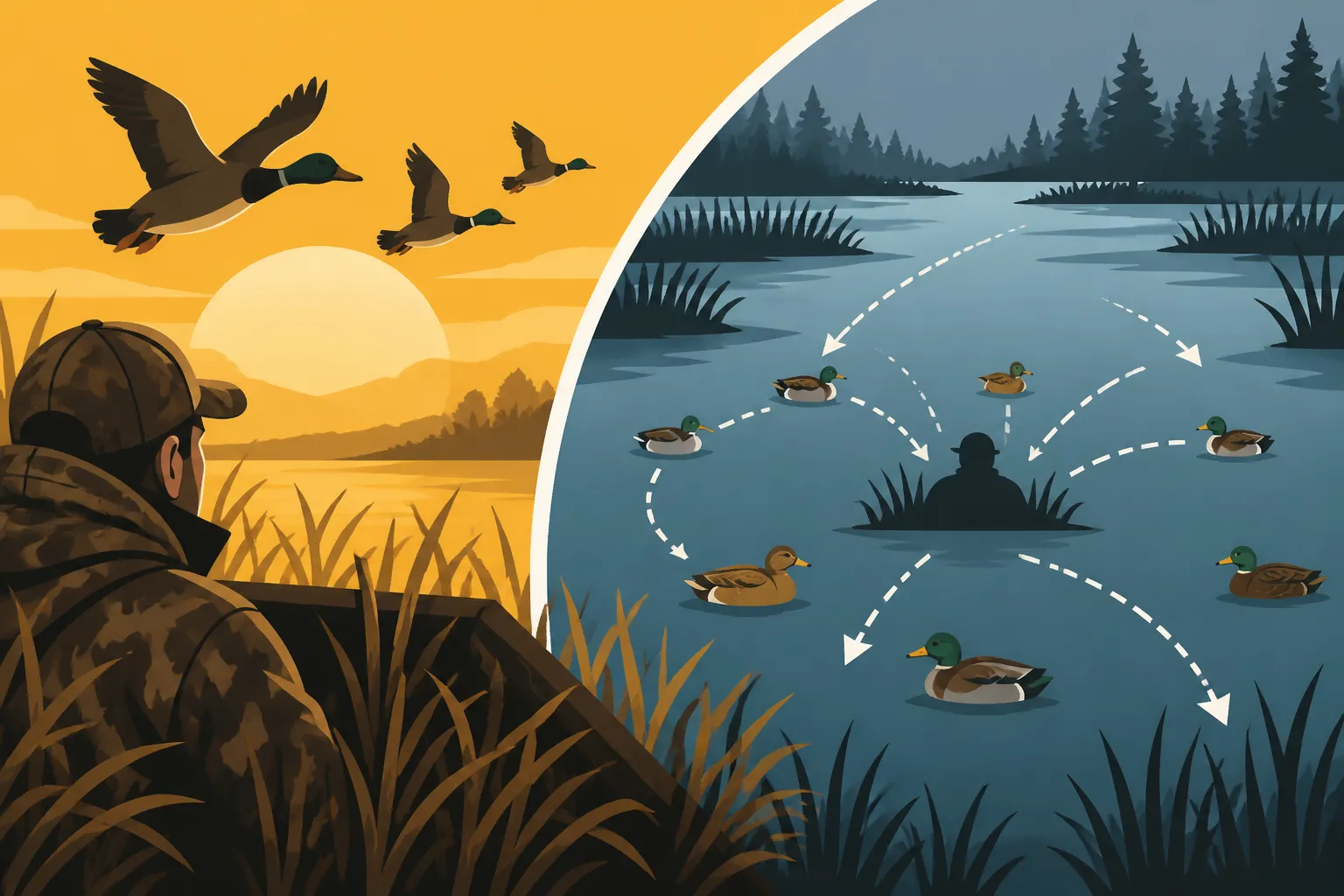
Think about the birds' approach. Ideally, you want them to finish into the wind, directly in front of your blind, presenting an easy shot. Position your main spread upwind of your blind, leaving a clear "landing strip" in front. For ducks, a J-hook or C-shaped spread often works well, with the opening directly in front of your position. For geese, a more open U-shape with the landing zone in the middle can be effective. Always try to put the sun at your back, if possible, making it harder for birds to see into your blind.
Here's a quick reference for decoy strategies based on pressure:
| Bird Type | Pressure Level | Recommended Decoy Count | Key Decoy Postures/Types | Positioning Tips |
|---|---|---|---|---|
| Turkey | Low | 3-5 | Strutter, jake, feeding hens | Visible, confident spread, slight movement |
| Turkey | Medium | 2-3 | Submissive hen, half-strut jake | Natural grouping, slightly quartering away from blind |
| Turkey | High | 1-2 | Lone feeding/loafing hen, non-aggressive jake | Subtle, blend with terrain, focus on realism over flash |
| Waterfowl | Low | 1-2 dozen+ | Mixed species, spinners, flags | Large, open "U" or "J", clear landing zone |
| Waterfowl | Medium | 1-2 dozen | Natural species ratio, subtle motion | Tighter "J" or "C", upwind of blind, good concealment |
| Waterfowl | High | 6-12 (or fewer) | Feeding, resting, no aggressive postures, minimal motion | Very loose, realistic pockets, excellent concealment, in front of blind |
Advanced Tactics for Ultra-Wary Birds
Sometimes, despite your best efforts with basic and intermediate techniques, those birds just won't play ball. This is where you have to get creative, think outside the box, and often combine your decoy strategy with other hunting methods. These tactics are particularly useful on over-hunted parcels or when dealing with a particularly stubborn flock.
Ghosting the Spread
"Ghosting the spread" means taking most or all of your decoys out, or at least moving them far away from your immediate ambush point. This might sound counterintuitive, especially for waterfowl, but hear me out. For turkeys that have seen every plastic tom and hen in the county, sometimes the absence of decoys is the most powerful decoy of all. Instead of relying on visuals, you rely entirely on calling and your ability to hide. A bird that's been decoy-shy might be more willing to come to a location based solely on vocalizations, especially if it doesn't immediately see a "setup." This works well when Run-and-Gun Turkey Tactics on Public Land are your primary method.
For waterfowl, this might mean moving your decoys further out than normal, creating a "safe zone" well away from your blind. The idea is to have them see birds, but not directly where they'd associate with danger. You're then relying on them to finish closer to your blind, perhaps just within range, even if they don't fully commit to the main spread. Another variation is to set up far from your decoys, using them merely as confidence boosters, hoping to intercept birds passing by.
Using Natural Cover as Decoys
Sometimes, the best "decoy" isn't plastic at all, but rather the natural environment itself. For turkeys, think about subtle terrain features: a small rise, a thick brush line, or even a standing tree. These can act as natural barriers or objects that a tom will circle, often bringing him closer to your position as he tries to get a better look at what's beyond. If you're Hunting the Minnesota Rut in Early November for deer, this concept of using natural terrain to guide movement is just as vital.
For waterfowl, this means positioning your spread relative to existing stumps, logs, grass clumps, or even floating islands of vegetation. These natural elements break up the water's surface, provide visual interest, and can draw birds in. A small cluster of decoys tucked behind a log might seem more natural than a wide-open spread to a wary duck. The key is to make your setup look like an undisturbed, inviting habitat.
Adapting to Changing Conditions
Pressured birds are often more sensitive to changes in weather, light, and wind. What worked yesterday might not work today. Pay close attention to these variables and be willing to adjust your decoy placement on the fly. For instance, on a bright, bluebird day with no wind, a highly visible, static decoy might be a bust. That's when subtle motion (like a jerk string) or even pulling decoys might be necessary. In contrast, on a windy, overcast day, a spinner might actually look more natural.
Similarly, consider the time of day. Early morning might be better for a more aggressive turkey spread, as birds are often more vulnerable right off the roost. Later in the day, as pressure builds and toms become more reluctant, a quieter, more subtle approach is usually better. For waterfowl, the best Minnesota Waterfowl Hunting on Lakes and Potholes often requires constant adjustment to wind shifts and bird flight patterns. The hunter who is willing to adapt and move their decoys, even mid-hunt, is often the one who finds success with truly pressured birds.
Final Thoughts on Decoy Placement
Dealing with pressured birds in Minnesota, whether they're wild turkeys or migrating waterfowl, requires patience, observation, and a willingness to adapt. Don't fall into the trap of thinking "more is better" or sticking to a single, rigid decoy strategy. These birds are survivors, and they've learned to avoid obvious threats.
By understanding their behavior, simplifying your spreads, focusing on hyper-realistic positioning, and adapting to the specific conditions of the hunt, you can significantly increase your chances of success. Use all the tools at your disposal – aerial maps, scouting reports, and even the GoHunt app for terrain analysis – to truly understand the ground you're hunting and how the birds are using it. Remember, the goal isn't just to put out decoys, it's to create an illusion so convincing that even the most educated bird drops its guard.
Disclaimer
The information provided in this article is for general guidance only. Hunting regulations and best practices can change, and it is the hunter's responsibility to stay informed about current Minnesota DNR rules and safety guidelines. Always prioritize safety and ethical hunting practices.