Wind and Thermals on a Minnesota Ridge
The frustration of having a perfect morning hunt ruined by swirling winds or an unexpected thermal shift is something every Minnesota hunter knows all too well. You've scouted, you've hung your stand in what seemed like the ideal spot, only to have your scent betrayed by an unpredictable air current, sending that trophy buck high-tailing it out of the area before you even knew he was there. It’s enough to make you pull your hair out! This comprehensive guide is here to help you truly understand how wind and thermals behave on a Minnesota ridge, transforming those confusing air currents into a powerful tool for your hunting success.
Understanding the Basics of Wind and Thermals
Before we dive into the nitty-gritty of ridge hunting, it's crucial to grasp the fundamental differences and interactions between wind and thermals. Many hunters use these terms interchangeably, but they're distinct forces, both equally capable of ruining or making your hunt, especially when you're perched on a ridge in the Minnesota wilderness. If you don't understand these basic principles, you'll constantly be playing catch-up with the environment, rather than letting it work for you.
The Difference Between Wind and Thermal
Think of wind as the broad, horizontal movement of air caused by pressure differences across large areas. This is the stuff you check on your weather app – that 10 mph breeze from the northwest. It's generally more consistent over flat terrain, but as soon as it hits an obstacle like a stand of timber or, more importantly, a ridge, it gets deflected and can become incredibly tricky. Wind is the dominant force on days with strong atmospheric pressure systems moving through, carrying your scent across long distances in a relatively predictable path, unless it's interrupted by terrain.
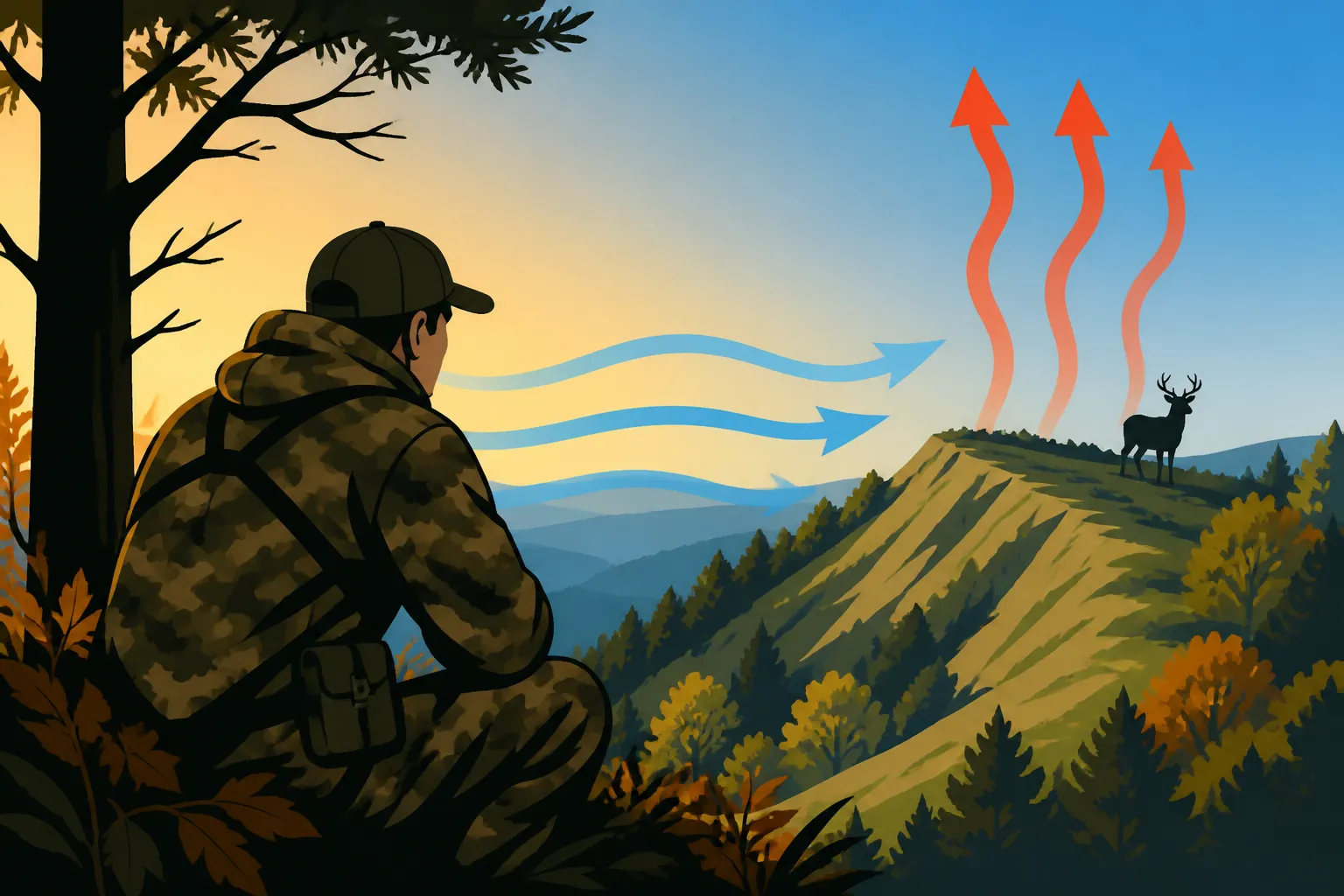
Thermals, on the other hand, are localized, vertical air currents driven by temperature differences. They're like miniature, invisible elevators for your scent. As the sun warms the ground, air rises (daytime thermal), and as the ground cools, air sinks (nighttime thermal). These are much more subtle than wind, often going unnoticed unless you're actively monitoring them with a puff bottle or paying close attention to leaf movement. What makes them so sneaky is that they can override or significantly alter the direction of the prevailing wind, especially in broken topography like our beloved Minnesota ridges. You might have a steady 5 mph wind from the west, but a strong thermal could be pulling your scent straight up, or dumping it down into a valley, creating a completely different scent cone than you anticipate.
Factors Affecting Air Movement in Minnesota
Minnesota's diverse landscape, from the vast northern forests to the rolling farmlands and rugged bluff country of the southeast, presents a multitude of factors that influence how wind and thermals behave. It's not a one-size-fits-all situation, and understanding these nuances is key to adapting your strategy.
The density of timber cover plays a huge role. In dense conifer swamps or thick young aspen stands, prevailing winds are broken up and funneled, creating pockets of calm air or localized swirls. Conversely, open hardwood ridges or agricultural fields offer less resistance, allowing the wind to flow more consistently. Snow cover is another major player, especially during the late seasons. Snow reflects sunlight, impacting how quickly the ground warms or cools, which directly affects thermal activity. A fresh blanket of snow on a cold, sunny morning will create very strong upward thermals as the sun warms the exposed ground and rock, but the snow itself remains cold, delaying the full warming effect on shaded slopes.
Topography is, of course, paramount. Not all ridges are created equal. A gentle, sprawling ridge in central Minnesota will behave differently than a steep, rocky bluff in southeastern Minnesota. The angle of the slope, the presence of saddles, draws, or ravines, and even the type of vegetation on the ridge (think open oaks versus thick cedar) all contribute to how air currents are channeled and disrupted. This is where tools like GoHunt, with its detailed mapping features, can be invaluable. You can zoom in and analyze the contours, identifying potential wind tunnels or thermal sinks before you even set foot on the ground. Understanding these micro-climates created by the interaction of wind, thermal, and terrain is what truly separates a seasoned ridge hunter from someone just hoping for a lucky break.
Ridge Dynamics: How They Influence Air Currents in Minnesota
Ridges are essentially nature's giant air deflectors, and understanding how they interact with both wind and thermals is paramount for successful hunting. Forget what you think you know about flatland wind; a ridge is a whole different beast. The complexity of these dynamics is often underestimated, leading to blown hunts and frustrating encounters where deer seem to materialize out of thin air, or disappear just as quickly.
Daytime Thermals: Rising Air
As the sun climbs in the morning sky and begins to warm the earth, the ground on south-facing slopes and exposed ridge tops heats up first. This warmer air becomes less dense and starts to rise, creating an upward thermal current. If you're hunting a ridge at sunrise, your scent will generally be carried up and over the ridge. This means that if deer are bedded lower down on a leeward slope (away from the prevailing wind), they might not smell you if your stand is directly above them, even if you are upwind of their horizontal position.
However, it's not always that simple. These rising thermals don't just go straight up; they're often influenced by the prevailing wind. A strong westerly wind might push a rising thermal slightly to the east as it ascends. Picture your scent plume as a balloon tied to a string – it wants to go up, but the wind is tugging it sideways. The thermal acts as the initial lift, but the overall trajectory is a combination of both forces. By mid-morning, especially on a sunny day in Minnesota, these upward thermals can become quite powerful, pulling your scent up out of valleys and draws. This can be advantageous if you're positioned high, as your scent may lift above the deer's nose in the lower areas. However, if deer are using the ridge top or the opposite side, that rising thermal could carry your scent directly to them as it crests. This is often the trickiest time to hunt ridge tops, as the thermals are at their strongest and most unpredictable.
Nighttime Thermals: Sinking Air
As the sun sets and the air cools, especially during those crisp Minnesota evenings, the process reverses. The earth radiates its heat into the atmosphere, causing the air closest to the ground to cool down. Cooler air is denser and begins to sink, creating a downward thermal current. This is when your scent will generally fall down the ridge and into the lower elevations, collecting in valleys, draws, and low-lying pockets.
For an evening hunt, this means if you're set up high on a ridge, your scent is being carried down to any deer moving in the draws or valleys below. This can be a perfect scenario if you're anticipating deer to feed or travel through these lower areas, as your scent will be carried away from their approach. However, if deer are already making their way up the ridge to bed on the top for the night, or are cruising just below the crest, that sinking thermal could drop your scent right into their path. During the colder months, especially when hunting the rut in late October or hunting the peak rut in early November, these sinking thermals can be very pronounced, making evening approaches to ridge stands crucial. You might need to skirt around the base of the ridge or approach from a higher elevation to avoid contaminating the lower areas where deer might be feeding. Always remember that cold air sinks, and it will take your scent with it.
Wind Direction Changes Around Ridges
Beyond thermals, prevailing winds themselves become highly localized and tricky around ridges. Imagine the wind as a fluid, like water flowing over a rock. When the wind hits the side of a ridge (the windward side), it's forced up and over the top. This creates a predictable flow on the windward side and often a calm, swirling eddy on the leeward (downwind) side. Deer often use these leeward sides, especially for bedding, as they offer shelter from the direct wind and allow them to detect anything approaching from above via sight, and anything approaching from below via scent carried by the swirling currents.
However, what happens when the wind hits a saddle or a draw along that ridge? It funnels. That gentle breeze can suddenly accelerate and become a strong, concentrated current as it's squeezed through a narrower opening. These funnels are excellent travel corridors for deer, making them prime stand locations, but they are also infamous for unpredictable wind patterns. Your wind checker might show a consistent direction at your stand height, but a few yards away, or just a little lower or higher, the wind could be doing something completely different. This is especially true in areas with broken topography, where winds can shift 180 degrees in a matter of seconds. Relying solely on your weather app can be a big mistake here; constantly checking your wind with a puff bottle or milkweed is essential to gauge the true direction and how it's interacting with the terrain. This is why when you're scouting Minnesota public land before season, you're not just looking for deer sign, but trying to visualize how the wind will move through these features.
Here's a quick look at how thermals behave:
| Thermal Type | Time of Day | Air Movement | Scent Direction (from ridge top) | Ideal Stand Placement (Scent) |
|---|---|---|---|---|
| Daytime | Morning-Noon | Rises | Up and Over Ridge | Below deer, or high above |
| Nighttime | Evening-Night | Sinks | Down into Valleys/Draws | Above deer |
Practical Application: Hunting Strategies for Minnesota Ridges
Knowing the science behind wind and thermals is one thing; putting it into practice in the real world of Minnesota hunting is another. This is where the rubber meets the road, and where understanding these air currents truly transforms from theory into tangible success.
Strategic Stand Placement on Ridges
When considering where to hang a stand on a ridge, you need to think about both the prevailing wind and the thermal influence. For morning hunts, if you anticipate deer to be in the lower elevations or moving up, you want to position your stand slightly below the ridge crest on the leeward side. This allows the rising thermal to carry your scent up and over the ridge, away from the deer below. If you're higher than the deer, the thermal works in your favor. Conversely, if you're targeting deer that are already on the ridge top or feeding on the windward side, you'll want to be on the windward side yourself, ensuring the wind carries your scent away from where you expect them to approach.
For evening hunts, the strategy often reverses. With sinking thermals, you want to be high on the ridge, allowing your scent to drop into the valley or draw below you, away from any deer moving up the ridge or feeding on the ridge top. Setting up on the leeward side of the ridge, especially near a deer trail leading up, can be deadly. Remember, deer are often using these ridges for travel and bedding, so understanding Where Big Woods Bucks Bed in Minnesota can give you a significant edge in stand placement. Always try to place your stand where the most likely deer approach path puts them into the wind or rising thermal relative to your position, while your scent is carried away from them. This often means facing the direction you expect deer, with your back to the wind.
It's also crucial to identify those micro-funnels or natural travel corridors that often form along ridges. A subtle dip in the ridge line, known as a saddle, or a deep draw cutting through, can act as a natural highway for deer. However, these are also notorious for swirling winds. When Hanging a Stand on a Big Woods Funnel, you'll need to be extra vigilant with wind checks and consider a mobile setup if the wind isn't cooperating. Sometimes, Using a Ground Blind on Minnesota Public Land allows for more flexibility to shift your setup slightly if the wind does something unexpected, compared to a fixed treestand.
Entry and Exit Routes for Ridge Hunting
This is often where many hunters compromise their hunt before it even begins. Your entry and exit routes are just as critical as your stand placement, perhaps even more so. The goal is to approach your stand and leave it without alerting any deer in the area with your scent, sound, or sight.
For morning hunts, an ideal entry might involve approaching from the leeward side of the ridge, staying low in a draw or even a small creek bed if possible. You want to utilize the cool, sinking air of predawn to keep your scent pooled low, below any deer that might be moving or bedded higher up. As you ascend to your stand, the sun begins to rise, and the thermals start to shift upward, helping to lift any lingering scent away from your target areas. The same principle applies to your exit: use the rising morning thermal to carry your scent up and away as you descend.
For evening hunts, you'll want to take advantage of the prevailing wind and the later, sinking thermals. Approach your stand from a path that keeps the wind in your face or quartering into you, and your scent blowing away from where deer are likely to be moving. As you settle in, the thermals will begin to pull your scent down into the valleys. For your exit, you'll be leaving in the dark, with thermals firmly pulling scent downwards. This means you should try to exit low, if possible, allowing your scent to continue to drop and be carried away from any deer that might have moved in higher on the ridge after dark. If you're Hunting the Minnesota Rut in Early November, bucks can be cruising heavily, and a careless entry or exit can ruin an entire hunt. Always try to use terrain features like ravines, creeks, or dense cover to conceal your movement and contain your scent.
Using Technology to Your Advantage
In today's hunting world, we have access to incredible tools that can give us a serious edge, especially when it comes to understanding complex terrain and air currents. Apps like GoHunt or onX Hunt are game-changers for dissecting a Minnesota ridge system. Before you even leave the house, you can study topographical maps and aerial imagery to identify key features: saddles, draws, benches, steep slopes, and potential bedding areas. You can see how these features might funnel wind or create thermal traps.
Many of these apps now include sophisticated wind prediction tools that overlay predicted wind direction onto the map, often at various times throughout the day. While these are invaluable starting points, never rely on them 100%. They predict general atmospheric wind, not the micro-currents created by terrain. Use them to choose your general area, but once you're on the ground, always use a physical wind checker (puff bottle, milkweed, string) to confirm local conditions. Furthermore, features like waypoint marking are essential for documenting bedding areas, rub lines, scrape lines, and funnel points observed while Finding Sign in Minnesota Big Woods, helping you to connect the dots between deer behavior and air movement. GoHunt allows you to mark these locations and plan multiple stand setups for different wind directions, making you much more adaptable on a Minnesota ridge.
Advanced Considerations and Troubleshooting
Even with a solid understanding of wind and thermals, hunting Minnesota ridges can throw curveballs. Experienced hunters know that sometimes, despite all your preparation, the air currents just don't cooperate. Learning to read these subtle shifts and react accordingly is the mark of a truly effective ridge hunter.
Impact of Weather Fronts and Barometric Pressure
Weather fronts bring significant changes to both wind and thermal patterns. A strong cold front pushing through will often bring high, steady winds and rapidly dropping temperatures. These strong winds can sometimes overpower localized thermals, making the wind direction more predictable, but also increasing the chances of your scent traveling farther and faster. The drop in temperature will make sinking thermals more pronounced in the evening and delay rising thermals in the morning. On the flip side, a warm front might bring lighter, more variable winds and higher humidity, making thermals less distinct and often leading to those frustrating "swirling" conditions.
Barometric pressure also plays a fascinating role. A rapidly dropping barometer often signals an approaching storm, and deer tend to become more active before the front hits. This increased activity, however, can be accompanied by highly unstable air, leading to unpredictable wind shifts. A stable, high-pressure system, on the other hand, often brings clear skies, light winds, and very distinct thermal patterns – crisp rising thermals in the morning, strong sinking thermals in the evening. Understanding how to Read Aerial Photos for Big Woods Deer in conjunction with weather forecasts can help you predict these broader patterns and select the right ridge to hunt. If you're seeing a big pressure change coming, consider hunting a ridge where you have multiple access points or alternative stand sites ready for a shift.
Dealing with Swirling Winds in Complex Terrain
Ah, the dreaded swirling wind. This is the nemesis of many ridge hunters, especially in Minnesota's truly rugged areas like the bluff country or areas with deep, intricate ravines. Swirling winds occur when the prevailing wind hits complex topography and breaks up, creating eddies and unpredictable mini-currents that can carry your scent in every direction imaginable. This is usually more common on low wind days, or when the wind is hitting a very steep, broken face.
When you encounter consistent swirling wind, your options become limited but crucial. Firstly, if possible, avoid hunting that particular spot on that particular day. If the wind isn't cooperating, it's often better to live to hunt another day or relocate to an area with more predictable air currents, such as a flatter, more open ridge section, or even a different type of terrain entirely. If you're committed to the spot, consider an ultra-low impact approach. This might mean hunting from the ground in very dense cover, using the vegetation itself as a partial scent barrier. While a treestand is often preferred for deer hunting, in these tricky conditions, Using a Ground Blind on Minnesota Public Land might be a more viable option as it can offer some degree of scent containment, especially a well-brushed-in blind.
Another strategy is to aim for mid-slope benches or fingers off the main ridge. These smaller features might offer more consistent wind than the main crest or the deep valley floor. Continuously monitor your wind direction with a puff bottle, not just once, but every 5-10 minutes. If you see consistent swirling, you might need to adjust your approach or consider a different stand entirely. Sometimes, the only solution to truly swirling winds is to hike deeper, finding ground others walk past, where the terrain might offer more consistent air flow. No matter how good your plan, sometimes Mother Nature simply dictates a change of plans.
Disclaimer
Please remember that hunting regulations and land access rules can change. Always consult the latest Minnesota Department of Natural Resources (DNR) regulations and obtain all necessary licenses and permits before heading afield. Safety should always be your top priority.