Timber Wolves Versus Coyotes in Minnesota
One of the most common head-scratchers for hunters and outdoor enthusiasts in Minnesota is trying to tell the difference between a timber wolf and a coyote, especially when you just catch a fleeting glimpse or are trying to interpret tracks in the snow. These two canids, while related, are distinct animals with different behaviors and ecological roles, and mistaking one for the other can lead to a lot of confusion in the field. This guide aims to clear up that confusion, offering clear distinctions so you can confidently identify and understand the nuances between these magnificent wild dogs that roam our Minnesota landscapes.
Physical Distinctions: Size, Coloration, and Features
The most immediate and often the easiest way to differentiate between a timber wolf and a coyote is through their physical appearance. While they might share a similar silhouette, their size, build, and specific facial features tell a very clear story. Learning these visual cues is step one in becoming a more observant and knowledgeable outdoorsperson.
Overall Size and Build
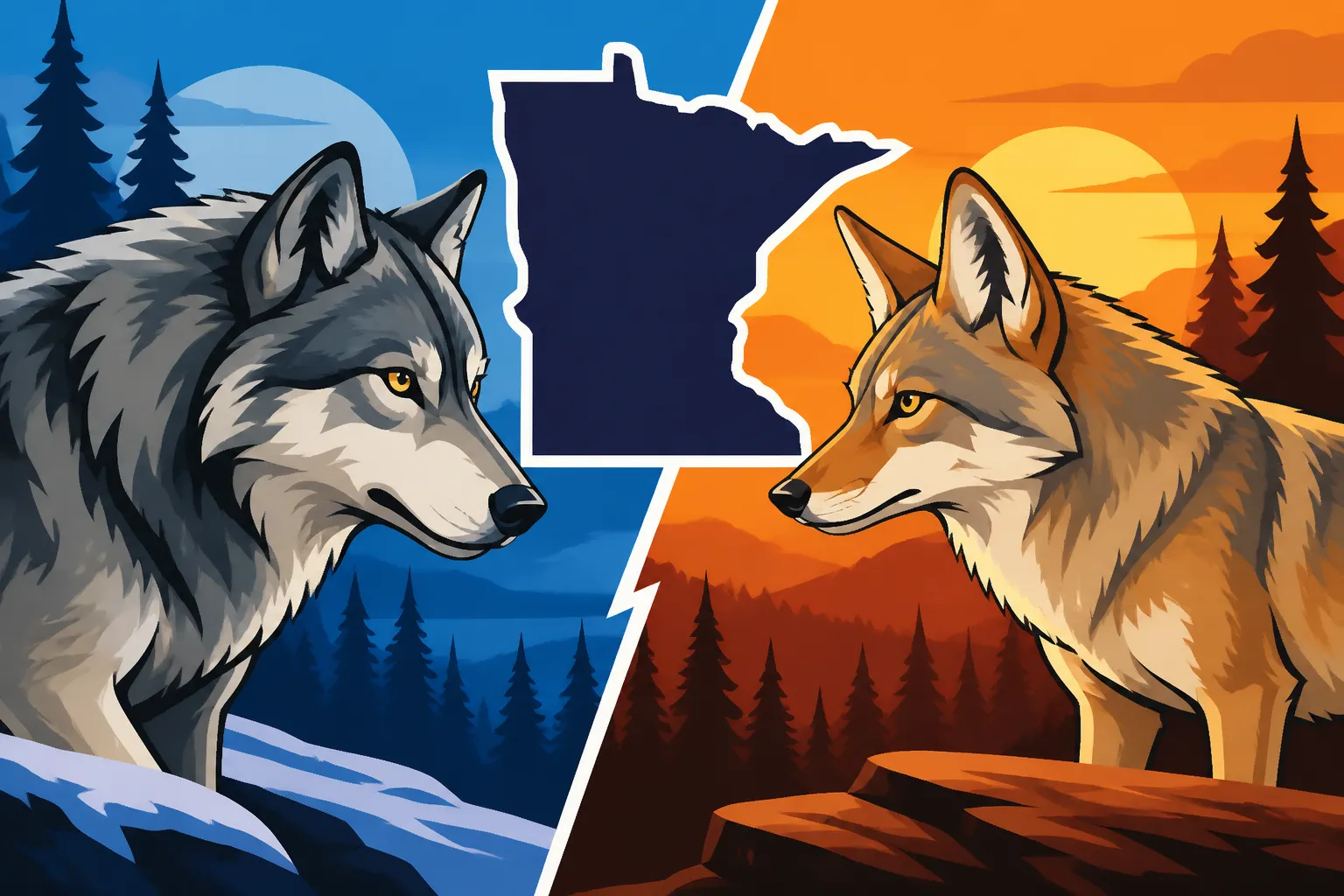
When you first see a timber wolf, often referred to as a gray wolf, the sheer scale of the animal is what really hits you. They are significantly larger and much more powerfully built than coyotes. Think of a wolf as roughly the size of a large German Shepherd or even bigger, with males often weighing in at 80 to 120 pounds, though some larger individuals can exceed that. Their body is robust, with a deep chest, long legs, and a broad skull. When you see a wolf standing, it commands presence; they look like a formidable apex predator, built for power and endurance in pursuit of large prey like deer or moose. They carry themselves with an imposing stride, their large paws seeming to float over the terrain.
Coyotes, on the other hand, are much daintier by comparison. They often weigh between 20 to 50 pounds, putting them in the size category of a medium-sized dog, like a Border Collie or a smaller retriever. Their build is much leaner and more athletic, almost streamlined, designed for agility and speed. They have a narrower chest, more slender legs, and a more pointed muzzle. If you see a coyote next to a wolf, the difference is startling—the coyote appears almost diminutive, lacking the bulk and raw power of its larger cousin. This difference in size isn't just cosmetic; it dictates what they can hunt, how they move through their habitat, and how they interact with their environment.
Coat Color and Markings
While both species can have a varied coat color, there are general patterns that can help with identification. Timber wolves, despite the "gray wolf" moniker, exhibit a wide spectrum of colors. You can find wolves that are almost pure white, especially in northern regions where camouflage in snow is advantageous, to grizzled grays, browns, and even black. The most common color variation in Minnesota will be a mix of gray and brown, often with a darker saddle on their back and lighter underparts. Their fur tends to be denser and longer, particularly in winter, providing insulation against the harsh Minnesota cold. Sometimes, their coats can be quite shaggy, especially around the neck and shoulders.
Coyotes typically display a more uniform, yellowish-gray or grayish-brown coat. They often have reddish-brown on the backs of their ears and forelegs, and a white or cream-colored throat and belly. A distinctive feature for many coyotes is a black-tipped tail and often a dark, almost black, stripe down the middle of their back. Their fur is generally shorter and not as dense as a wolf's, giving them a slightly sleeker appearance. While there can be individual variations, the overall palette of a coyote is usually lighter and less varied than that of a wolf. When you're glassing a distant animal, these color nuances, especially the reddish tones and black tail tip, can be crucial for a quick ID.
Head, Ears, and Tail
Looking at the head, ears, and tail can provide critical clues, especially if the animal is partially obscured or at a distance. A timber wolf's head is broad and blocky, almost bear-like in its robustness. Their ears are relatively short and rounded at the tips, proportional to their large head. Their muzzle is wide and strong, reflecting their powerful bite needed to take down large prey. The tail of a wolf is typically held relatively straight, often dragging low or slightly curved, and it's quite bushy and proportionate to its large body size. It usually does not have a distinct black tip, but rather blends with the body coloration.
Coyotes, in contrast, have a much more pointed, fox-like muzzle. Their ears are noticeably larger in proportion to their head, erect, and come to a much sharper point. This can give them a perpetually alert appearance. Their tail is often described as bushy but is more slender than a wolf's and is almost always tipped with black. When a coyote runs, its tail often drops below the horizontal, and it might even tuck it slightly between its legs, especially if it feels threatened. These subtle differences, from the shape of the head to the way the tail is carried, are often the key identifying features for experienced observers. If you're using an optic like those you might find with GoHunt mapping tools, focusing on these features can make all the difference in a positive identification.
Behavioral Differences: Social Structure, Habitat, and Vocalizations
Beyond their looks, timber wolves and coyotes behave quite differently, shaped by their evolutionary paths and ecological roles. Understanding these behavioral patterns can give you further insights into which animal you're encountering, even if you don't get a clear visual. Their social structures, preferred environments, and the sounds they make are distinct indicators.
Pack Dynamics vs. Solitary Nature
Timber wolves are renowned for their complex social structure, living and hunting in organized packs. A wolf pack is essentially an extended family unit, typically consisting of a breeding pair, their offspring, and sometimes other non-breeding adults. This cooperative living arrangement is crucial for their survival, allowing them to effectively hunt large ungulates like deer and moose, protect territory, and raise their young. When you observe wolves, you'll often see them moving as a unit, communicating through body language and vocalizations. This pack cohesion is a defining characteristic of their species, and it's what makes them such efficient predators in their environment.
Coyotes, while sometimes seen in small family groups or pairs, are much more solitary in nature, particularly outside of the breeding season. They may form temporary hunting partnerships, especially in areas with abundant food, but they lack the rigid pack hierarchy and cooperative hunting strategies of wolves. More often than not, you'll encounter a lone coyote, perhaps a pair, but rarely a large, cohesive group moving with purpose like a wolf pack. This difference in social structure influences everything from their hunting tactics to their territorial defense. When you're out Finding Sign in Minnesota Big Woods, seeing multiple large tracks together might point to wolves, while single tracks could easily be a lone coyote.
Habitat Preferences
Minnesota offers a diverse range of habitats, and both wolves and coyotes have adapted to different niches within it. Timber wolves are generally creatures of vast, wild landscapes. In Minnesota, this means they are predominantly found in the northern forests, particularly in the coniferous and mixed deciduous forests of the "Big Woods" country, like the Superior and Chippewa National Forests. They require large territories with ample cover and a healthy population of their preferred prey, such as white-tailed deer, moose, and sometimes beaver or snowshoe hare. Areas with minimal human disturbance are typically their stronghold. Understanding Minnesota's Wolf Population distribution often means looking at these dense, remote forest regions.
Coyotes are far more adaptable and widespread. While they certainly exist in forested areas, they thrive in a greater variety of habitats, including open grasslands, agricultural fields, suburban fringes, and even urban parks. They are far less intimidated by human presence and have successfully colonized landscapes dramatically altered by development. In Minnesota, you'll find coyotes in virtually every county, from the deep woods of the north to the farmlands of the south and the metro area suburbs. Their diet is incredibly varied, allowing them to exploit different food sources across these diverse environments. Whether you're hunting pheasants on farmland or deer in the big woods, a coyote sighting is always a possibility.
Calls and Sounds
The vocalizations of wolves and coyotes are one of the most striking differences between the two species, often allowing for identification even when the animals themselves remain unseen. The iconic sound of the timber wolf is its long, mournful howl. These howls can carry for miles through the forest, serving to communicate with other pack members, define territory, or rally the group. A wolf's howl is deep, sustained, and often ends with a drawn-out, resonant note. You might hear a single wolf howl, or a chorus of several pack members joining in, creating a powerful, almost haunting symphony of sound. Listen carefully, and you'll notice the distinct, low frequency.
Coyotes, while they also howl, have a very different vocal repertoire. Their calls are characterized by a series of sharp, yappy barks, often followed by short, high-pitched howls and yips that often sound like a chaotic, excited chorus. This distinctive "yipping" is a hallmark of coyote communication. They might sound like multiple animals even when it's just one or two, thanks to the way their calls echo and blend. If you've ever heard a group of coyotes "singing" at dusk or dawn, it's an unmistakable sound, often described as more frantic or dog-like than the deep, resonant calls of a wolf. For those interested in Coyote Calling in a Minnesota Winter, understanding these distinct vocalizations is paramount to success.
Tracks, Scat, and Sign: Reading the Outdoors
Often, you won't get a clear visual of a timber wolf or a coyote, especially in dense cover or during low light conditions. This is where your tracking skills come into play. Learning to distinguish their tracks, scat, and other signs they leave behind can give you a clear picture of who's been passing through your hunting area. This knowledge is an invaluable asset for any serious outdoors enthusiast or hunter.
Track Size and Gait
The size of a track is usually the most telling indicator. A timber wolf track is significantly larger than a coyote's, typically measuring around 4 to 5 inches long and 3.5 to 4.5 inches wide for adults. Their toes are often more splayed, and the overall print has a robust, powerful appearance. You'll often be able to see clear nail prints. Wolves have a typical "direct register" gait when trotting, meaning the hind paw often lands directly in the print of the front paw, creating a long, straight line of tracks. This creates a very purposeful, almost single-file appearance, especially in fresh snow or mud. Their stride length is also much longer, reflecting their larger body. GoHunt mapping can sometimes help you visualize travel corridors where such tracks might be common.
Coyote tracks, by contrast, are much smaller, usually measuring about 2.5 to 3.5 inches long and 2 to 3 inches wide. Their toes are often held more tightly together, giving the track a more compact, oval shape. While you might see nail prints, they tend to be less prominent than a wolf's. Coyotes also direct register, but their overall track pattern will be narrower and their stride length shorter. Imagine the difference between the track of a large, heavy-set dog versus a medium-sized, agile dog. This size difference is often the definitive clue when examining prints in the dirt or snow. Always remember to look for consistency in size and pattern, as a single, ambiguous track can be misleading.
| Feature | Timber Wolf (Gray Wolf) | Coyote |
|---|---|---|
| Size | Large (80-120+ lbs), robust, deep chest | Medium (20-50 lbs), lean, agile, streamlined |
| Coat Color | Highly varied: white, gray, brown, black; often grizzled | More uniform: yellowish-gray/brown; reddish-brown on ears/legs |
| Head | Broad, blocky, powerful muzzle | Pointed, fox-like muzzle |
| Ears | Relatively short, rounded tips, proportional to head | Larger, erect, sharply pointed, proportional to head |
| Tail | Bushy, carried low/straight, blends with body color | Bushy, black-tipped, often carried lower than horizontal |
| Social Structure | Pack animals (family units), cooperative hunters | Often solitary or in small family groups, less cohesive |
| Habitat | Vast northern forests, minimal human disturbance | Highly adaptable; forests, farmlands, suburbs, urban fringes |
| Vocalizations | Long, mournful, deep howls; sustained notes | Sharp, yappy barks; high-pitched yips and howls; frantic chorus |
| Track Length | 4-5 inches | 2.5-3.5 inches |
| Track Width | 3.5-4.5 inches | 2-3 inches |
| Scat Size | Large (1-2 inches diameter), often fur/bone | Smaller (0.5-1 inch diameter), often hair, berries, insects |
Scat and Prey Remains
The droppings (scat) and the types of prey remains left behind can also offer valuable insights. Timber wolf scat is typically quite large and robust, often an inch to two inches in diameter and several inches long. Because wolves are obligate carnivores and hunt large prey, their scat frequently contains a significant amount of hair, bone fragments, and sometimes even bits of hide from deer, moose, or beaver. It often has a strong, musky odor. You'll frequently find wolf scat along game trails, logging roads, or at territorial markers. This clearly indicates where these powerful predators are active, and is useful in understanding What Wolves Eat in Northern Minnesota.
Coyote scat is noticeably smaller and more slender, generally half an inch to an inch in diameter. While it can also contain hair from small mammals like rabbits or rodents, it's far more likely to include evidence of a more omnivorous diet. You might find seeds, berries, grass, or even insect fragments, especially during different seasons. Coyotes are opportunistic feeders, taking advantage of whatever food source is available, from fawns and small game to carrion, fruits, and insects. Finding scat rich in berries might indicate a coyote, especially if you're in an area that also has a healthy Minnesota Deer Herd Size, as both can be present.
Other Field Signs
Beyond tracks and scat, both animals leave other signs that can speak volumes if you know what to look for. Wolves, being large and territorial, often leave distinct rub marks on trees or logs, especially around their core territory or denning areas. They might scratch the ground or urinate to mark boundaries. When multiple wolves are present, you might see signs of disturbance over a larger area, or perhaps a flattened patch of snow where a pack has bedded down. If you come across a large kill site—a deer, for instance, with significant bone and hide fragments scattered around and signs of multiple feeding animals—it's a strong indicator of wolf activity. This can be critical information, especially if you're concerned about Wolf Depredation on Minnesota Livestock.
Coyotes, being lighter and more agile, leave less pronounced physical signs. Their rubs might be smaller or less frequent. However, they are known to use scent marking extensively, often urinating on prominent objects like fence posts, rocks, or small bushes. They are also adept at using existing trails and paths, so their tracks might blend more easily with human or deer activity. Kill sites attributed to coyotes are typically smaller, focusing on smaller prey like rabbits, fawns, or scavenged carrion. While they will certainly take down a deer, especially fawns or weakened adults, their kill sites often show less destructive feeding patterns than a pack of wolves, usually focusing on softer tissues first. When you're actively scouting, using tools like GoHunt can help you overlay public land boundaries and topographical features, which can be useful when interpreting where either of these animals might be moving and leaving sign.
Ecological Roles and Hunting Considerations
Understanding the distinctions between timber wolves and coyotes goes beyond mere identification; it's about appreciating their unique ecological contributions and how our interactions with them, particularly as hunters, differ. Their roles in the ecosystem are pivotal, and human management strategies reflect these differences.
Predator-Prey Dynamics
Timber wolves, as apex predators, play a critical role in maintaining the health and balance of their ecosystems. By primarily preying on ungulates like deer and moose, they help to cull sick, old, or weak individuals from the herd, which in turn can lead to stronger, healthier prey populations overall. Their presence can also influence the behavior of prey animals, leading to more cautious movements and healthier habitat use. In areas with stable wolf populations, you often find a more robust and responsive ecosystem. While some hunters might worry about wolf populations impacting deer numbers, the reality is often more complex, involving habitat, winter severity, and disease. It's a natural balance, and wolves are a crucial part of the wild north.
Coyotes, while also predators, operate on a different scale. Their diverse diet means they exert pressure on a wider range of smaller prey animals, including rodents, rabbits, ground-nesting birds, and fawns. They are highly opportunistic, readily consuming carrion, insects, and even plant matter. This adaptability makes them incredibly successful across varied landscapes. In areas where larger predators like wolves are absent, coyotes can sometimes fill a similar niche, though usually with smaller prey. Their role is more about keeping smaller animal populations in check and acting as efficient scavengers. Understanding these dynamics is key to appreciating the full picture of Minnesota's wildlife.
Hunting and Management Implications
The management and hunting regulations for timber wolves and coyotes in Minnesota are vastly different, reflecting their conservation status and population levels. Timber wolves are a protected species in Minnesota. As such, hunting them is prohibited. They hold a special place in the state's wildlife heritage, and their management is a complex issue driven by ecological considerations and public sentiment. As a hunter, it's crucial to be aware that Game You Cannot Hunt in Minnesota includes the timber wolf, and misidentification could lead to serious legal consequences. Responsible hunters take the time to know the rules and positively identify their target.
Coyotes, on the other hand, are classified as an unprotected species in Minnesota, which means there are generally open hunting seasons for them year-round, often without specific bag limits, though local ordinances or specific methods might have restrictions. Many hunters pursue coyotes for their fur, for predator control, or simply for the challenge of the hunt. They are a valuable furbearer and provide exciting hunting opportunities, particularly in the winter months. For those interested in Predator and Furbearer Hunting in Minnesota, coyotes offer a fantastic opportunity to sharpen skills, learn animal behavior, and contribute to wildlife management by managing local predator populations that can sometimes impact deer or turkey fawns and poults. Always check the current regulations before heading afield, as rules can change.
Disclaimer
This article is for general informational purposes only and does not constitute professional advice. Laws, prices and regulations vary by location and change over time. Consult a qualified professional for guidance on your specific situation.