First Focal Plane Versus Second
Choosing a rifle scope can feel like navigating a maze, especially when you start delving into the nuances of reticle placement. Many hunters, myself included, have stood in the sporting goods aisle, scratching their heads over terms like "First Focal Plane" (FFP) and "Second Focal Plane" (SFP). It's a common frustration, because on the surface, they both look like scopes! But understanding the difference isn't just about jargon; it's about knowing how your aiming point will behave in the field, and that can make all the difference between a clean shot and a missed opportunity in Minnesota's diverse hunting landscapes. This guide will cut through the confusion, explaining what FFP and SFP scopes are, their real-world implications for hunters, and how to pick the right one for your specific Minnesota hunting adventures.
Understanding the Focal Plane Basics: Where Your Reticle Lives
Before we dive into the nitty-gritty of why one might be better than the other for a particular hunt, let's get a handle on what "focal plane" actually means in the context of a rifle scope. It sounds technical, but it's really about where the reticle – those crosshairs or fancy Christmas tree patterns – is physically located inside the scope's optical system. This placement dictates how the reticle appears and behaves when you adjust the magnification.
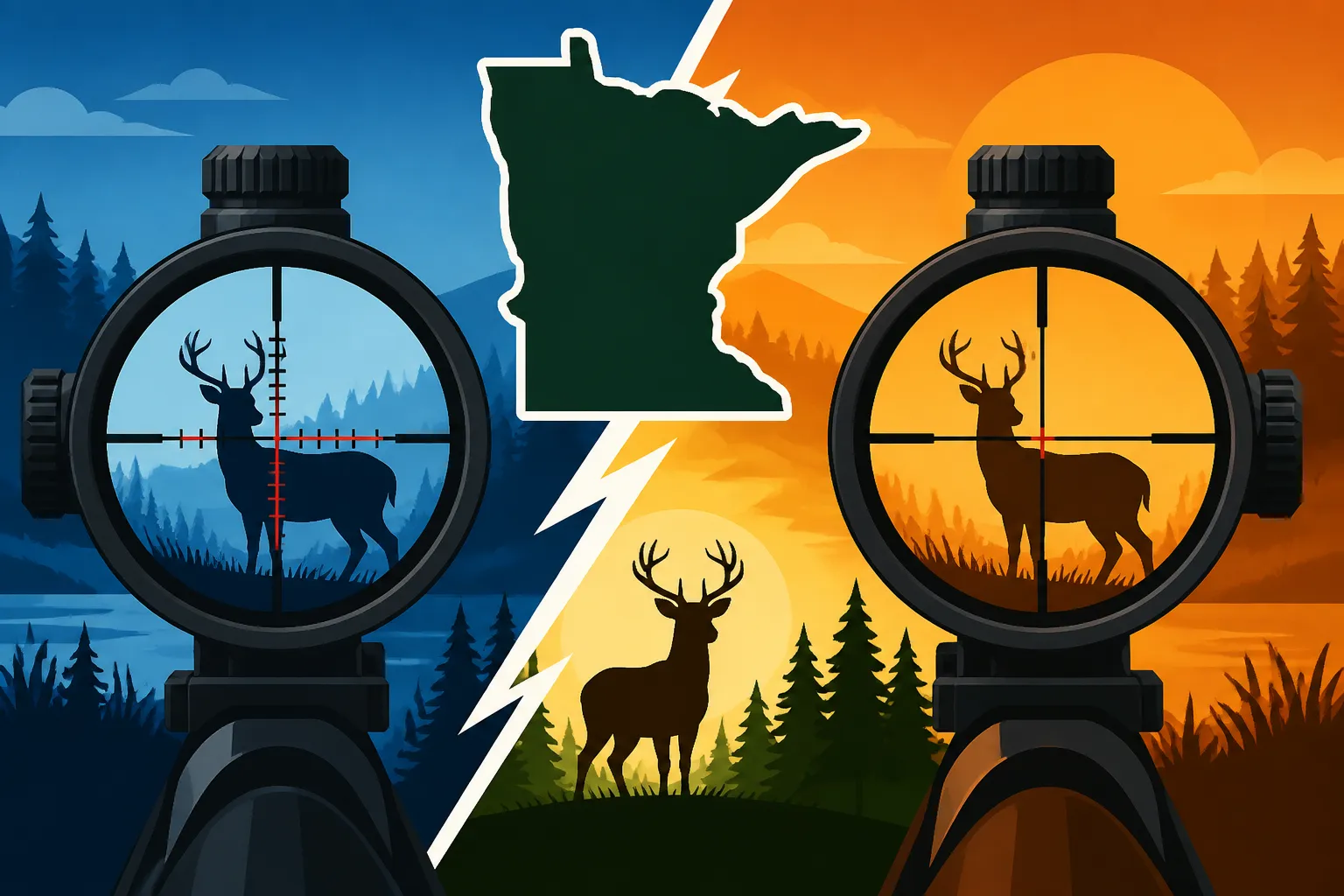
Imagine your scope is a tube with a series of lenses. Somewhere in that tube, your reticle is etched onto a piece of glass. If it's etched on the first focal plane (FFP), it means the reticle is positioned in front of the magnification system. This causes the reticle to grow and shrink proportionally with the target image as you change the scope's magnification. Think of it like a permanent marker drawing on the objective lens itself; everything scales up or down together.
On the other hand, if your reticle is on the second focal plane (SFP), it's located behind the magnification system. This means that as you increase or decrease the magnification, the target image will get larger or smaller, but the reticle itself will always appear the same size to your eye. It's like having the crosshairs drawn on the eyepiece lens – they stay constant no matter how zoomed in or out you are on your quarry. This fundamental difference is what leads to the distinct advantages and disadvantages of each type in the field.
First Focal Plane FFP Scopes: The Scalable Advantage
First focal plane (FFP) scopes have gained significant traction, particularly with precision shooters and those who routinely engage targets at varying distances. The core benefit of an FFP scope stems directly from how its reticle scales with magnification. When you zoom in, the reticle appears larger, and when you zoom out, it appears smaller. This isn't just a visual trick; it's a critical design choice that makes the subtensions (the hash marks, dots, or lines on your reticle used for holdovers or windage adjustments) accurate at any magnification setting.
Think about it: if you're using a reticle with markings for 1 MOA or 1 MRAD, those markings will represent exactly 1 MOA or 1 MRAD of target at 100 yards, whether your scope is set to 4x or 16x. This consistency is invaluable when you're making quick adjustments in the field without changing your magnification or doing complex mental calculations. For instance, if you're set up for a potential long shot across a wide-open field while Hunting Minnesota Farmland Deer and need to hold over for bullet drop or compensate for a crosswind, your reticle's markings are always true. This means less room for error, especially under pressure.
The Pros of FFP Scopes for Minnesota Hunting
- Consistent Subtensions: As mentioned, this is the biggest draw. Your holdover points and windage marks are always accurate, regardless of magnification. This simplifies aiming for bullet drop or wind drift at unknown ranges or when you're quickly needing to adjust on a moving target.
- Ranging Capability: Many FFP reticles include specific ranging features, like milling scales. Because the reticle scales with the target, these features remain accurate at all magnifications, allowing for precise range estimation if you know the size of your target. While many hunters rely on a Rangefinders in Thick Popple Cover, having a backup ranging method can be a lifesaver.
- Precision at Higher Magnification: When you crank up the magnification for a precise shot, the reticle's finer details also grow, making it easier to hold a very exact point on your target without the reticle lines feeling too thick and obscuring the animal. This is especially useful for small game or very distant shots.
- Ideal for Diverse Distances: If your hunt might involve both close-up encounters and unexpected long shots, an FFP scope allows you to maintain consistent aiming principles across that entire spectrum. This could be relevant if you're hunting varied terrain like a large WMA that spans both open fields and dense timber. Using a comprehensive mapping tool like GoHunt can help you identify these varying terrain types, allowing you to plan your shots and choose the appropriate gear.
The Cons and Considerations of FFP Scopes
- Reticle Visibility at Low Magnification: This is often the most significant complaint for FFP scopes, especially for hunters in thick cover. When you're zoomed out to the lowest magnification (say, 3x or 4x), the reticle shrinks significantly. In dense woods, dark timber, or during low-light conditions like dawn or dusk, those fine lines can become incredibly hard to see against a busy background or a dark animal. Imagine waiting for a buck to step out in the shadows of the big woods; if your reticle disappears, you're out of luck.
- Reticle Thickness at High Magnification: Conversely, when you're at maximum magnification, the reticle lines can become quite thick. While this aids in precision for some, for others, it can feel like the reticle is obscuring too much of the target, especially a small vital zone on a distant animal.
- Cost: Generally, FFP scopes tend to be more complex to manufacture and thus come with a higher price tag than their SFP counterparts. While prices vary wildly, this can be a factor for budget-conscious hunters.
- Cluttered Appearance: Some FFP reticles, particularly those with extensive holdover and windage markings, can look very "busy" at higher magnifications, which some hunters find distracting.
Real-World FFP Applications in Minnesota
So, where would an FFP shine brightest here in Minnesota? Consider situations where shot distances are unpredictable, or you need precise holdovers without fiddling with turrets or changing your magnification.
- Open Farmland & Prairie Hunts: If you're chasing deer or coyotes across the wide-open spaces of southwestern or western Minnesota, where shots can stretch from 50 to 300+ yards, an FFP scope is excellent. You can quickly dial your magnification to acquire the target, and your holdover points will be immediately reliable. This is perfect for Coyote Calling in a Minnesota Winter where coyotes might hang up at significant distances.
- Elk Hunting (If You're Lucky!): For the few fortunate hunters who draw one of Minnesota's coveted elk tags in Kittson County, shots could be long and across open prairie or brushland. The consistent subtensions of an FFP would be a huge advantage when ranging and placing a precise shot on a large animal at extended distances.
- Mixed Terrain Deer Hunts: Imagine hunting an area that transitions from a dense woodlot into a food plot or agricultural field. You might encounter a deer at 50 yards in the timber, then spot another at 250 yards on the field edge. An FFP allows you to switch between these scenarios without worrying about the accuracy of your hold marks.
- Predator and Furbearer Hunting: When calling foxes or coyotes, they can come charging in close or stop at a considerable distance. An FFP scope allows you to adapt instantly, using the same holdover principles whether they're 50 or 200 yards out.
While an FFP scope might offer incredible versatility, its learning curve, particularly regarding reticle visibility at low power, is something to seriously consider for our typically dense Minnesota forests.
Second Focal Plane SFP Scopes: The Consistent Reticle Choice
Second focal plane (SFP) scopes represent the more traditional design and are likely what most hunters have grown up using. The defining characteristic of an SFP scope is that its reticle remains constant in size regardless of the magnification setting. As you zoom in, the target gets larger in your field of view, but the reticle itself always looks the same to your eye.
This consistency in reticle appearance is a huge comfort for many, especially in situations where speed and simplicity are paramount. However, this design choice comes with a trade-off: the subtensions on your reticle (those hash marks or dots) are only accurate at one specific magnification setting. This "true" magnification is typically the highest power setting on the scope (e.g., 9x on a 3-9x scope, or 12x on a 3-12x scope), but it's always specified by the manufacturer. If you use those hold marks at any other magnification, they will not be accurate, requiring you to make mental adjustments or ignore them entirely.
The Pros of SFP Scopes for Minnesota Hunting
- Always Visible Reticle: This is a major advantage for SFP scopes, especially in the thick cover and low-light conditions often encountered in Minnesota. Since the reticle doesn't shrink with magnification, it remains a consistent, easily visible size across all power settings. This means you won't lose your crosshairs against a dark background or in the shadows of a pine stand, which is a critical factor when Rifle Scopes for Low-Light Timber are being evaluated.
- Uncluttered View: Because the reticle doesn't grow, complex reticle designs don't become overly busy or thick at high magnifications, maintaining a clean sight picture on your target's vital zone. This can be less distracting for some hunters who prefer a minimalist aiming point.
- Affordability: SFP scopes are generally less complex to design and manufacture than FFP scopes, which often translates to a more budget-friendly price point. This allows hunters to get quality optics without breaking the bank.
- Familiarity and Simplicity: For many hunters, an SFP scope is simply what they're used to. It's straightforward: point and shoot. For close to medium ranges, where precise holdovers are less critical, the simplicity is a major benefit.
The Cons and Considerations of SFP Scopes
- Subtensions Only Accurate at One Magnification: This is the primary drawback. If your scope's holdover marks are accurate at 9x, and you take a shot at 4x, those marks will no longer represent the correct bullet drop or windage. You'll either have to use your turrets to dial in the shot (which takes time) or rely solely on a "point-and-shoot" method using the main crosshair.
- Limited Ranging: While some SFP reticles have ranging capabilities, they are only accurate at the designated magnification, making them less versatile for quick field ranging than FFP options.
- Less Ideal for Extreme Long Range: For truly extreme long-range shooting where precise holdovers and windage at varying magnifications are crucial, an SFP scope can become cumbersome due to the need to keep it at its "true" magnification or constantly adjust turrets.
Real-World SFP Applications in Minnesota
SFP scopes are incredibly popular and effective for a reason, especially for the typical hunting scenarios we face in Minnesota.
- Thick Woods Deer Hunting: If you primarily hunt deer in dense northern Minnesota timber or heavy cattail sloughs, where shots are often 100 yards or less, an SFP scope is a fantastic choice. The reticle will always be visible, even at low power, allowing for quick target acquisition when a deer bursts out of cover. When Still-Hunting Minnesota Big Woods where visibility is often limited to 50-75 yards, a simple SFP reticle is fast and effective.
- Brushy River Bottoms: Areas like the Mississippi River bottoms or brushy creek drains often mean tight quarters and fast action. Here, the consistent visibility of an SFP reticle at low magnifications is a distinct advantage. If you're Hunting a Funnel Between Two Sloughs, an SFP might give you that quick acquisition needed.
- Deer Drives on Public Land: During a Deer Drives With Three or Four Hunters, shots are often close-range and fast. You don't have time to worry about reticle scaling; you need a clear, visible aiming point right now. An SFP excels here.
- General Purpose Hunting: For the average Minnesota hunter who takes shots primarily within 200 yards and doesn't rely heavily on complex holdover reticles, an SFP offers simplicity, reliability, and excellent value. It's a workhorse for many.
The simplicity and reliability of the SFP reticle, especially its constant visibility, make it a steadfast companion for many of Minnesota's most common hunting scenarios.
FFP vs. SFP: Choosing the Right Scope for Your Minnesota Hunt
The decision between an FFP and an SFP scope ultimately boils down to your specific hunting style, the terrain you frequent, the typical shot distances you expect, and your personal preferences. There's no universal "better" scope; there's only the one that best fits your needs.
Let's consider some common Minnesota hunting scenarios and how they might influence your choice.
The Close-Quarters Timber Hunter
If your passion lies in still-hunting the dense pines of northern Minnesota, navigating tangled aspen regeneration, or setting up in thick alder bottoms, chances are your shots will be relatively close—think 100 yards or less. In these environments, quick target acquisition and a clearly visible reticle in low light are paramount. You won't typically be making long-range holdovers, and precise bullet drop compensation isn't a primary concern.
For this style of hunting, an SFP scope often makes the most sense. The reticle always appears full-sized, making it easy to pick up against a dark deer in the shadows, even at the lowest magnification. Imagine a big buck ghosting through heavy cover at dawn; you need that reticle to be bright and clear, not a tiny, wispy crosshair. You'll likely be using your main crosshair as a simple aiming point, and for practical Zeroing a Rifle for Big Woods Distances, this is perfectly adequate.
The Farmland Edge and Open Country Hunter
Perhaps you spend your fall hunting the agricultural fields of southern or western Minnesota, where deer often feed in wide-open spaces, and shots can extend to 200, 300, or even 400 yards. Or maybe you're out calling coyotes across vast prairies in winter. In these scenarios, precise holdovers for bullet drop and windage become much more critical, and shot distances can vary significantly.
This is where an FFP scope truly shines. The ability to use your reticle's subtensions for accurate holdovers at any magnification is a massive advantage. You might zoom in to 10x to precisely place a shot on a distant buck, knowing your 2 MOA hash mark is still exactly 2 MOA. Then, if a doe pops up at 75 yards, you can zoom out to 4x, and your main crosshair is still exactly where it needs to be, with those same accurate subtensions available if you need a quick adjustment. This consistency, especially when combined with a tool like GoHunt to scout open areas and understand potential shot angles, can greatly increase your confidence in making ethical long-range shots.
The All-Around, Versatile Hunter
Many of us are generalists, hunting a variety of terrain and game across Minnesota. One weekend might find us in the big woods; the next, on a farmland edge. This is where the choice gets a bit tougher, and compromises might be made.
- Consider Your Primary Scenario: If 80% of your hunting is in dense cover, lean towards the SFP for reticle visibility. If 80% is open country, the FFP's scaling reticle will be more beneficial.
- Illumination: If you decide on an FFP scope but are concerned about low-light visibility, look for models with an illuminated reticle. This can effectively mitigate the "too-small" problem at low magnification by providing a bright, easily visible aiming point.
- Practice, Practice, Practice: Whichever you choose, invest time at the range. Understand how your specific reticle behaves at different magnifications and distances. If you go with an SFP, know at what magnification your holdovers are true, and what they represent at other powers. If you choose an FFP, practice seeing and using the scaling reticle at both low and high powers.
Key Considerations in a Glance
To help you visualize the core differences, here's a quick comparison:
| Feature | First Focal Plane (FFP) | Second Focal Plane (SFP) |
|---|---|---|
| Reticle Size | Scales with magnification (grows/shrinks) | Remains constant size at all magnifications |
| Subtension Accuracy | Accurate at ALL magnification settings | Accurate at ONE specific magnification (usually highest) |
| Visibility at Low Power | Can become very fine, hard to see in low light/cover | Always visible, excellent for low light/thick cover |
| Visibility at High Power | Can become thick, potentially obscuring target | Always appears fine, uncluttered sight picture |
| Ranging Capability | Accurate at all magnifications | Accurate only at "true" magnification |
| Cost (Generally) | Higher | Lower |
| Best for | Long-range precision, varied distances, holdovers | Close to medium range, quick acquisition, thick cover |
| Minnesota Example | Open farmland deer, coyote calling, elk hunting | Big woods deer, river bottom hunting, deer drives |
Ultimately, your choice is a personal one. Many Minnesota hunters will find an SFP perfectly adequate and even preferable for the majority of their hunting. It's often simpler, more affordable, and provides that reassuringly clear reticle in thick cover. However, if you are regularly pushing ethical shot distances, plan to dial for specific ranges, or want the consistency of a scaling reticle for complex holdovers, an FFP scope might be worth the investment and learning curve.
Consider the role of mapping and scouting tools like GoHunt in your decision-making process. By using such a tool to understand the topography, cover, and typical shot distances of your hunting area, you can make a more informed decision about whether you'll primarily be making short, fast shots in dense cover or needing precise, longer-range adjustments across open fields. This type of preparation, combined with knowing your gear, will lead to more successful and confident hunts.
Remember, the most important thing is that you are confident and proficient with your chosen optic. Spend time at the range, understand its limitations and capabilities, and practice with it in conditions that mimic your actual hunting environment. Whether you go with FFP or SFP, knowing your equipment inside and out is the key to success on any Minnesota hunt.
Disclaimer
This article is for general informational purposes only and does not constitute professional advice. Laws, prices and regulations vary by location and change over time. Consult a qualified professional for guidance on your specific situation.