Binocular Choice for Minnesota Whitetails
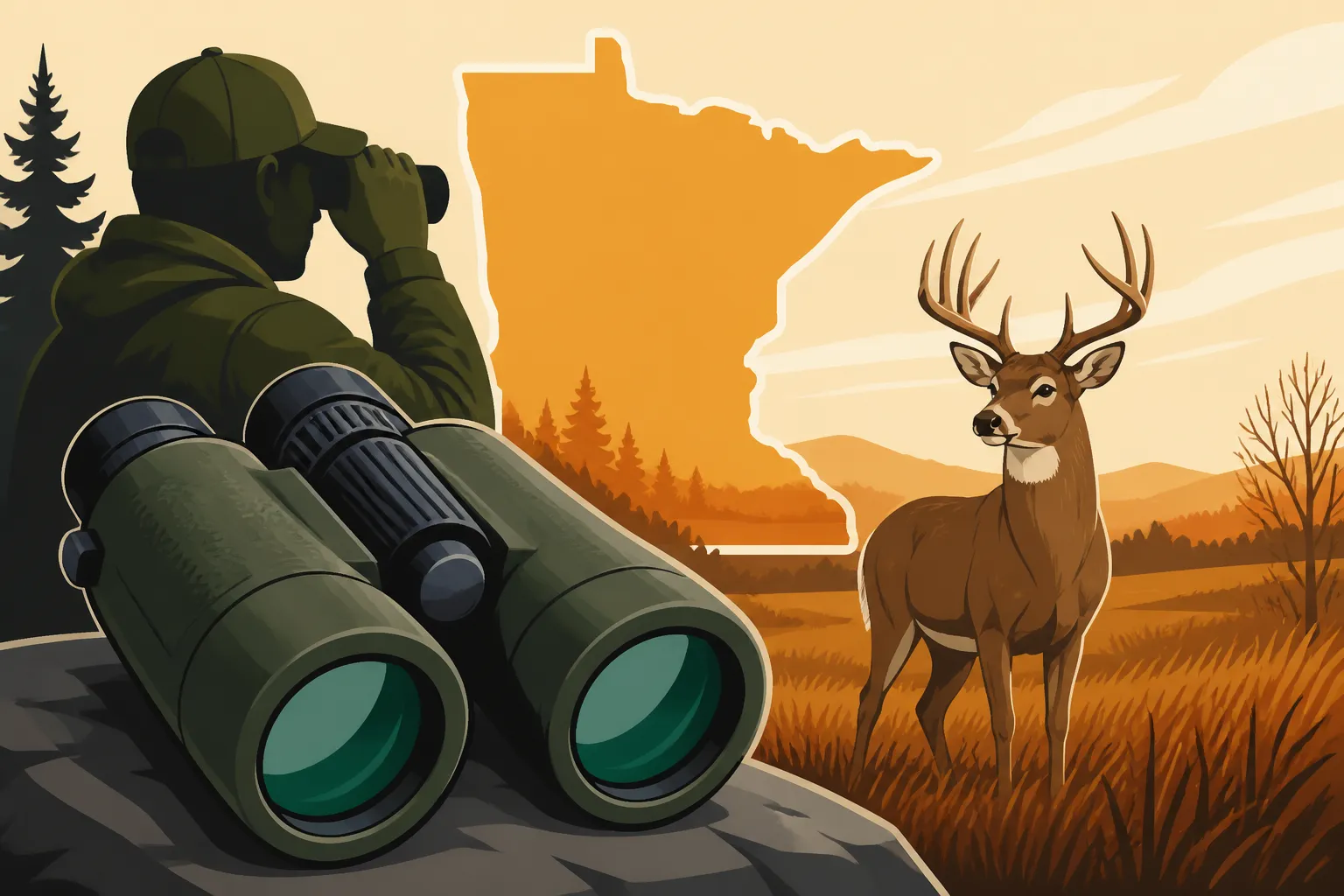
The moment you step foot in Minnesota's diverse deer country, whether it's the sprawling Big Woods or a patchwork of farmland, you realize that seeing the deer before it sees you is half the battle. This guide is all about helping you cut through the confusion of optics options so you can pick the perfect pair of binoculars to give you that critical edge against elusive Minnesota whitetails.
Understanding Minnesota's Diverse Deer Habitat and Its Impact on Optics
Minnesota is a land of incredible contrasts, and what works for glassing a deer in one part of the state might be completely useless in another. Your choice of binoculars needs to reflect the specific terrain you'll be hunting. It's not a one-size-fits-all scenario, and understanding these differences is the first step toward making a smart purchase.
Big Woods and Northern Forests
Up north, in places like the Superior National Forest or the vast tracts of the Chippewa, you're dealing with thick stands of aspen, birch, and conifer. Visibility is often limited to short ranges, sometimes just 50 to 100 yards, especially in the dark timber. Here, your primary goal with binoculars isn't to pick out a deer a mile away across a field, but rather to resolve detail in heavy cover or confirm what you're seeing in low light. You're looking for an ear flick, a patch of hide through the brush, or the glint of an antler in a shadow. Overly powerful magnification can actually be a detriment, making the image shaky and narrowing your field of view too much, which is terrible for quickly scanning dense woods. The low light of a deep forest canopy, especially at dawn and dusk, demands optics that gather as much light as possible to maintain image brightness and clarity. Hunting Minnesota Big Woods teaches you a lot about the challenges of this terrain, and your optics need to match those challenges.
When you're still-hunting through a thick popple cut, stopping every few steps to scan, you need a binocular that's light, easy to handle, and quick to bring to your eyes. Heavy, bulky binoculars become a burden, constantly snagging on branches or bouncing around. Durability is also key, as bumps and scrapes are inevitable. The ability to distinguish antler tines from branches in the dim light of a deer bedding area, especially when Where Big Woods Bucks Bed in Minnesota, is priceless. You're not usually setting up a tripod here; you're using them handheld, so stability and ease of use are paramount.
Farmland and Transition Zones
Head south and west, and the landscape opens dramatically into agricultural fields, shelterbelts, and scattered woodlots. In these areas, like those found in the heart of Minnesota's pheasant country or even closer to the Twin Cities' fringes, you might need to identify a deer feeding at a quarter-mile or more. The challenge here shifts from resolving detail in thick cover to accurately judging distance and antler size across expansive distances. A common mistake is thinking you only need high magnification for long shots with your rifle, but for scouting and watching deer patterns, your binoculars are your primary tool. You'll use them extensively to scout from a distance, checking cut cornfields, soybean fields, and distant tree lines. Hunting Minnesota Farmland Deer means you'll spend a lot of time glassing.
In these open areas, you're less concerned with light-gathering for extreme low light, and more with magnification power and image stability for extended viewing. While a good field of view is always helpful, a slightly narrower view with higher magnification allows you to really dissect a distant field edge or the far side of a river bottom. The ability to identify a specific buck you've been watching, or to confirm if a distant shape is a deer or a hay bale, becomes much easier with the right magnification. You'll often be sitting for long periods, perhaps in a ground blind or even using a vehicle as a rest, which can aid in stabilizing higher-magnification optics.
Bluff Country and River Bottoms
The rugged bluff country of Southeast Minnesota, carved by the Root and Cannon Rivers, presents a unique optical challenge. Here, you're dealing with steep elevation changes, a mix of dense timbered hillsides, open agricultural fields in the valleys, and winding river bottoms. You might be glassing across a deep coulee from one ridge to another, or picking apart a south-facing slope where deer are likely to be soaking up the sun. The ranges can vary wildly, from short, tight shots in the draws to long-distance viewing across expansive valleys. This requires a versatile optic that can perform well in both dense cover and open spaces.
When you're trying to Reading a Ridge for Northern Minnesota Deer (though this applies equally to the bluff country), you're looking for subtle movements, changes in terrain, or specific points where deer might cross. The rapid changes in light as the sun moves across varied topography mean your binoculars need excellent contrast and color rendition to differentiate deer from shadows and foliage. You might be setting up high on a bluff, trying to spot deer moving into a field below, or crawling through a river bottom, trying to pick out bedded deer on a steep bank. The ability to quickly adjust focus and maintain a clear image through different light conditions and at varying distances is paramount.
Key Binocular Specifications for Whitetail Hunting
Once you understand where you'll be hunting, it's time to dive into the technical aspects of binoculars. These specifications aren't just numbers on a box; they directly translate to how well you'll be able to spot and identify deer in various Minnesota hunting scenarios.
Magnification and Objective Lens Diameter
This is usually expressed as two numbers, like "8×42" or "10×42." The first number, the "8x" or "10x," refers to the magnification power. An 8x binocular makes objects appear 8 times closer than they are with the naked eye. A 10x makes them appear 10 times closer. For most Minnesota whitetail hunting, an 8x or 10x magnification is the sweet spot.
-
8×42: This is often considered the most versatile choice for many hunters. The 8x magnification provides a wider field of view, making it easier to scan dense timber and follow moving deer. It's also more forgiving of natural hand shake, resulting in a more stable image, which is a huge benefit when you're quickly trying to pick up movement or glassing for extended periods. The 42mm objective lens (the second number, referring to the diameter of the front lenses) is large enough to gather plenty of light, providing a bright, clear image even in the dim conditions of dawn and dusk, which are prime deer movement times. For still-hunting or hunting in thick woods where ranges are shorter, an 8×42 is often superior, making it easier to acquire targets quickly. If you're pondering 8×42 Versus 10×42 in the Woods, consider the 8×42's stability and wider view for close-range opportunities.
-
10×42: While the 10x magnification brings distant objects closer, it also narrows the field of view and magnifies hand shake. This can make it more challenging to quickly find a deer in thick cover or to maintain a steady image. However, for open country hunting, such as glassing expansive fields or distant bluffs, the added magnification can be invaluable for identifying antler details or judging a deer's body language. If you're hunting primarily in farmland zones or scouting from afar, a 10×42 might be a better choice, assuming you can hold it steady. Some hunters combine a 10x for long-range glassing with a smaller, lighter 8x monocular for quick checks in dense cover, but for an all-around binocular, a 10×42 requires a bit more practice and a steadier hand.
Field of View and Eye Relief
These two often-overlooked specs significantly impact your viewing experience and effectiveness in the field.
-
Field of View (FOV): This refers to the width of the area you can see through your binoculars at a specific distance (usually 1,000 yards or meters). A wider FOV is incredibly beneficial in Minnesota's varied terrain. In thick timber, a wide FOV allows you to scan a larger area more quickly, increasing your chances of spotting a deer before it moves out of sight. When Still-Hunting Minnesota Big Woods, you're constantly looking for any anomaly, and a wide FOV helps tremendously. In open country, a wide FOV helps you track moving animals or scan broad landscapes without constantly shifting your view. Generally, lower magnification binoculars will have a wider FOV than higher magnification ones, which is another reason 8x models are often preferred for general hunting. Always look for a binocular that balances sufficient magnification with a generous field of view to maximize your situational awareness.
-
Eye Relief: This is the distance your eyes can be from the ocular lenses (the ones you look through) and still see the full, unvignetted image. It's especially important for hunters who wear eyeglasses or sunglasses. If the eye relief is too short, you'll have to press your glasses uncomfortably against the eyepieces, or you won't see the entire field of view. Most modern binoculars have adjustable eyecups that twist up or down to accommodate both eyeglass wearers and those without. Look for binoculars with at least 15-18mm of eye relief if you wear glasses. This feature ensures comfort during long glassing sessions, preventing eye strain and allowing for quick, clear viewing, which is crucial when trying to locate a deer against a busy background or during the critical last minutes of legal shooting light.
Prism Type and Lens Coatings
These internal components are where much of the optical magic happens, directly influencing image quality, brightness, and durability.
-
Prism Type: The prisms inside binoculars are responsible for correcting the image (flipping it right-side up and left-to-right) and shortening the light path. There are two main types:
- Porro Prisms: These are the traditional style, giving binoculars their classic wider, offset shape. They typically offer a slightly wider field of view and a more three-dimensional image. However, they are generally heavier and less compact than roof prism designs, and because the objective lenses are not inline with the eyepieces, they are more susceptible to being knocked out of alignment if dropped.
- Roof Prisms: Most modern hunting binoculars use roof prisms. They allow for a more compact, streamlined, and durable design where the objective lenses and eyepieces are in a straight line. The trade-off is that roof prisms require more sophisticated and expensive coatings to achieve the same optical performance as Porro prisms because light loses more energy internally. For hunting, the compact and rugged nature of roof prism binoculars often makes them the preferred choice, especially when you're hiking miles into public land or using a pack system where space is at a premium.
-
Lens Coatings: This is where good binoculars truly separate themselves from great ones. Lens coatings are microscopically thin layers applied to the glass surfaces to reduce light reflection and increase light transmission. This means more light reaches your eye, resulting in a brighter, sharper image with better contrast and true-to-life colors.
- Coated: A single layer on at least one lens surface.
- Fully Coated: A single layer on all air-to-glass surfaces.
- Multi-Coated: Multiple layers on at least one lens surface.
- Fully Multi-Coated (FMC): Multiple layers on all air-to-glass surfaces. This is what you want to look for in a quality hunting binocular. FMC optics transmit the maximum amount of light, which is absolutely critical for spotting deer in the low-light conditions prevalent at dawn and dusk, or when peering into deep, dark timber. Good coatings also reduce glare and enhance contrast, making it easier to distinguish a deer's outline from its surroundings. Don't skimp here; the quality of the lens coatings directly impacts how much useful light your binoculars can deliver to your eyes, which is vital when light is limited, like when Low-Light Performance in a Scope is also critical.
Ergonomics, Durability, and Hunter-Specific Features
Beyond the pure optical performance, how a binocular feels in your hands, how well it stands up to the elements, and its practical features can make or break your hunting experience. Minnesota weather is notoriously unpredictable, and your gear needs to be ready for anything.
Weight, Size, and Handling
Imagine trying to keep a heavy, bulky binocular steady after holding it up for five minutes while glassing a distant clear-cut. Or trying to quietly pull a large binocular out of a pack in a treestand without bumping it. The physical attributes of your binoculars matter just as much as their optical prowess.
-
Weight: Lighter is generally better for hunting, especially if you plan on doing a lot of still-hunting, scouting, or covering significant ground on public land. A heavy binocular can become a burden around your neck or chest, causing fatigue and making you less likely to use it as often as you should. However, too light can sometimes mean cheaper materials, so it's a balance. The sweet spot is often found in the 20-30 ounce range for full-size 8×42 or 10×42 models. When you're packing a stand and climbing sticks for a hunt, every ounce counts. Lighter optics help you stay nimble and quiet.
-
Size: Compactness goes hand-in-hand with weight. A binocular that fits comfortably in your hands and doesn't protrude too much from your chest or pack is ideal. Modern roof prism designs excel here. This becomes even more critical when you're navigating tight cover, sitting in a small treestand, or trying to remain low-profile in a ground blind.
-
Handling: This is subjective but crucial. The binocular should feel balanced in your hands, with easy-to-reach focus and diopter adjustment wheels. The texture of the armor (usually rubber) should provide a secure grip, even when wet or cold. Ergonomic thumb indents and finger ridges can significantly improve handling comfort and stability, especially during prolonged glassing sessions. Quick access and quiet operation are also paramount for hunting – you don't want a noisy strap or a stiff focus wheel to give away your position.
Waterproofing and Fogproofing
If you've spent any time hunting in Minnesota, you know that a beautiful sunny morning can turn into a cold, driving rain or a heavy, wet snow by afternoon. And the morning dew or freezing fog can be brutal on unprotected optics.
-
Waterproofing: This is non-negotiable for hunting binoculars. Reputable binoculars are "O-ring sealed" to prevent moisture, dust, and debris from entering the housing. Look for ratings like IPX7, which means they can be submerged in water to a certain depth for a specific period without leakage. This protects your investment from rain, snow, accidental drops in a puddle or cattail slough, or even just high humidity. Without proper waterproofing, moisture can seep in, leading to internal fogging or permanent damage to the delicate optical components. When Muzzleloader Tactics in December Cold or Keeping a Muzzleloader Dry in Lake-Effect Snow, your binoculars face the same harsh conditions.
-
Fogproofing: Internal fogging is a nightmare. It happens when warm, moist air inside the binocular comes into contact with cold glass, forming condensation. To prevent this, quality binoculars are "nitrogen purged" or "argon purged." This means all the air inside the binocular is replaced with an inert gas (nitrogen or argon), which doesn't contain moisture. This gas prevents internal condensation and subsequent fogging when moving from a warm truck into freezing air, or when encountering sudden temperature changes. Both waterproofing and fogproofing ensure that your binoculars remain clear and functional no matter what Mother Nature throws at you during a long Minnesota hunting season.
Harness Systems and Accessories
Having the best binoculars in the world won't do you much good if they're rattling around in your pack or swinging wildly around your neck. The right harness system makes them accessible, secure, and comfortable.
-
Binocular Harness: This is a game-changer for serious hunters. Instead of a traditional neck strap that lets your binoculars swing and bounce, a harness distributes the weight across your shoulders and back, keeping the binoculars snug against your chest. This not only makes them much more comfortable to carry for extended periods but also keeps them stable, preventing them from banging against trees or your rifle. Most importantly, a good harness allows for quick, quiet access to your optics – you can bring them to your eyes in seconds without fumbling. Many harnesses also include small pockets for lens cloths, wind indicators, or small calls. Brands like FHF Gear or Kuiu offer excellent harness systems that hold your binoculars securely yet allow for silent, one-handed deployment.
-
Lens Covers and Straps: Don't underestimate these simple accessories. Good objective lens covers (the ones on the front) and ocular lens covers (the ones you look through) protect your valuable glass from scratches, dust, and moisture. Flip-down or attached covers are preferable to loose ones that can get lost. Many binoculars come with integrated lens caps or tethered options. A high-quality neck strap or wrist strap, even if you use a harness, can provide an extra layer of security, particularly when you momentarily take your binoculars off the harness to glass from a peculiar angle or climb into a stand. A simple lens cloth, ideally microfiber, should always be kept in your harness or pocket for quick cleaning of smudges or moisture.
Budgeting for Binoculars and What to Expect
Binoculars, like any quality hunting gear, represent an investment. The price range is vast, from under $100 to well over $2,000. Knowing what to expect at different price points can help you make an informed decision without breaking the bank or regretting a cheap purchase. It's often said that you should spend as much as you can reasonably afford on your optics because they're arguably one of the most critical pieces of gear for a successful hunt.
Entry-Level Options (Under $300)
In this price bracket, you'll find binoculars that are generally suitable for casual use, backup pairs, or for new hunters just starting out. You can certainly spot deer with these, but don't expect top-tier performance, especially in challenging conditions.
- What to Expect: At this price, you'll likely find binoculars that are "fully multi-coated" but perhaps not on every air-to-glass surface, or the quality of the coatings may not be as high. Light transmission will be decent in good daylight, but low-light performance will suffer noticeably at dawn and dusk. The glass quality itself might be standard, leading to less sharp images, especially towards the edges of the field of view, and sometimes color fringing (chromatic aberration). Ergonomics might be basic, with cheaper rubber armor and less refined focus mechanisms. They will likely be waterproof and fogproof, but the seals might not be as robust or long-lasting as higher-end models.
- Best Use Cases: These are fine for bright, mid-day glassing, or for short-range scanning in open woods. They can be a good starting point for youth hunters or those who only hunt a few days a year and don't rely heavily on optics for extended periods. However, if you plan to Scouting Minnesota Public Land Before Season extensively or spend long hours in a treestand, their limitations will become apparent. You might quickly find yourself frustrated by their lack of clarity or brightness during critical moments.
Mid-Range Performers ($300-$800)
This is often considered the sweet spot for many serious Minnesota whitetail hunters. Here, you start to see a significant jump in optical performance and build quality without reaching the premium price tags. This is where most hunters can find excellent value.
- What to Expect: In this range, you can expect truly "fully multi-coated" optics on all air-to-glass surfaces, providing excellent light transmission and brightness, often rivaling much more expensive binoculars in good light. You'll also likely find higher quality glass (often ED – Extra-low Dispersion – glass in the upper end of this range) which dramatically improves sharpness, color fidelity, and reduces chromatic aberration. Ergonomics are usually much improved, with better grip, smooth focus wheels, and robust housing. Waterproofing and fogproofing will be very reliable. Many brands in this category offer exceptional warranties, which can be a huge comfort. GoHunt often features reviews of binoculars in this price range, highlighting their performance for various hunting applications.
- Best Use Cases: Binoculars in this class are more than capable of handling the diverse challenges of Minnesota hunting. They perform well in low light, offer clear and crisp images, and are durable enough to withstand years of hard use in the field. They are ideal for hunters who spend serious time scouting and hunting, demand good performance, but don't feel the need for marginal gains at exponential cost. For someone who might be Hanging a Stand on a Big Woods Funnel and needs to carefully pick apart distant cover, these offer the clarity to do so.
Premium Optics (Over $800)
Once you cross the $800 threshold and head north towards $2,000+, you are entering the realm of elite performance. These binoculars offer the absolute best in optical quality, often incorporating proprietary lens coatings, fluoride-containing glass elements, and precision engineering.
- What to Expect: At this level, you're getting peak performance. Light transmission will be maximized, often approaching 95% or higher, resulting in images that are incredibly bright, even in the deepest shadows and during the lowest light conditions imaginable. Resolution and sharpness are outstanding from edge to edge, with virtually no chromatic aberration. Colors are vibrant and true to life, providing exceptional contrast for distinguishing game. The build quality is exceptional, often featuring lightweight, high-strength chassis materials (like magnesium) and incredibly precise, durable internal mechanisms. Eye relief is generous, and ergonomics are near perfect for extended, comfortable glassing. Warranties are typically industry-leading, often lifetime and fully transferable.
- Best Use Cases: If you are a dedicated hunter who demands every possible advantage in the field, hunts in extremely challenging low-light conditions, or performs extensive long-range glassing where every detail matters, premium binoculars are worth the investment. Think serious elk hunters, sheep hunters, or anyone who needs to identify a specific deer at extreme distances or in the absolute last minutes of legal shooting light. For the Minnesota hunter who might be Hunting the Minnesota Rut in Early November and needs every optical advantage to spot that cruising buck, these can make a difference. Websites like GoHunt frequently discuss the nuances and benefits of investing in these top-tier optics, often providing detailed comparisons and insights for the most discerning hunters. They are also fantastic for scouting, helping you Reading Aerial Photos for Big Woods Deer and verify details on the ground.
Testing and Maintenance for Optimal Performance
Even the best binoculars need proper care and selection. Don't just grab a pair off the shelf; take the time to test them out and then commit to a routine that keeps them in prime condition for years of service.
In-Store and Field Testing
Buying binoculars is a personal experience, and what feels right to one person might not to another. Don't just rely on specifications; actually, try them out.
- In-Store Testing: When at a retailer, don't just look across the room.
- Look through a window: This is crucial. Observe objects at varying distances outside the store, from close up to as far as you can see. Pay attention to how quickly the focus adjusts and how crisp the image is.
- Check low-light performance: If possible, step into a dimly lit area of the store or wait for dusk. See how much detail you can resolve in shadows compared to other models. This is where quality optics shine.
- Evaluate eye relief: If you wear glasses, put them on and adjust the eyecups. Can you see the full field of view comfortably?
- Assess ergonomics: Hold them for a few minutes. Do they feel balanced? Is the grip secure? Can you easily reach the focus wheel and diopter with one hand?
- Compare side-by-side: If possible, compare 8x and 10x models simultaneously to feel the difference in stability and field of view. You can gain valuable insight into what feels best for your personal preferences.
- Field Testing (If Possible): If a retailer offers a trial period, take advantage of it. Take the binoculars to your usual hunting grounds or a local park. Test them during dawn and dusk. Practice glassing for small details in varied terrain. This real-world test is invaluable for understanding how they will perform when it truly counts. Pay attention to how they feel on your chest in a harness, or how easy they are to deploy when you're on the move. Consider how they perform when you need to quickly locate a deer that might only be partially visible, perhaps on a Scrape Lines Along a Logging Trail.
Cleaning and Storage Best Practices
Your binoculars are an investment, and proper care will ensure they last for decades. Neglect can quickly degrade performance and shorten their lifespan.
- Cleaning Lenses: The most important rule: never wipe dry lenses with anything abrasive. Dust and grit can scratch the coatings.
- Step 1: Blow off loose debris: Use a can of compressed air or a soft lens blower brush to gently remove dust, dirt, or lint.
- Step 2: Use a lens cleaning solution: Apply a drop or two of optical lens cleaning solution (specifically designed for coated optics) to a clean microfiber lens cloth.
- Step 3: Gently wipe: Starting from the center and working your way out in a circular motion, gently wipe the lenses. Avoid excessive pressure.
- Step 4: Dry: Use a fresh, dry part of the microfiber cloth or a new one to gently buff away any streaks. Never use paper towels, tissues, or shirt sleeves.
- Body Cleaning: For the rubber armor, a damp cloth with mild soap is usually sufficient. Avoid harsh chemicals.
- Storage:
- Dry and temperate: Always store binoculars in a cool, dry place. Avoid extreme temperatures, like leaving them in a hot car, which can damage internal components or degrade seals over time.
- Protective case: When not in use, store them in their original case or a padded binocular case to protect them from dust and impact. Keep lens caps on at all times.
- Desiccant packs: If you live in a humid environment, consider placing a small desiccant pack (like silica gel) in the binocular case to absorb moisture.
Warranty and Customer Service
Even the best optics can encounter an issue, or you might have questions. A strong warranty and responsive customer service are important considerations.
- Lifetime Warranty: Many reputable optics manufacturers offer a "lifetime warranty" that covers defects in materials and workmanship, sometimes even accidental damage. This type of warranty can provide incredible peace of mind and protect your investment for the long haul. Always read the fine print to understand what is covered and whether it's transferable.
- Customer Service: Before purchasing, check reviews on a company's customer service. Do they respond quickly? Are they helpful? Do they stand behind their products? Knowing that you can get support if needed is a big factor, especially for a piece of gear as crucial as your primary hunting optics. Websites like GoHunt often include discussions about brand reliability and customer support experiences, which can be a valuable resource for hunters looking to make an informed decision. Having confidence in your gear, and the company that made it, allows you to focus on the hunt, not worry about your equipment failing when you're trying to Tracking a Deer in Fresh Minnesota Snow or Blood Trailing After Dark in Minnesota.
Choosing Your Whitetail Binoculars: A Comparison
To help summarize some of the key trade-offs, here's a quick comparison of the common considerations:
| Feature/Spec | 8×42 Binoculars | 10×42 Binoculars |
|---|---|---|
| Magnification | Moderate (8x) | Higher (10x) |
| Field of View | Wider, easier to scan and find targets quickly | Narrower, more precise for distant objects |
| Image Stability | More stable, less hand shake visible | More susceptible to hand shake, requires steadier hold |
| Low-Light Brightness | Often perceived as brighter due to larger exit pupil | Slightly dimmer due to smaller exit pupil |
| Ergonomics | Easier to hold steady for extended periods | Can be more fatiguing to hold steady |
| Ideal Terrain | Thick timber, dense cover, still-hunting, eastern MN | Open fields, long-range glassing, western MN farmland |
| Target Acquisition | Faster for moving targets or scanning brush | Slower for initial acquisition, better for detail |
| Overall Versatility | High, excellent all-around choice for varied hunting | Good for specific long-range needs, less versatile for dense cover |
Remember, the "best" binocular isn't necessarily the most expensive or the most powerful. It's the one that best suits your individual hunting style, the specific terrain you'll be hunting in Minnesota, and your budget. Take your time, do your research, and test them out. The right pair of binoculars will truly enhance your hunting experience and give you the confidence to make the shot when the opportunity finally arises.
Disclaimer
This article is for general informational purposes only and does not constitute professional advice. Laws, prices and regulations vary by location and change over time. Consult a qualified professional for guidance on your specific situation.