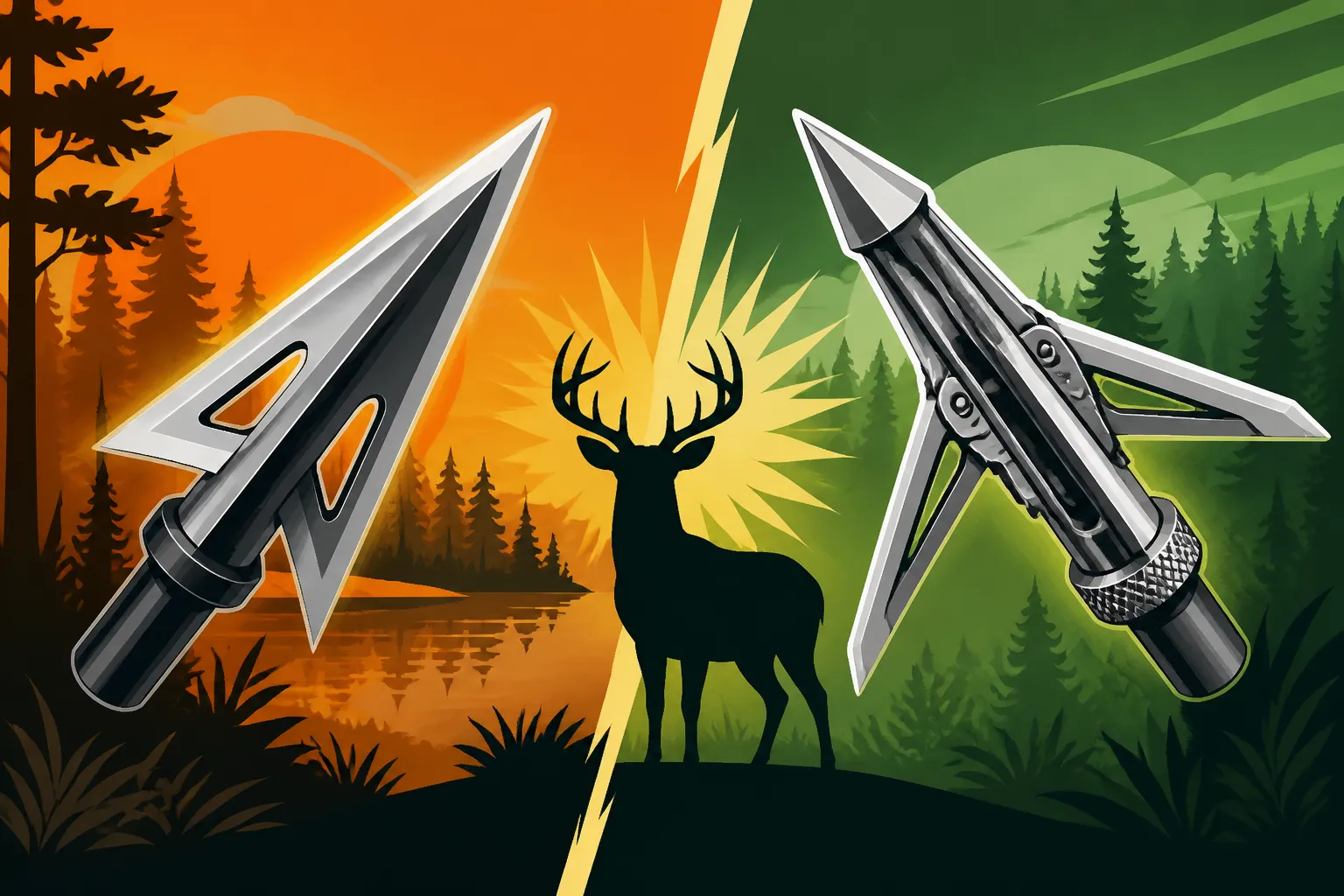
Fixed Versus Mechanical Broadheads
Ah, the age-old debate in the bowhunting world! If you've spent any time at all around a campfire or in a deer camp here in Minnesota, you’ve undoubtedly heard passionate arguments for both fixed-blade and mechanical broadheads. It's a choice that can feel incredibly personal, almost like choosing your hunting partner, and getting it wrong can lead to a lot of second-guessing and frustration in the field. After all, you spend countless hours scouting, practicing, and enduring the elements, all for that one moment of truth. You want every piece of your gear to perform flawlessly when that magnificent whitetail steps into your shooting lane. This guide is here to cut through the noise, validate your concerns, and help you navigate the nuances of fixed versus mechanical broadheads so you can make an informed decision for your next Minnesota bowhunt.
The Enduring Appeal of Fixed-Blade Broadheads
Fixed-blade broadheads are the veterans of the archery world, the tried-and-true workhorses that have brought down game for generations. Their simplicity is their strength, and for many Minnesota hunters, that reliability is non-negotiable, especially when facing the unexpected challenges our diverse landscapes can throw at you.
Design and Durability for Minnesota's Toughest Game
When you look at a fixed-blade broadhead, what you see is what you get: a sturdy ferrule with blades rigidly attached. There are no moving parts to fail, no deployment mechanisms to worry about, and no tiny screws or O-rings that might get gummed up with dirt or ice. This robust design makes them incredibly durable, a quality that's highly valued when you're hunting in places like our northern Minnesota big woods or navigating the dense cover of a cattail slough.
Imagine you're tucked away in a well-placed Treestand Setups in Minnesota Hardwoods, and that buck of a lifetime finally steps out. The shot angle might not be absolutely perfect, or perhaps you graze a small twig you didn't see. With a fixed blade, you have a much higher confidence that the broadhead will maintain its integrity and cutting surface, driving straight through bone and tissue. I've personally seen fixed blades blow through shoulders and continue on to produce a pass-through that would have undoubtedly caused a mechanical to shatter or deflect. That kind of real-world toughness is paramount when a deer might have dense muscle or a thick hide, or if the arrow needs to plow through a rib before reaching the vitals. It’s peace of mind knowing your broadhead is built like a tank.
Understanding Flight Characteristics and Tuning
Now, let's be realistic: the simplicity of a fixed blade on the stand sometimes comes with a bit more complexity on the practice range. Because those blades are always exposed, they can act like miniature fletchings, catching the wind and influencing arrow flight. This "planing" effect is a common frustration for many bowhunters, and it means that fixed blades often require more meticulous bow tuning to achieve field-point accuracy.
You can’t just screw them on and expect them to fly exactly like your practice tips. You'll likely need to spend time paper tuning, walk-back tuning, and experimenting with arrow rest adjustments to ensure your broadheads are hitting precisely where your field points do. It’s a process that demands patience and attention to detail. If your bow isn't perfectly tuned, or if your form isn't consistent, those fixed blades can steer your arrow off course. This is why some hunters shy away from them, feeling like the extra tuning effort detracts from their limited practice time. However, for those who take the time to dial in their setup, the reward is a broadhead they know will fly true and penetrate reliably every single time. It's a journey, not a destination, but a worthwhile one for the confidence it brings.
Ethical Considerations and Penetration
Beyond durability, the consistent penetration of fixed-blade broadheads is a huge ethical advantage. When an arrow hits, those blades are already cutting, initiating the wound channel immediately. This translates to maximum energy transfer and tissue damage from the moment of impact. Even with a less-than-perfect shot, a sharp, well-designed fixed blade has a better chance of pushing through bone and creating a significant wound channel, leading to a faster, more humane harvest.
For hunters with lower draw weights or those shooting a traditional bow, this consistent penetration is absolutely critical. You might not have the raw kinetic energy to reliably deploy and drive a mechanical broadhead through heavy bone, but a sharp, two-blade or three-blade fixed head will often slice its way through. Think about the thick muscle and bone of a mature whitetail buck. You want a broadhead that maintains its cutting integrity through every layer. The cutting angle and razor sharpness of good fixed blades are designed for this purpose: to slice through tissue and organs with minimal resistance, maximizing blood loss and ensuring a swift, ethical kill. Many bowhunters agree that a fixed blade often provides the best chance at a pass-through, which is crucial for a short blood trail and recovery. If you're wondering about Minimum Draw Weight for Minnesota Deer, consider how your broadhead choice interacts with your specific setup.
The Modern Advantage of Mechanical Broadheads
Mechanical broadheads represent the newer generation, a response to hunters' desires for increased accuracy and massive wound channels. They've gained immense popularity for good reason, offering distinct advantages that can dramatically change the way you approach your hunt.
Field-Point Accuracy and Simplified Tuning
The single biggest draw of mechanical broadheads, and frankly, what converts many hunters, is their ability to fly like field points. This is a game-changer. When the blades are retracted, the broadhead presents a tiny, aerodynamic profile, minimizing air resistance and eliminating the "planing" effect associated with fixed blades. What does this mean for you, the hunter? It means less time spent painstakingly tuning your bow to match broadhead flight, and more time practicing with the confidence that your hunting arrow will hit exactly where your practice arrow does.
This simplified tuning process is a huge boon, especially for busy hunters with limited time. You can switch between practice tips and hunting broadheads without needing to make significant adjustments to your bow, which simplifies your pre-season routine. For those using a Crossbow Versus Vertical Bow in Minnesota, mechanicals often make the setup process even more straightforward due to the inherent consistency of crossbow platforms. This inherent accuracy can instill a powerful sense of confidence, knowing that if you do your part, the broadhead will fly true to your aim point, crucial for those longer shots often presented in open areas.
Massive Cutting Diameter and Hemorrhage
Once a mechanical broadhead impacts its target, the magic really happens. The blades deploy, often creating a much larger cutting diameter than most fixed blades could ever achieve. We're talking about wound channels that look like a small pizza cutter went through the animal. This massive cutting surface creates tremendous hemorrhage, leading to significantly shorter blood trails and often, quicker recoveries.
Imagine an arrow slicing through vital organs with a 2-inch or even 3-inch cutting diameter. The amount of damage and blood loss is often catastrophic, leading to a very rapid and humane harvest. This is especially advantageous for a Bowhunting Minnesota's Long Archery Season where tracking conditions might be tough due to weather or thick vegetation. A profuse blood trail is your best friend when trying to locate a deer, and mechanicals excel at creating them. The larger entry and exit holes not only ensure rapid blood loss but also provide more visibility for tracking purposes, which is invaluable when hunting alone or in challenging terrain.
Potential Failure Points and Design Trade-offs
However, it's crucial to acknowledge the Achilles' heel of mechanical broadheads: their moving parts. While the design is intended to be foolproof, there's always a risk of mechanical failure. The most common concern is blades not deploying properly upon impact. This can happen if the broadhead hits a very hard object like heavy bone at an awkward angle, or if there isn't enough kinetic energy from your bow to overcome the deployment mechanism. Imagine a blade partially deploying or not deploying at all – suddenly, your large cutting diameter is significantly reduced, and penetration might be compromised.
Another trade-off is the potential for some kinetic energy loss during deployment. While often minimal with modern designs, it's still a factor. Additionally, the small O-rings, rubber bands, or collars used to hold the blades in place can sometimes get brittle in extreme cold, become dirty, or simply fail prematurely, leading to pre-deployment in flight or erratic flight. These potential failure points introduce a variable that many traditional fixed-blade users are simply unwilling to accept. It's a balancing act: you gain accuracy and cutting diameter, but you introduce a layer of mechanical complexity that could, in rare cases, betray you.
Choosing the Right Broadhead for Your Minnesota Hunt
So, how do you decide which broadhead is right for you? It's not a one-size-fits-all answer. Your choice should be a thoughtful process, taking into account your specific gear, the conditions you hunt in, and ultimately, your personal confidence.
| Feature | Fixed-Blade Broadheads | Mechanical Broadheads |
|---|---|---|
| Design | Simple, rigid blades attached to ferrule | Retractable blades, deploy on impact |
| Durability | Excellent, robust, less prone to failure | Good, but blades/mechanisms can fail under stress |
| Flight Accuracy | Can require more tuning, potential for planing | Excellent, often flies like field points, easy tuning |
| Penetration | Consistent, efficient, great for bone/heavy cover | Generally good, but some energy lost on deployment |
| Wound Channel | Good, consistent | Often massive, creates large entry/exit wounds |
| Reliability | High, no moving parts to fail | High, but depends on mechanism integrity |
| Shot Angle Forgiveness | Generally high, maintains cutting through bone | Can be sensitive to extreme angles, potentially impeding deployment |
Matching Broadhead to Bow Setup and Game
Your archery setup plays a huge role in broadhead performance. If you're shooting a traditional recurve or longbow with a lower draw weight and slower arrow speed, a highly efficient fixed blade is almost always the superior choice. Its inherent cutting efficiency ensures maximum penetration even with less kinetic energy. Conversely, if you're rocking a modern compound bow with a high draw weight, shooting arrows at blistering speeds, you likely have more than enough kinetic energy to confidently deploy a mechanical broadhead and drive it through a deer.
Consider your arrow weight too. A heavier arrow carries more momentum, which can aid penetration for both broadhead types, but it's particularly beneficial when using mechanicals that absorb some energy upon deployment. Ultimately, you need to ensure your setup can generate enough kinetic energy and momentum to push your chosen broadhead effectively through the animal for a clean pass-through. Don't be afraid to consult your bow manufacturer's recommendations or a reputable pro shop for advice specific to your rig. When considering Arrow Weight for Short Shots, a heavier arrow might be preferred for momentum with a mechanical, even at close ranges.
Terrain and Shot Scenarios in Minnesota
Minnesota's hunting terrain is incredibly varied, from the dense conifer swamps and thick popple cuts of the north to the rolling farmlands and wooded river bottoms of the south. The environment you hunt in should absolutely influence your broadhead choice.
If you find yourself primarily hunting in the thick timber of the big woods, where shot distances are generally close (20-30 yards) and the possibility of deflecting off a branch is higher, a rugged fixed-blade broadhead might be your best bet. Its robust design is less likely to be compromised by an errant twig, and its consistent penetration is key when a deer might be quartering away or behind a bit of brush. For those Hunting Minnesota Cattail Sloughs for Deer, the risk of hitting dense vegetation before the target also favors the fixed blade's resistance to deflection and pre-deployment.
On the flip side, if you're hunting open agricultural fields or over food plots in areas like southeastern Minnesota, where shots might stretch out to 40-50 yards, the field-point accuracy of a mechanical broadhead becomes a major advantage. In these scenarios, precision is paramount, and the massive wound channels from a mechanical can be devastating on a broadside animal. For planning these hunts, using mapping tools like GoHunt can be incredibly helpful to visualize the terrain, identify likely shot distances, and pinpoint those ideal ambush spots. Scouting Minnesota Public Land Before Season is crucial, and good mapping can help you assess the likely shot scenarios you'll face. Similarly, when Reading Aerial Photos for Big Woods Deer, you might identify tight shooting lanes that lean towards a fixed blade.
Personal Confidence and Practice
At the end of the day, the most important factor in broadhead selection is your personal confidence in your chosen head and your ability to shoot it accurately. If you spend all season worrying whether your mechanical blades will deploy, or if your fixed blades are flying true, that mental stress will translate into your shooting. The best broadhead in the world is useless if you can't put it precisely where it needs to go.
This means rigorous practice. You must shoot your actual broadheads (or identical practice versions provided by the manufacturer) before hunting season. Don't just assume they'll fly like your field points, even if they're mechanicals. Spend time at various distances, from close-range to your maximum ethical shooting distance, ensuring consistency. If you find you can’t get a fixed blade to group consistently, or if you experience issues with a particular mechanical deploying during practice, you need to make a change. Your confidence is your most valuable asset in the woods, and it stems directly from knowing your equipment inside and out. Focus on developing a perfect shot with whatever broadhead you choose; that's the real key to success and ethical hunting.
Disclaimer
This article is for general informational purposes only and does not constitute professional advice. Laws, prices and regulations vary by location and change over time. Consult a qualified professional for guidance on your specific situation.