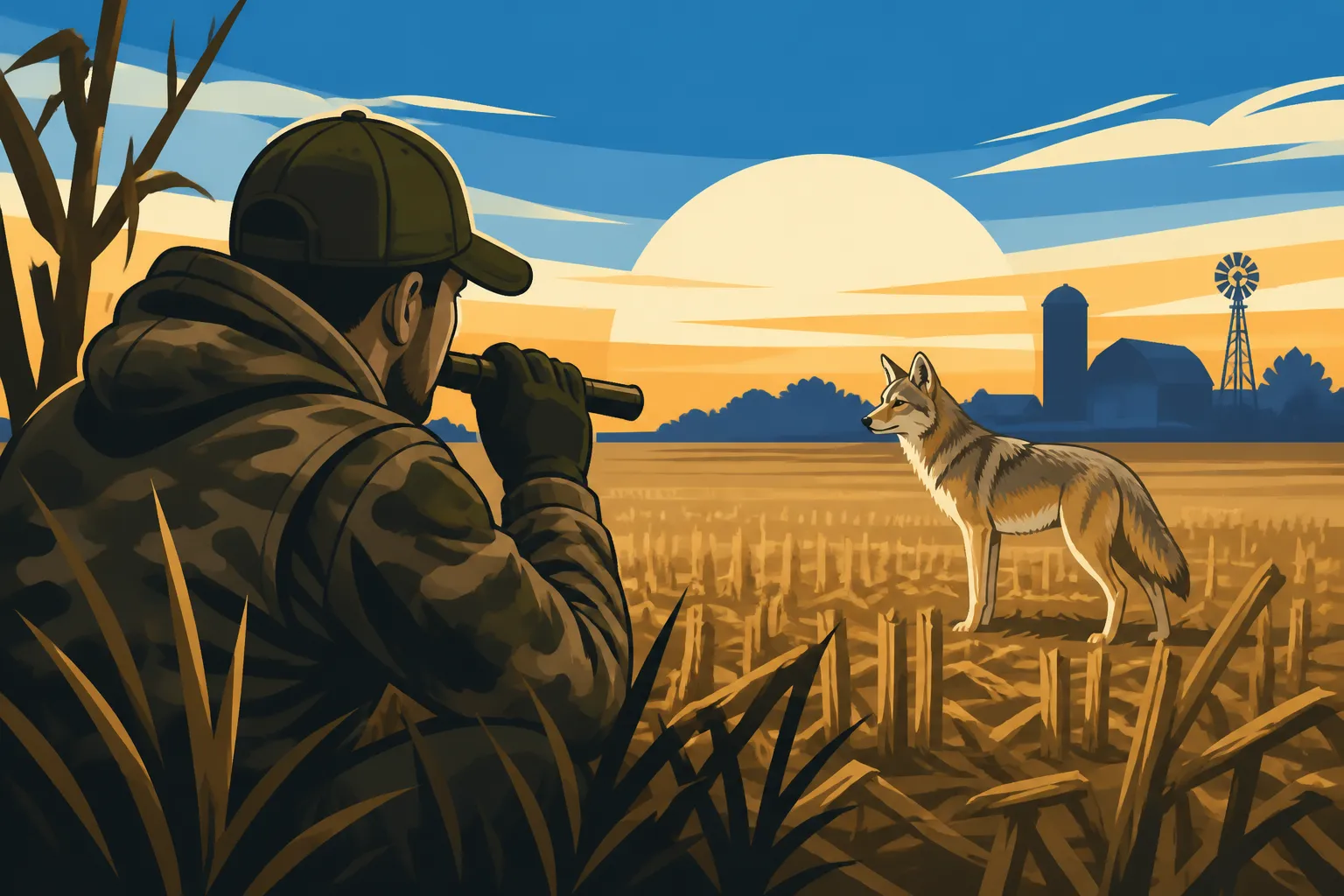
Coyote Calling in Minnesota Farm Country
The persistent howls echoing across Minnesota's farm fields are a familiar sound, often signaling more than just wildlife activity; they can mean a real threat to livestock and a significant impact on local deer populations. For many landowners and hunters, these clever canids represent a constant challenge. This comprehensive guide will arm you with the knowledge and tactics to effectively call coyotes in Minnesota's diverse agricultural landscapes, turning those frustrating howls into successful hunting opportunities.
Understanding the Farmland Coyote in Minnesota
Coyotes are incredibly adaptable animals, and Minnesota's farm country offers them an ideal environment to thrive. Unlike their big woods cousins, farmland coyotes often exhibit different behaviors and patterns, making understanding their local habits key to successful calling.
Why Coyotes Thrive in Agricultural Areas
Farm country provides a veritable buffet and ideal cover for coyotes. Think about it: fields of corn, soybeans, and alfalfa offer dense cover for denning and travel, especially when crops are standing. The edges of these fields, drainage ditches, tree lines, and neglected brushy areas become prime hunting grounds and travel corridors. These areas also hold an abundance of small prey like voles, mice, and rabbits, which feast on spilled grain or crop residues. Furthermore, many farms inevitably have livestock, be it chickens, sheep, or even calves, presenting an opportunistic food source for a hungry coyote. The sheer availability of food, water, and varied cover allows their numbers to flourish, often leading to conflicts with farmers and impacting deer fawns.
Their presence can be a real headache, not just for farmers concerned about their livelihood, but also for deer hunters who see fewer fawns reaching maturity in areas with high coyote populations. Understanding this dynamic is the first step in formulating an effective strategy. When you're Scouting Minnesota Public Land Before Season, pay close attention not just to deer sign, but also to coyote scat and tracks along field edges and in brushy draws.
Coyote Diet and Behavior in Farm Country
Farmland coyotes are opportunistic predators, meaning they'll eat just about anything they can get their paws on. While small rodents and rabbits form the backbone of their diet, especially in areas with abundant fields, they'll readily switch to deer fawns in spring and summer, injured adult deer in winter, or even domestic fowl. During crop growing seasons, they'll use the dense cover of standing corn or soybeans to stalk prey, making them incredibly difficult to spot. Once crops are cut, their behavior shifts, and they become more visible, often ranging widely across open fields or concentrating along remaining cover strips.
Their denning habits also adapt to farm landscapes. They might dig dens in overgrown creek banks, wooded fence lines, or even under old farm structures. Knowledge of these behaviors and preferences, particularly during different times of the year, can greatly inform your calling strategy. For example, during winter months, they might be more concentrated around areas that still offer food or shelter from the harsh Minnesota weather, like unharvested standing corn or thick cattail sloughs.
Essential Gear for Minnesota Farm Country Calling
Calling coyotes effectively in open farmland requires a thoughtful approach to gear, from the sounds you project to the rifle you carry. The right equipment can make all the difference when those wary coyotes decide to investigate.
Calls: Electronic vs. Hand Calls
Choosing the right call is paramount. Both electronic and hand calls have their place in a coyote hunter's arsenal, and often, a combination of the two yields the best results.
- Electronic Calls: These are incredibly versatile, offering a wide range of realistic sounds from distressed rabbits and fawns to coyote howls and barks. Brands like Foxpro and Primos offer excellent electronic callers that can be crucial for reaching out across vast farm fields. The ability to place the call away from your setup can draw a coyote's attention away from your hiding spot, making them focus on the sound source instead of you. This is especially beneficial in open terrain where concealment can be a challenge. You can also control volume and vary sounds with ease, which is a huge advantage when trying to elicit a response from distant or wary coyotes. Some modern callers even integrate with mapping apps, like the GoHunt platform, allowing you to mark stands and calling locations directly.
- Hand Calls: While requiring more skill and practice, hand calls offer unparalleled authenticity and the ability to instantly adjust the tone and volume of a distress sound based on a coyote's reaction. From open-reed calls mimicking a cottontail in distress to closed-reed calls for pup yelps or mouse squeaks, hand calls provide intimate control. They are lightweight, require no batteries, and can be used to quickly add realism or a follow-up sound to an electronic sequence. Many experienced callers swear by the subtle nuances only a hand call can produce, especially when trying to coax in a hung-up coyote that's heard every electronic trick in the book.
Optics and Firearm Considerations
In the wide-open spaces of Minnesota farm country, you'll often be taking longer shots than you might in thick timber. Therefore, your optics and firearm choices are critical.
- Rifle Caliber and Setup: When targeting coyotes, a flat-shooting rifle is often preferred. Calibers like .223 Remington, .204 Ruger, or .22-250 Remington are popular for their speed and minimal pelt damage, especially if you plan to save the hide. If you're carrying a larger caliber for deer and happen upon a coyote, something like a .243 or 6.5 Creedmoor would also be effective. The key is accuracy at distance. Ensure your rifle is zeroed precisely for the expected ranges you'll encounter. For more on preparing your rifle, check out our guide on Sighting In a Rifle for Minnesota Woods Ranges, though the principles apply to open country too.
- Scopes and Binoculars: A good quality scope with variable magnification (e.g., 3-9x or 4-12x) is ideal, allowing you to zoom out for wide field of view when scanning and zoom in for precise shots. Clarity is paramount, especially during low-light conditions at dawn or dusk when coyotes are most active. Complement your scope with a pair of quality binoculars, perhaps 8×42 or 10×42, for scanning distant tree lines, fence rows, and field edges. They'll help you spot that subtle flick of an ear or movement in the brush long before a coyote commits to the call.
Coyote Hunter's Gear Checklist
| Item | Electronic Call | Hand Call | Notes |
|---|---|---|---|
| Call | Essential | Recommended | Range of sounds, hands-free operation; authenticity, portability |
| Firearm | Rifle (.223, .204, .22-250) | Rifle (.223, .204, .22-250) | Flat-shooting, accurate at distance. |
| Optics | Scope (3-9x, 4-12x), Binos (8x, 10x) | Scope (3-9x, 4-12x), Binos (8x, 10x) | Clarity, variable magnification. |
| Concealment | Camouflage (full suit), Ground Blind | Camouflage (full suit), Ground Blind | Blend into surroundings, break up silhouette. |
| Decoy (optional) | Motion decoy (fur or feather) | Motion decoy (fur or feather) | Distracts coyote's attention from your position. |
| Seat | Portable chair/cushion | Portable chair/cushion | Comfort for extended waits, helps with stillness. |
| Wind Checker | Essential | Essential | Crucial for setup and approach. |
| Headlamp (night) | Essential | Essential | For setup/breakdown in dark, legal for hunting with landowner permission. |
| Mapping App | GoHunt, OnX Hunt | GoHunt, OnX Hunt | For property lines, terrain, historical stand locations. |
| Blaze Orange (season) | Required | Required | During firearms deer seasons, day or night. |
Effective Calling Strategies and Setups in Farm Country
Coyote calling is as much an art as it is a science. Success in Minnesota's farm country hinges on understanding the terrain, predicting coyote movement, and employing smart calling sequences.
Reading the Landscape for Setups
Unlike the big woods where you might focus on thickets and ridge lines, farm country setups demand an understanding of open spaces, prevailing winds, and the subtle cover offered by agricultural features.
- Identify Travel Corridors: Coyotes frequently use ditches, creek beds, fence lines, and the edges of wooded areas or shelterbelts as travel routes. When you're driving through farm country, keep an eye out for these natural funnels. A good setup will position you to intercept a coyote moving along one of these features. Use aerial maps on your GoHunt or OnX Hunt app to Reading Aerial Photos for Big Woods Deer, applying similar principles to identify potential coyote highways in open farmland.
- Utilize Elevated Positions or Cover: In relatively flat farm country, finding a good vantage point is crucial. This could be a slight rise, a stand of trees, or even the edge of a standing cornfield. You want to be able to see approaching coyotes from a distance, giving you time to prepare. If natural elevation isn't available, consider using a quality ground blind, as detailed in our article on Using a Ground Blind on Minnesota Public Land, to break up your silhouette and provide concealment against the open backdrop.
- Wind is Your Friend and Foe: Always, always, always hunt with the wind in your favor. Coyotes have an incredible sense of smell, and if they catch your scent, your hunt is over. Position yourself so the wind is blowing your scent away from where you expect the coyote to approach. Often, this means positioning yourself on the downwind side of a suspected travel corridor or bedding area. Our guide on Wind and Thermals on a Minnesota Ridge offers principles that apply to understanding air currents in any terrain, including open fields.
Call Sequences and Decoy Use
Once you've chosen your spot, it's time to bring out the calls and maybe a decoy. The sequence and type of calls you use can greatly influence whether a coyote commits or hangs up.
- Start Subtle, Get Aggressive: A common strategy is to start with a soft, pleading distress call – perhaps a mouse squeak or a subtle cottontail in distress. This can pique a coyote's curiosity without immediately putting them on high alert. If you get no response after a few minutes, gradually increase the volume and intensity. If a coyote is hesitant, try a few soft whines or pup yelps to tap into their social curiosity or maternal instincts. Don't be afraid to go aggressive with a loud, frantic rabbit distress call if you're trying to reach out across a large field or provoke a response from a distant animal.
- Mix It Up with Howls and Barks: While distress calls are primary, incorporating coyote vocalizations can be very effective. Howls can serve as locator calls to determine if coyotes are in the area. A challenge howl might bring in an aggressive male, while barks can pique curiosity. Listen for responses. If a coyote howls back, you know you're in business.
- Decoys as a Distraction: A motion decoy, such as a spinning piece of fur or a feather attached to a stake, can be a game-changer. Position it 20-40 yards in front of your setup. The visual stimulation will often draw a coyote's eyes to the decoy, distracting them from your position and allowing them to close the distance with less wariness. It gives them something to focus on other than you, making them feel more confident in their approach. This can be especially useful when calling wary farm country coyotes who have seen it all.
Wind, Thermals, and Approach
Successful coyote hunting in open farmland means being hyper-aware of your surroundings and the invisible forces of nature.
- Constant Wind Monitoring: Even if you set up perfectly with the wind, conditions can change. Carry a small wind checker to constantly monitor the wind direction, especially if you plan to stay in one spot for an extended period. If the wind shifts, you might need to quickly reposition or adjust your calling strategy to avoid being busted.
- Thermal Currents: While less pronounced in truly flat fields, thermals (rising and falling air currents) can still play a role, especially around topographical features like creek beds, treelines, or slightly elevated areas. In the morning, as the sun warms the earth, air will generally rise. In the evening, as the air cools, it will fall. These subtle shifts can carry your scent further than you'd expect, so try to understand their patterns in your chosen hunting area.
- Stealthy Approach and Exit: Just as important as the call is your approach and exit from the calling stand. Move slowly and quietly, using any available cover to remain undetected. Avoid skylining yourself on ridges or exposing yourself against open fields. After a call, especially if you haven't had success, give the area ample time before moving. A coyote might have come in silently and be observing from a distance. If you spook a coyote on your exit, they'll be even warier next time.
Seasonal Considerations and Advanced Tactics
Coyote behavior changes with the seasons, and adapting your calling tactics accordingly will increase your success rate in Minnesota's varied farm country.
Winter Calling Strategies
Winter is often the most productive time for coyote calling in Minnesota farm country. The sparse cover, often snow-covered, makes coyotes easier to spot, and their need for food becomes more acute.
- Food Scarcity Drives Aggression: With natural food sources buried under snow or depleted, coyotes are more likely to respond to distress calls, driven by hunger. This is the time to lean into those loud, frantic rabbit distress calls.
- Track Them Down: Fresh snow reveals everything. Use it to your advantage to locate active coyote travel routes, concentrations of tracks, and even recent kills. Following tracks might lead you to a good setup location downwind of where coyotes are actively hunting or bedding. You can find more about Coyote Calling in a Minnesota Winter in our dedicated guide.
- Visibility is Key: In winter, a good pair of binoculars is invaluable. Coyotes will often sit up on a distant knoll or along a fence line to survey an area before committing. Spotting them early allows you to adjust your call volume or use a hand call to coax them in. The GoHunt app can help identify those subtle elevation changes in seemingly flat fields that coyotes might use as vantage points.
- Dress Warm and Stay Still: Long waits in frigid Minnesota winters demand appropriate clothing. Layer up, use hand warmers, and ensure you can remain absolutely still for extended periods. Movement in the stark, snow-covered landscape will instantly give you away.
Night Hunting Considerations
Night hunting coyotes is legal in Minnesota, with specific stipulations that you absolutely must adhere to. This can be an incredibly effective strategy, as coyotes are primarily nocturnal.
- Legal Requirements: In Minnesota, you can hunt coyotes day or night. However, if using artificial lights (including thermal or night vision optics), you must be on private land with the landowner's permission. If hunting on public land at night, consult the specific regulations for that area – some may prohibit artificial lights. During any open firearms deer season, day or night, hunters are required to wear blaze orange. This is a critical safety measure and a legal requirement, as covered in detail in our article on Night Hunting Rules for Minnesota Coyotes. Always verify the current regulations with the Minnesota DNR before heading out.
- Gear for Darkness: Night hunting requires specialized gear. A good quality red or green light designed for hunting, or even better, thermal or night vision optics, will give you the edge. Remember to shine your light around the area first, gradually bringing it to where you expect a coyote. Often, a coyote will respond to the call and then stop at a distance, trying to locate the source.
- Patience and Stealth: At night, sounds travel further, and coyotes are often even warier. Set up well in advance of darkness. Use softer calls initially, relying more on howls to locate them. If using a light, avoid shining it directly at a coyote for too long, as this can spook them. A quick flash to confirm identity, then a steady beam for the shot.
- Safety First: Hunting at night carries inherent risks. Always know your backdrop, be absolutely certain of your target, and never shoot at sounds. Hunt with a partner for added safety, and always inform someone of your hunting location and expected return time.
Ultimately, successful coyote calling in Minnesota farm country is a blend of preparation, understanding, and adaptability. By knowing your quarry, mastering your gear, and reading the subtle cues of the landscape, you can turn those challenging wide-open spaces into your hunting advantage.
Disclaimer
Please note: Hunting regulations and laws can change frequently. Always consult the official Minnesota Department of Natural Resources (DNR) website or their current hunting regulations handbook before engaging in any hunting activities. This guide is for informational purposes only and does not supersede state or federal hunting laws.