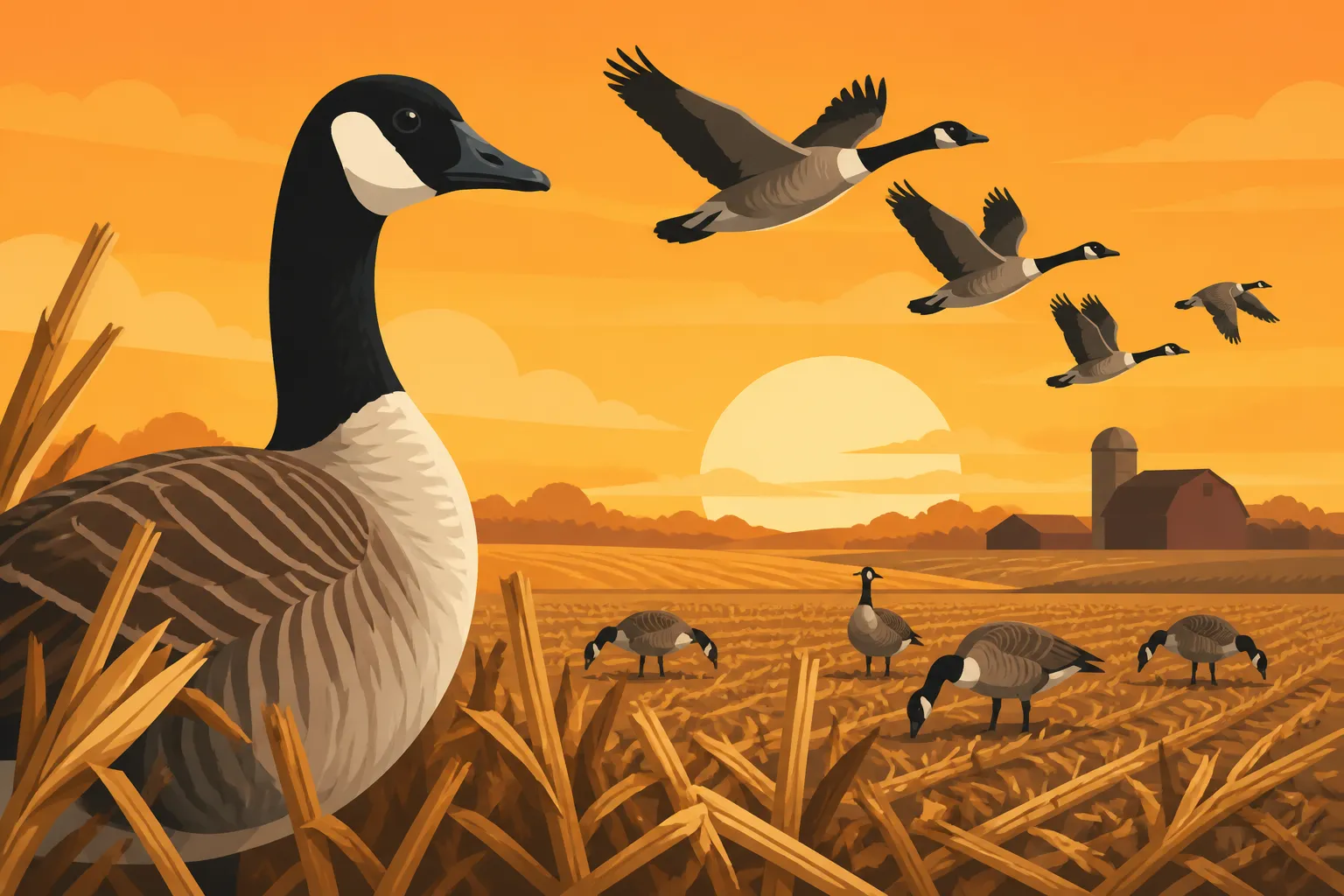
Canada Geese on Minnesota Farmland
There's nothing quite like the sight and sound of hundreds of Canada geese descending on a Minnesota cornfield, but trying to intercept them can be one of the most frustrating pursuits in waterfowl hunting. These birds are incredibly smart, often landing just out of range, or avoiding your spread entirely. This guide is here to unravel the mysteries of hunting Canada geese on Minnesota farmland, offering practical advice to help you transform those missed opportunities into successful, memorable hunts, from early season resident birds to late season migrators.
Understanding the Allure and Challenge of Farmland Geese
Canada geese are adaptable birds, and Minnesota's vast agricultural landscape provides an irresistible buffet for them. Understanding why they are there and what makes them wary is the first step toward putting them in your decoy spread.
Why Geese Gravitate Towards Minnesota Farmland
Our Minnesota farmland, especially the stubble fields after harvest, is a goose magnet. It's not just about sustenance; it's about survival. They're looking for calories to fuel their flights and stay warm, and our corn and soybean fields offer an unparalleled energy source. After the combines have run, there's always plenty of spilled grain and leftover kernels to be found, making these fields a veritable all-you-can-eat buffet. This constant food supply is a primary driver, pulling both resident birds and migrating flocks down from their northern journeys.
Beyond the rich food sources, farmland offers a sense of security that geese crave. The wide-open spaces of a cut cornfield or soybean stubble provide excellent sightlines, allowing geese to spot predators like coyotes, foxes, or even human hunters from a great distance. They prefer these open areas where they can feed, preen, and loaf without feeling trapped or ambushed. Often, these prime feeding fields are within easy flight distance of secure loafing and roosting areas, such as large lakes, rivers, or secluded potholes. These natural water bodies offer a safe haven where they can spend the night, resting and conserving energy before returning to the fields at first light.
The Specific Frustrations of Hunting Farmland Geese
While the allure of farmland is clear to the geese, the frustrations for hunters are equally apparent. Perhaps the biggest challenge is dealing with the sheer wariness of these birds, especially as the season progresses. Geese quickly learn to associate decoy spreads and calling with danger. A flock of a hundred birds has a hundred pairs of eyes, and if even one bird senses something is amiss, the entire flock will flare. This makes getting them to commit to a spread incredibly difficult, leading to many moments of watching birds circle, decide against it, and fly off to the next field.
Another significant hurdle is gaining access to these prime feeding grounds. Much of Minnesota's prime goose country is privately owned. This means you can't just set up shop wherever you see geese. Securing permission from landowners is paramount, and it often requires time, effort, and building good relationships. For many hunters, the thought of knocking on doors can be intimidating, but it's often the only way to get consistent access to the best fields. You can find more advice on Knocking on Doors in Minnesota Farm Country. Even with permission, there's the physical challenge of moving dozens of heavy full-body decoys, layout blinds, and other gear across muddy or snow-covered fields. It's a logistical puzzle that demands effort and often, a dedicated hunting crew.
Key Scouting Strategies for Successful Farmland Goose Hunts
Success in farmland goose hunting hinges almost entirely on meticulous scouting. You can have the best gear and the most realistic calls, but if you're not where the geese want to be, it's all for naught. This isn't just about finding birds; it's about understanding their habits and patterns.
Reading the Landscape: Identifying Hot Spots from Afar
Before you even step foot in a field, modern technology can be your best friend. Start by using satellite imagery tools, whether it's a free online map service or a dedicated hunting app like GoHunt. These tools allow you to virtually "fly over" vast areas of Minnesota farmland, identifying potential feeding fields, roosting lakes, and the flight paths connecting them. Look for large, recently harvested cornfields, especially those with visible stubble, or newly planted winter wheat. These are obvious food sources. Pay attention to water sources nearby; geese rarely feed too far from a place where they can drink and loaf.
Once you've identified potential areas, it's time to put boots to the ground—or, more accurately, tires to gravel roads. Drive the backroads at dawn and dusk, observing from a distance with binoculars or a spotting scope. Geese are creatures of habit, often flying the same routes to and from their feeding grounds. Identifying these flight corridors can give you a huge advantage, as it narrows down where you might need to set up. Note their entry and exit points in fields, as well as the specific areas they're congregating in. Look for the tell-tale white patches of goose droppings against the brown stubble, indicating recent activity. You can also gain an edge by Scouting With the Minnesota Recreation Compass App to pinpoint potential public access points near active fields, if private land access isn't an option.
Boots on the Ground: Confirming Patterns and Gaining Access
Once you've narrowed down some promising locations from a distance, the next step is closer, more direct observation. This might involve setting up far from the field with a high-powered spotting scope, watching the birds for a full feeding cycle. You're looking to confirm daily patterns: when do they arrive, where exactly do they land, how long do they stay, and what direction do they leave? Are they flying in small groups or massive flocks? This level of detail is critical for setting up your decoy spread and blinds in the optimal location. Look for visual cues like heavily disturbed stubble, indicating consistent feeding, or freshly excavated holes where geese have rooted for missed kernels.
Perhaps the most critical "boots on the ground" step, especially in Minnesota's predominantly private farmland, is securing permission. This is where good relationships and clear communication come into play. Approach landowners respectfully, introduce yourself, and explain what you'd like to do. Offer to share some of your harvest, or help with a chore around the farm. Sometimes, just asking at the right time – perhaps after the fields have been picked clean – can make all the difference. Remember, without permission, you can't hunt. Even if you see a hot field, always prioritize gaining legal access before planning your hunt. A well-placed inquiry can lead to years of enjoyable hunting on a specific property, turning what seemed like a closed-off opportunity into a regular haunt.
Essential Gear and Setup for Farmland Goose Hunting
Farmland goose hunting is a gear-intensive pursuit, and having the right equipment, combined with knowing how to use it effectively, can make or break your hunt. From realistic decoys to effective concealment, every piece plays a vital role.
Decoy Spreads That Fool Wary Birds
When it comes to fooling Canada geese on Minnesota farmland, your decoy spread is your primary tool. You'll need more than just a handful of decoys; large flocks often require large spreads to feel confident enough to commit. Full-body decoys are generally considered the most realistic, offering a three-dimensional representation that stands out in a flat field. They come at a higher price point and are heavier to transport, but their realism can be unmatched. Silhouettes and shells are more affordable and easier to carry, and they can add volume to a spread, making it appear larger and more inviting. Many hunters combine these types, using full-bodies closest to the blinds for realism, and then stretching out with silhouettes and shells to create a massive, visible spread.
The configuration of your spread is just as important as the number of decoys. A common strategy is to create a "U" or "J" shape, with the open end facing into the wind, providing a clear landing zone directly in front of your blinds. Geese almost always land into the wind, so understanding wind direction is crucial. Incorporate movement into your spread with fliers, which simulate geese landing or taking off, or flags that mimic flapping wings. These elements add realism and can draw the eye of high-flying birds. A "family group" approach, with clusters of 3-5 decoys, can also make the spread appear more natural and less like a random scattering. Remember, the goal is to make your spread look like a safe, inviting feeding party that the incoming geese can't resist joining.
Concealment is King: Blinds and Camouflage
Canada geese have incredible eyesight, and if they spot anything out of place, they'll flare faster than you can blink. This is why concealment is absolutely paramount in farmland hunting. Layout blinds are the standard for field hunting, allowing you to lie flat on your back, hidden from overhead birds. These blinds are designed to blend into agricultural fields, often coming in stubble-pattern camouflage. However, simply setting a blind in the middle of a field isn't enough. You need to brush it in, using natural vegetation from the field itself – corn stalks, soybean stubble, or even local grasses. The goal is to break up the hard lines of the blind and make it disappear into the surrounding environment. You can find more detail on Brushing In a Blind on a Field Edge to ensure your setup is truly invisible.
If layout blinds aren't an option, or if the terrain allows, you might utilize natural cover. Hay bales, fence rows, or even the edge of a standing crop field can provide concealment. Sometimes, even digging a small pit blind, if permissible and practical, can offer superior concealment, but this is far more labor-intensive. Regardless of your chosen method, pay attention to the little details. Make sure no gear is exposed, that your face is covered with a mask or paint, and that your silhouette is completely broken up against the horizon. A well-hidden hunter is often the difference between birds circling out of range and birds dropping their feet for a landing.
Calling Strategies for Farmland Geese
Calling is the art that brings your decoy spread to life. For Canada geese, especially on Minnesota farmland, a mix of calls and realistic sequences can be incredibly effective, but it takes practice. Short-reed calls are popular for their versatility, allowing for a wide range of notes from deep honks to sharp clucks. Longer flute calls can produce a more traditional, deeper honk that carries well across open fields. It's not about making the loudest noise; it's about making the most convincing noise.
Your calling sequence should mimic what a feeding flock sounds like: a mix of greeting calls, content clucks, and excited honks. When birds are far out, a series of attention-grabbing honks can pull their gaze to your spread. As they get closer, switch to more contented clucks and moans, reassuring them that everything is safe. Pay attention to how the real birds are responding; if they turn, ease off. If they continue on, try to re-engage them. It's a conversation. For pressured birds, less can sometimes be more. Over-calling can make smart geese wary, so sometimes a few well-timed, realistic clucks are more effective than a barrage of loud honks. Consistency in your practice, understanding the various calls, and reading the birds' reactions are key to mastering this crucial skill.
Executing the Hunt: Tactics for Different Farmland Scenarios
Knowing the gear is one thing, but knowing how to deploy it throughout Minnesota's varied goose seasons is where true expertise comes into play. From the early resident bird hunts to the challenging late-season pushes, each period demands a slightly different approach.
Early Season Strategies (September/October)
The early goose season in Minnesota, typically opening in September, often targets resident Canada geese. These birds haven't faced as much hunting pressure yet, so they can be a bit more forgiving. Flocks tend to be smaller, often family groups or local birds, rather than the massive migratory waves. During this time, scouting for local feeding patterns is paramount. These birds will often use the same fields day after day, and may not range as far from their roosting water. A key strategy is to identify these consistent patterns and set up exactly where they want to be.
Early season also means warmer weather, which impacts how you manage your gear and yourself. Hydration is important, and you might not need the heavy layering required later in the year. While birds might be less wary, still prioritize good concealment; they're not completely oblivious. Pay close attention to roost-to-feed patterns. Many resident geese will loaf on small ponds or local lakes during midday and fly to feed early morning and late afternoon. Setting up for these peak flight times can be highly productive. For a deeper dive into these initial hunts, you can explore Early Goose Season Tactics in Minnesota.
Mid to Late Season Challenges (November/December)
As autumn deepens into winter, Minnesota's farmland goose hunting shifts dramatically. Mid-season brings the main push of migratory Canada geese, often in huge flocks that have seen plenty of hunting pressure as they've traveled south. These birds are significantly warier, making them a true challenge. Late season, especially into December, means colder temperatures, often snow-covered fields, and dwindling food sources. Geese become even more concentrated on finding reliable food, and their patterns might shift from field to field as existing ones are picked clean or become less accessible due to snow.
During these challenging periods, flexibility and perseverance are key. You'll likely need larger decoy spreads to impress these big, wary flocks. Movement in your spread, whether from fliers or flags, becomes even more critical to catch their attention. Calling should be precise and realistic, avoiding anything that sounds artificial. Weather plays a huge role; geese will often feed more aggressively before a cold front or storm. Finding new food sources becomes a daily scouting mission, as fields that were hot last week might be barren this week. Even though this period can be tough, the rewards of decoying a massive flock of cold-weather geese are immense. It often feels like a chess match against highly intelligent adversaries. For specific tips on how animals adapt to dwindling resources, you might consider insights from Late-Season Food Sources for Minnesota Whitetails, which can offer analogous concepts for geese.
Legalities and Logistics: Important Considerations
Hunting Canada geese in Minnesota involves adherence to specific regulations, and understanding these is non-negotiable for a legal and ethical hunt. First and foremost, you need to be aware of the specific Minnesota Goose Zones and Seasons and bag limits for the particular time of year and location you're hunting. These can vary, so always check the most current regulations. You also need to ensure you have the appropriate licenses. This includes a valid Minnesota small game license, as well as a Minnesota Federal Duck Stamp Requirement and proof of Minnesota Migratory Game Bird Certification (HIP registration). These requirements fund conservation efforts and help the state track harvest data.
When it comes to ammunition, there's a critical rule to remember: federally approved non-toxic shot is required for all waterfowl hunting. This means no lead shot. Common choices include steel, bismuth, or tungsten alloys. Pay attention to shot size; for Canada geese, larger shot sizes like BB, BBB, or T are often preferred for their energy and knockdown power. You can learn more about ammunition choices, even if focused on ducks, by reading Waterfowl Loads for Minnesota Divers. Finally, always be mindful of shooting hours, which are typically from one-half hour before sunrise to sunset. These legal and logistical details might seem like paperwork, but they are crucial for ensuring your hunt is compliant and contributes positively to waterfowl conservation.
Adapting to Pressure and Maximizing Success
Hunting Canada geese, especially on Minnesota farmland, is rarely a "set it and forget it" endeavor. The birds are constantly adapting to pressure, and so must you. It's a continuous learning process that demands flexibility, observation, and a willingness to analyze and adjust.
Overcoming Wary Birds and Hunter Pressure
The more birds get hunted, the smarter they become. This is particularly true for Canada geese, which often migrate through areas with heavy hunting pressure. To overcome their wariness, you might need to change your tactics significantly. One key strategy is mobility. If a field has been hunted heavily, the geese will likely avoid it for a while. Be prepared to scout new areas daily and move your setup to where the birds are currently feeding. This could mean packing up and relocating entire decoy spreads, which is labor-intensive but often necessary for success.
Sometimes, a smaller, more natural decoy spread can be more effective than a massive one. If geese are seeing huge spreads every day, a subtle, smaller "family group" of half a dozen full-bodies might look less threatening. Pay meticulous attention to your hide, ensuring it's absolutely perfect. Even a slight glint of a face or an unnatural bump in the stubble can send a wary flock spiraling away. Patience is another virtue; instead of trying to force birds into range, sometimes waiting for the perfect opportunity, when a small group is committed and low, will yield better results than taking a hopeful shot at a high-flying flock.
Post-Hunt Analysis and Continuous Improvement
Every hunt, whether successful or not, offers valuable lessons. After the birds have flown off, take some time to analyze what worked and, more importantly, what didn't. Did the geese flare at a specific point in their approach? Was your calling effective, or did it seem to push them away? Was your concealment compromised? Did your decoy spread look natural from their perspective? Learning from these experiences is how you become a better goose hunter. Perhaps you notice that birds always land on the far side of your spread, indicating you need to adjust your landing zone for next time.
Building relationships with landowners is an ongoing process. A successful hunt might lead to an invitation back, but a respectful and clean departure after every hunt is equally important. Offer to help with any trash, even if it's not yours. Leave the gate as you found it. A simple thank you can go a long way in securing future access to those prime Minnesota farmland fields. This continuous cycle of scouting, hunting, analyzing, and building relationships is what makes farmland goose hunting so engaging and ultimately rewarding.
Farmland Goose Decoy Comparison
To help you decide which decoys might be best for your Minnesota farmland hunt, here's a quick comparison of the most common types:
| Decoy Type | Realism Level | Portability | Cost (Relative) | Pros | Cons | Best Use Case |
|---|---|---|---|---|---|---|
| Full-Body | High | Low (bulky/heavy) | High | Extremely realistic, good visibility, durable | Expensive, heavy to carry, requires more storage | Close to blinds, focal points of a spread, primary decoys |
| Shell | Medium | Medium | Medium | Lighter than full-bodies, stackable, adds volume | Less realistic profile, can blow over in high winds | Adding numbers to a spread, budget-friendly bulk |
| Silhouette | Low-Medium | High (flat) | Low | Very portable, quick setup, adds mass visibility | Two-dimensional, less realistic up close | Large volume spreads, distant geese, easy transport |
| Wind Sock / Flag | High (movement) | High | Low | Creates realistic movement, highly visible | Can look unnatural if not used correctly, needs wind | Enhancing realism, attracting distant birds, motion |
This table provides a general overview, and many hunters will mix and match these types to create a diverse and effective spread.
Disclaimer
This article is for general informational purposes only and does not constitute professional advice. Laws, prices and regulations vary by location and change over time. Consult a qualified professional for guidance on your specific situation.