Sleds and Drags for Snow Country
There’s nothing quite like the crisp air and hushed silence of a Minnesota winter hunt, but the moment you drop a deer in deep snow, the reality of recovery can hit you like a ton of bricks. That immense sense of accomplishment quickly shifts to the daunting, back-breaking challenge of getting your hard-earned venison back to the truck. This guide will walk you through the world of deer sleds and drags, showing you how these often-overlooked tools can transform your late-season Minnesota deer recovery from a grueling ordeal into a manageable task.
The Indispensable Role of Sleds and Drags in Snow Country
For anyone who has ever tried to drag a deer through knee-deep Minnesota snow without assistance, you know the feeling. Every few steps, your feet sink, the deer plows into the snow, and your muscles scream in protest. The notion of a sled or drag might seem like an extra piece of gear to haul, but once you've experienced the difference, you'll wonder how you ever hunted winter without one. These tools aren't just conveniences; they're essential for preserving your energy, your back, and even your hunting opportunities when the landscape turns white.
Why Your Back Will Thank You
Let’s be honest, few things are as physically demanding as dragging a mature whitetail buck out of the woods, especially when the snow is piled high. The resistance of the snow against the deer's body is incredible, creating a constant, heavy drag that can quickly exhaust even the most seasoned hunter. Trying to lift and pull a dead weight over uneven terrain, around fallen logs, and through thick brush is a recipe for pulled muscles and an early end to your hunting career. A good sled dramatically reduces this friction, allowing the deer to glide over the snow rather than plow through it. This simple reduction in resistance means you expend far less energy, making the entire process faster and significantly easier on your body. Imagine the difference between pushing a box across rough pavement and gliding it on wheels – that's the kind of advantage a sled offers in snow.
Beyond the physical exertion, there's the sheer awkwardness of a bare drag. The deer's legs can get caught on brush, its head can snag on saplings, and its body can roll and twist, making it difficult to maintain a steady pull. A sled contains the animal, keeping it streamlined and preventing it from becoming entangled. This control means you can focus on pulling forward, rather than constantly stopping to untangle or reposition your prize. In the vast, often rugged terrain of northern Minnesota, this difference can be the deciding factor in whether you make it back to the truck before dark, or find yourself struggling long after the sun has set.
Extending Your Hunting Reach
One of the biggest mental barriers to hunting deep in Minnesota's public lands during winter is the thought of recovering a deer far from a trail or road. Many hunters stick to areas closer to access points, even if they know bigger bucks might be holding out in more remote cover. This self-imposed limitation often comes from past experiences with grueling, seemingly endless drags. With a reliable sled or drag, that fear begins to melt away. Suddenly, those distant pockets of timber, the secluded cattail sloughs, or the hidden clear-cuts become viable hunting grounds because you have a plan for recovery. You're no longer constrained by the "how will I get it out?" question, which can unlock incredible hunting opportunities.
Consider the dense forests of the Superior National Forest or the expansive public lands of Beltrami County. These areas hold fantastic deer, especially later in the season when pressure pushes them into thicker cover. But these same areas can be a nightmare for recovery if you're unprepared. A well-chosen sled, especially one designed for heavy loads and rough terrain, allows you to confidently venture deeper, knowing you have the means to extract your deer efficiently. It expands your hunting map and your confidence to pursue deer in their sanctuaries. If you're willing to go where others aren't, a sled is your ticket to Hunting Deer in Deep Northern Minnesota Snow and finding success far from the crowds that often plague closer-to-road parcels.
Navigating the World of Deer Sleds and Drags
Just like choosing the right rifle or bow, picking the right sled or drag for your Minnesota hunting adventures depends on a few factors: the type of terrain you hunt, how far you typically go, and the size of game you're after. There's a spectrum of options, from minimalist designs to robust utility haulers, each with its own advantages. Understanding these differences will help you make an informed choice that suits your personal hunting style and the conditions you face.
Basic Dragging Devices: Simplicity and Portability
For hunters who prioritize light weight and compactness, basic game drags and flexible plastic sleds are excellent choices. A simple game drag might be nothing more than a sturdy strap or rope with handles that you attach to the deer's head or antlers. These are incredibly portable, fitting easily into a daypack, and are perfect for short drags over relatively clear ground or for boned-out game. They offer minimal protection for the carcass but significantly ease the direct pull. If you're only looking to move a field-dressed deer a few hundred yards to an ATV trail, a quality drag rope can be surprisingly effective, preventing direct hand contact with the cold, wet carcass and distributing the weight better than just grabbing an antler.
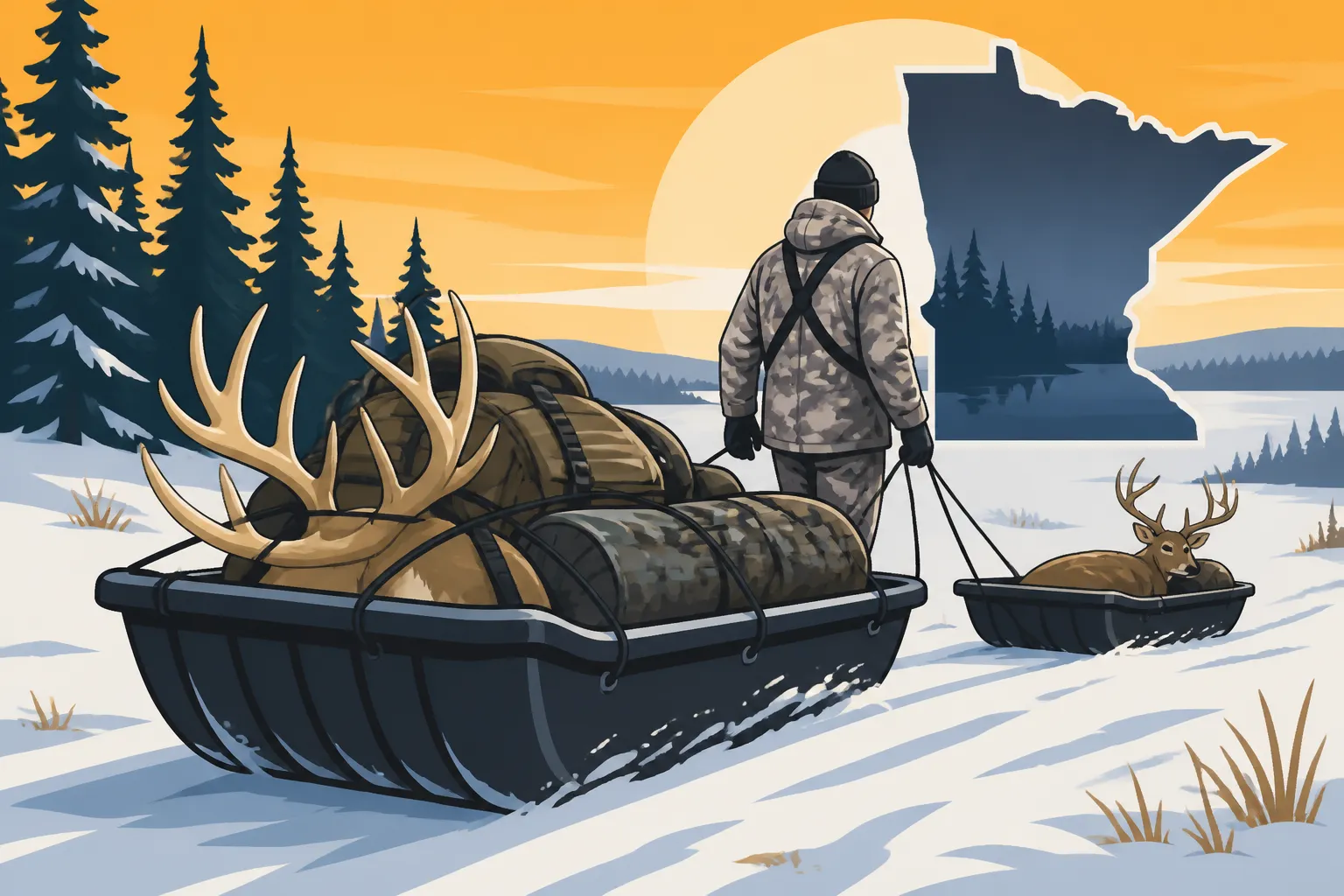
Flexible plastic sleds, often made of durable, rollable plastic, represent a step up in functionality. These are lightweight and can be rolled or folded for transport, yet they offer a smooth surface that glides easily over snow, grass, or even bare ground. They create a protective barrier for your deer, keeping the meat cleaner and free from debris as you pull it through the woods. Many come with pre-drilled holes for attaching ropes, making it easy to create a custom harness. These are a fantastic all-around option for single deer recoveries across varied terrain and moderate distances, like those found in many Minnesota Wildlife Management Areas. They're particularly useful when you need to Field Dressing a Deer in Cold Weather and want to keep your hands clean and warm while securing the carcass for transport.
Heavy-Duty Sleds for Serious Snow and Distance
When you’re facing deep snow, rough terrain, or the need to haul a really big Minnesota buck a long distance, a heavy-duty sled truly shines. These are typically constructed from thicker, more rigid high-density polyethylene (HDPE) plastic and often feature higher sides to better contain the carcass and other gear. Some specialized deer sleds even have molded contours specifically designed to cradle a deer, preventing it from sliding around during transport. The extra rigidity means they maintain their shape better over bumps and through thick brush, distributing the load more evenly and gliding with less effort.
These larger sleds often come with more robust rope attachments or even built-in harnesses designed for one or two people to pull. They're invaluable when you're hunting in remote areas like the Boundary Waters Canoe Area or the vast northern forests, where vehicle access is non-existent and a long, arduous drag is a real possibility. While bulkier to transport, their superior performance in challenging conditions makes them worth the investment, particularly for those dedicated to hunting Minnesota's remote big woods. For instance, if you've harvested a deer during Muzzleloader Tactics in December Cold and are facing several inches of fresh powder, these substantial sleds are your best friend.
Key Features to Consider for Minnesota Winters
Minnesota winters are no joke, and the gear you rely on needs to stand up to freezing temperatures, abrasive snow, ice, and potential impacts with hidden obstacles. When selecting a deer sled or drag, don't just grab the cheapest option. Look for specific features that will ensure durability, ease of use, and efficiency in the challenging conditions you’ll encounter in the North Star State.
Material and Construction for Durability
The material a sled is made from is paramount. High-density polyethylene (HDPE) is the gold standard for good reason. It’s incredibly strong, flexible even in sub-zero temperatures, and has a very low coefficient of friction, meaning it glides easily over snow and ice. Cheaper plastics can become brittle in extreme cold, leading to cracking and shattering if they hit a frozen stump or rock. Check the thickness of the material as well; a thicker plastic will obviously be more robust and resistant to punctures or tears from sharp branches or rocks hidden under the snow.
Beyond the material itself, examine how the sled is constructed. Are the edges reinforced? Are there any weak points where ropes attach? A well-designed sled will have smooth, rounded edges that won't dig into the snow or catch on brush. It should feel substantial, not flimsy, and inspire confidence that it can withstand the rigors of being dragged over frozen ground, through swamps, and across logging trails. Investing in quality here means your sled will last for many seasons, rather than failing you on a crucial recovery effort miles from your vehicle.
Handles, Ropes, and Harness Systems
The interface between you and the sled is critical for comfortable and efficient pulling. Simple rope loops are common, but they can cut into your hands, especially when cold and wet. Look for sleds with ergonomic handles that are easy to grip, even with insulated gloves on. Some sleds feature molded handles directly into the plastic, while others include sturdy T-handles on the rope system. The rope itself should be strong, durable, and resistant to abrasion from dragging over rough surfaces. Polypropylene or similar synthetic ropes are ideal, as they don't absorb water and freeze like natural fibers can.
For the ultimate in comfort and efficiency, consider a sled that integrates with or offers an optional full-body harness system. Pulling with just your arms and back is incredibly taxing. A harness that distributes the load across your shoulders, chest, and hips allows you to use your powerful leg muscles, transforming the drag into more of a steady hike. This is especially beneficial on longer hauls or when navigating challenging terrain. Imagine the difference when trying to Recovering a Deer From a Frozen Slough; being able to lean into the pull with your whole body will make a world of difference compared to just using your arms.
Design Elements for Efficiency and Versatility
Beyond the basic material and pulling mechanism, several design features can significantly improve a sled's performance. Many sleds incorporate runners or a ribbed bottom design. These raised channels help the sled track straight through the snow and further reduce friction, making it easier to pull, especially on softer snow. A smooth, flat bottom can sometimes create too much suction, while runners allow air to flow underneath, reducing drag.
Raised sides are another excellent feature. Not only do they help contain the deer, preventing it from flopping out on uneven ground, but they also allow you to stack additional gear inside the sled. Your backpack, rifle, or extra layers can ride along with the deer, consolidating your load and freeing your hands. Look for multiple attachment points around the perimeter of the sled. These allow you to use bungee cords or straps to securely fasten your game and gear, preventing anything from bouncing out during a bumpy retrieve. When scouting an area using mapping tools like GoHunt, you can identify potential obstacles like thick brush or uneven terrain, which will reinforce the need for a sled that can efficiently navigate these challenges without spilling its contents.
Practical Strategies for Effective Game Recovery
Having the right sled is only half the battle; knowing how to use it effectively is the other. A well-executed game recovery isn't just about strength; it's about smart planning, proper loading, and leveraging technique and teamwork. Especially in the wild and often unforgiving landscape of Minnesota, these strategies can make the difference between a smooth recovery and a frustrating struggle.
Pre-Planning Your Recovery Route
The best time to plan your deer recovery route isn't after the shot; it's before you even climb into your stand or start your still-hunt. As you Scouting Minnesota Public Land Before Season or even on the morning of your hunt, take a few minutes to identify the easiest way to get a deer out of the area you're hunting. Look for natural funnels, old logging trails, frozen waterways, or paths of least resistance that lead towards an accessible road or parking area. Using detailed topographic maps or satellite imagery on apps like GoHunt can be incredibly helpful for identifying slopes, dense cover, and potential bottlenecks. Knowing your escape route ahead of time means you can focus entirely on the hunt, rather than scrambling to find the easiest path after the animal is down.
Think about the terrain. Is it mostly flat, or are there significant hills? Are there any deep ravines or thick, impenetrable swamps that would be nearly impossible to navigate with a loaded sled? Planning around these natural obstacles, or even identifying ways to circumvent them, is key. If you know you’re hunting near a frozen lake or a wide-open field, consider that an advantage for sledding. Conversely, if you’re deep in the thickest part of the Nemadji State Forest, your planned route might need to be more winding but ultimately easier. This foresight will save you immense time and effort when the moment comes.
Loading and Securing Your Harvest
Properly loading your deer into the sled is more critical than many realize. Position the deer with its head facing the direction of pull. This creates a more aerodynamic profile, reducing resistance and preventing the antlers from snagging on brush. For larger deer, try to center its weight within the sled to ensure balanced pulling. If the weight is too far to one side, the sled will constantly want to veer off course, making pulling much harder.
Once the deer is in place, securely fasten it to the sled. Use bungee cords, ratchet straps, or strong rope passed through the sled's attachment points and over the deer's body. Pay particular attention to the legs and antlers to ensure they are cinched down and won't flail around or catch on anything. If you're also carrying your pack, rifle, or other gear, place it strategically within the sled, perhaps at the tail end, to add a bit of counterweight and keep the whole package stable. A well-secured load prevents frustrating stops and adjustments and means a smoother, more efficient retrieve, letting you concentrate on your footing and the path ahead.
Teamwork and Technique for Tough Hauls
While many deer recoveries are solo efforts, having a partner or two can turn an impossible task into a manageable one. If you're hunting with a group, like during one of those Deer Drives With Three or Four Hunters, coordinate your recovery strategy. Two people pulling a sled are exponentially more efficient than one, especially in deep snow or uphill. One person can take the lead on the main pull rope, while another can push from the back or guide the sled, providing extra momentum and preventing it from getting stuck on obstacles.
When navigating tricky spots, like over a large downed log or through a particularly dense thicket, communicate with your partners. It might be easier for one person to lift the front of the sled over an obstacle while the other pushes. On steep slopes, zig-zagging can be more effective than a straight-line ascent, as it reduces the incline. Take frequent, short breaks to conserve energy, especially if you're dealing with deep snow or adverse conditions. Remember, the goal is a safe and efficient recovery, not a race. Dress in layers, because you'll quickly warm up, and be prepared with Packs for a Day on Public Land that contain water and snacks for sustained effort.
Maintenance and Storage for Longevity
A deer sled or drag is an investment that, with proper care, can last you many, many seasons. Just like your firearms, optics, and other hunting gear, a little bit of attention after the hunt and during the off-season will ensure your recovery tools are always ready when you need them most. Neglecting these simple steps can lead to premature wear, reduced effectiveness, or even failure at a critical moment in the woods.
Cleaning and Inspection After Each Use
After successfully recovering your deer and getting it to the processing station, take a few minutes to clean your sled or drag. Blood, dirt, mud, and pine needles can cling to the plastic and rope. Use a stiff brush and water – a hose works great – to remove all debris. For blood, a mild soap solution can help clean thoroughly and prevent odors from lingering. Make sure to rinse thoroughly. Lingering organic matter can attract rodents or mold if stored improperly, and dried blood can become very difficult to remove later.
While cleaning, take the opportunity to inspect your gear. Check the plastic for any deep gouges, cracks, or signs of stress, especially around attachment points. Examine the pull ropes or harnesses for fraying, cuts, or weak spots. Are the handles still securely attached? Addressing minor issues like a slightly frayed rope end with some tape, or keeping an eye on a small crack, can prevent a major failure on your next hunt. This routine inspection is especially important if you’re hunting frequently during the colder months, potentially in diverse zones from the farmlands of Southwest Minnesota to the thick timber of the Northeast. A well-maintained sled is a reliable sled.
Proper Storage for Off-Season Care
Once the hunting season wraps up, proper storage is key to extending the life of your sled. Plastics, especially HDPE, are quite durable, but prolonged exposure to direct sunlight can degrade them over time, making them brittle. Store your sled in a cool, dry place out of direct sunlight – a garage, shed, or basement is ideal. If you have a flexible sled that can be rolled, ensure it's rolled loosely to prevent creasing that could weaken the material. Rigid sleds should be stored flat or hung to maintain their shape, especially if they've been carrying heavy loads. Avoid storing anything heavy on top of a sled if it's not designed for it, as this could warp the plastic over time.
For ropes and harnesses, ensure they are clean and completely dry before storage to prevent mildew or rot. Coil ropes neatly to prevent tangles and kinking. If your sled has removable components, consider storing them in a small bag to keep them together. Taking these simple steps during the off-season ensures that when next fall rolls around and you're planning your first hunt, whether it's for deer or even a Fall Turkey Tactics in Minnesota expedition where a small sled might be handy for hauling decoys, your recovery gear will be in top shape and ready for action.
Deer Drag Options Comparison
| Feature | Basic Game Drag Rope | Flexible Plastic Sled | Hard-Sided Utility Sled |
|---|---|---|---|
| Portability | Excellent (Pocket-sized) | Very Good (Rolls up/folds) | Good (Bulky, often requires vehicle) |
| Protection | Minimal (Direct contact with ground) | Good (Keeps carcass cleaner) | Excellent (Protects carcass from elements/debris) |
| Effort in Snow | High (Deer plows snow) | Low to Medium (Glides) | Low (Best glide, minimal friction) |
| Durability | Moderate (Rope can fray/snap) | Good (Resistant to punctures, flexible) | Excellent (Thick, impact-resistant plastic) |
| Cost | Low | Moderate | Higher |
| Best Use | Short, light drags; boned-out game; emergency situations | Moderate distance, single deer, varied snow; good for public land access | Long hauls, large deer, multiple animals, deep snow, rough terrain |
Disclaimer
This article is for general informational purposes only and does not constitute professional advice. Laws, prices and regulations vary by location and change over time. Consult a qualified professional for guidance on your specific situation.