Recovering a Deer From a Frozen Slough
There's a special kind of dread that settles in your gut when you've made a perfect shot, watched your deer go down, and then realize it’s piled up in the middle of a partially frozen Minnesota slough. The elation of the hunt quickly turns to anxiety, as you’re faced with the daunting and potentially dangerous task of retrieving your prize. This guide will walk you through the careful, safety-first steps and practical advice needed to recover a deer from such a treacherous, frozen bog.
The Heartbreak of a Slough Recovery: Assessing the Challenge
That moment when you see your deer drop, only to realize it's in a frozen slough, is truly heartbreaking. It’s not just about the difficulty of the drag; it’s the inherent danger of unstable ice and frigid water. Many hunters have been in this exact situation, staring out at their game, knowing they need to get it out but unsure how to do so safely. This isn't like recovering a deer from solid ground or even an unfrozen marsh; a frozen slough presents its own unique, potentially deadly, set of challenges.
Understanding the Risk: Ice Conditions and Hidden Dangers
Frozen sloughs are deceptive. While the edges might appear solid enough to hold your weight, the middle or areas with underlying springs, flowing water, or decaying vegetation can be dangerously thin. You might walk on what seems like perfectly good ice for a few yards, only for it to give way unexpectedly. If a deer, which typically weighs anywhere from 100 to 300 pounds or more, broke through, you can bet that ice is not safe for a human. The ice formation over a slough is rarely uniform, making every step a gamble.
Beyond the varied ice thickness, frozen sloughs often conceal other hazards. Submerged logs, cattail root systems, and varying depths can complicate recovery efforts. You might break through into deep water, only to find your feet tangled in muck or snagged on debris. The water can be shockingly cold, and even a brief immersion can lead to hypothermia. It's vital to recognize that the risk here isn't just a cold dunking; it's a serious threat to your life. When considering where to set up for a hunt, especially during late seasons when sloughs are beginning to freeze, it's worth reviewing maps and scouting possible Entry Routes Through a Cattail Slough to understand potential recovery challenges before you ever pull the trigger.
Initial Steps and Equipment Check Before Approaching
The absolute first rule when faced with a deer in a frozen slough is do not rush onto the ice. Your emotions might be telling you to get out there, but your safety must come first. Take a deep breath. Your initial priority should be to accurately locate the deer's position. Use a rangefinder, binoculars, or even a specific landmark on the far bank to pinpoint its exact spot. If you have a GPS, mark the deer's location. This helps you plan your approach without needing to repeatedly expose yourself to the ice's edge.
Once the deer is located, it’s time to gather your gear. This isn't a task for minimal equipment. You'll need:
- Long, sturdy ropes: At least two, 50-100 feet long.
- A long pole: An extendable boat hook, a gaff, or even a stout, long tree branch can work to reach out.
- Ice picks: Worn around your neck for self-rescue.
- A spud bar: To test ice thickness as you approach the edge.
- A life vest: Worn over your hunting clothes.
- A buddy: This is non-negotiable. More on this crucial point shortly.
- A change of clothes: In a dry bag, easily accessible.
- A warm drink and emergency food.
Consider the weather conditions. A calm, clear day is far safer for a recovery than a windy, snowy one where visibility is poor and ice conditions are harder to judge. Recovery can be a prolonged, exhausting ordeal, and being prepared for the elements is key. Before you even head out to hunt these tricky spots, using mapping tools like those from GoHunt can help you scout the topography and potential depths of sloughs, giving you a better idea of what you might encounter if a deer goes down there. This pre-hunt preparation is invaluable for understanding the terrain and planning for eventualities.
Prioritizing Personal Safety: No Deer is Worth a Life
Let's be incredibly clear: no deer, no trophy, no amount of venison is worth risking your life. This isn't just a platitude; it's a cold, hard fact. The dangers of thin ice and hypothermia are real and can escalate rapidly in Minnesota's frigid conditions. Approaching a deer stuck in a frozen slough demands an unyielding commitment to safety protocols.
The Critical Importance of a Partner and Safety Gear
You absolutely, unequivocally, should never attempt a frozen slough deer recovery alone. A second person isn't just extra muscle for pulling; they are your lifeline. If one person breaks through the ice, the other can call for emergency services, deploy a throw rope, or attempt a rescue from a safe distance. Without a partner, a simple mistake can turn into a tragic outcome. Ensure your hunting partner is aware of the plan, understands the risks, and knows how to react in an emergency.
Beyond a partner, specific safety gear is non-negotiable. Ice picks, often two small, pointed tools connected by a cord, should be worn around your neck. If you break through, these allow you to dig into the ice and pull yourself out. A throw rope bag, easily tossed to someone in the water, should be part of your kit. And while it might feel awkward over your heavy winter gear, wearing a life vest is critical. It will keep you afloat and greatly increase your chances of survival if you fall into the frigid water. Using a spud bar to test the ice ahead of you as you approach the edge is also crucial; hit the ice hard with the bar. If it breaks, the ice is too thin. If it bounces back, it's likely solid enough to proceed to that point, but never assume it's safe for more than a few steps without re-testing. It’s always a good practice to review general Minnesota Hunter Safety Requirements annually to refresh your knowledge on safe practices in the field.
Methods for Safe Ice Travel and Self-Rescue
Even with all the precautions, there’s always a risk when dealing with frozen water. If you find yourself in a situation where you must venture onto ice that isn't completely solid—perhaps it's marginally thicker near the shore—you need to spread your weight as much as possible. This means crawling on your stomach, or, if you have it, using a large piece of plywood or a rigid sled (like a Shappell Jet Sled) to distribute your weight more broadly. This is still extremely risky and should only be considered as a last resort to get to the deer, not onto the ice where the deer broke through.
If, despite all precautions, you or your partner fall through the ice, immediate action is vital.
- Don't panic. This is easier said than done, but panic wastes energy and hastens hypothermia.
- Turn towards the direction you came from. That ice was just solid enough to hold you.
- Use your ice picks. Drive them into the ice and kick your feet to get horizontal, then pull yourself out onto the surface.
- Roll away. Once out, roll or crawl to safety to continue distributing your weight.
If a partner falls in, immediately deploy the throw rope. Do not approach the edge unless you are on undeniably safe ice, and even then, do so with extreme caution while lying flat. Time is of the essence. Call 911 immediately; hypothermia sets in rapidly in Minnesota's cold water, and professional rescue might be necessary. At this point, the deer is secondary to human life.
Strategic Retrieval Techniques and Tools
Once safety measures are in place, you can focus on the actual retrieval. This often requires a combination of ingenuity, patience, and the right tools. The goal is always to get the deer without stepping onto unsafe ice yourself.
Reaching the Deer from a Safe Distance
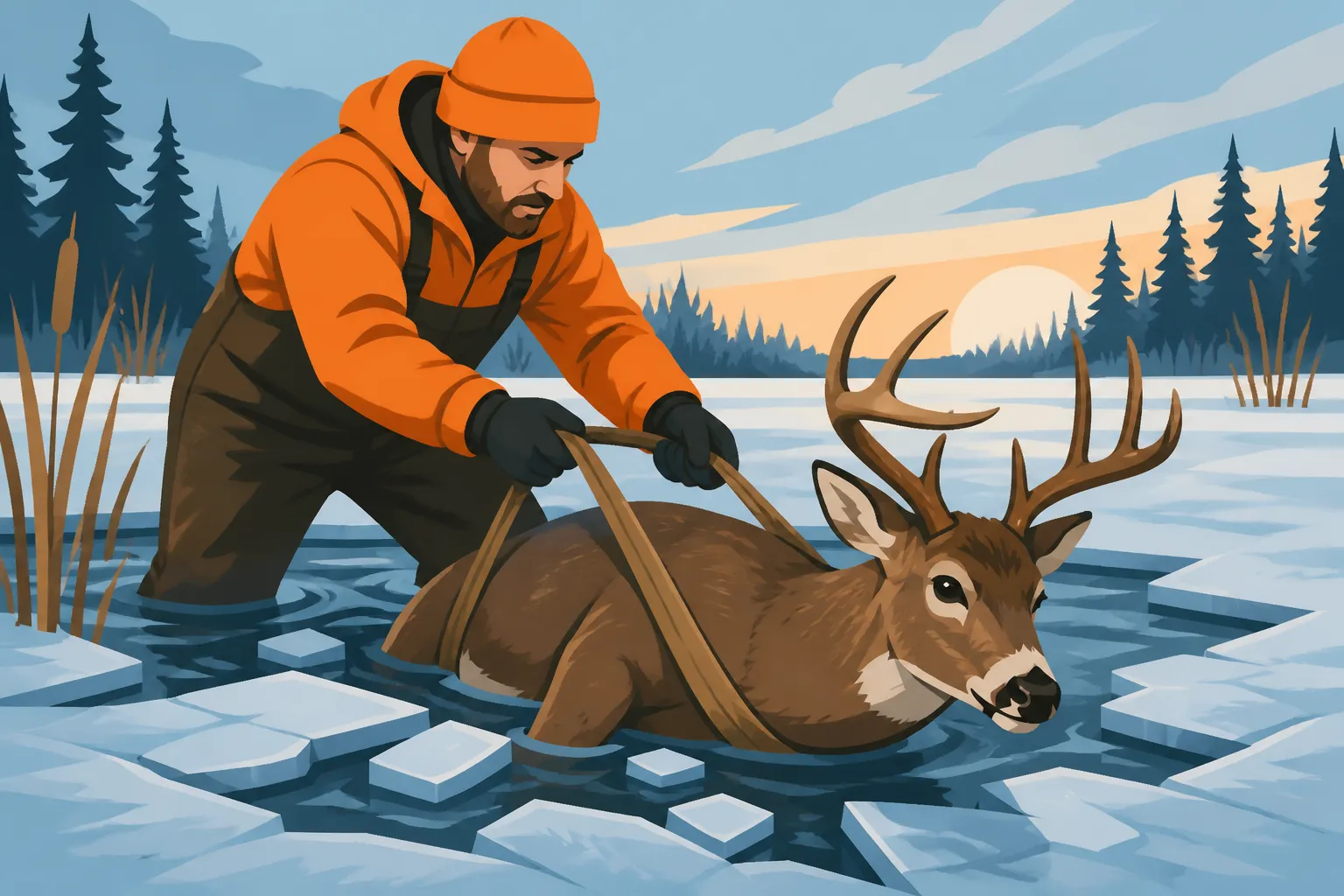
The safest approach is to reach the deer without ever putting your weight on the compromised ice. This is where those long poles and ropes become critical. If the deer is relatively close to the edge of safe ice, you might be able to use a gaff hook, an extendable boat hook, or even a sturdy branch to snag an antler or a leg. Once secured, slowly and steadily begin to pull.
For deer further out, you might need to get creative. Consider using multiple ropes. Secure one rope around an antler or leg if reachable, and use another to help guide and pull. If the ice is broken enough that you can clear a path, a small, inflatable boat like a pack raft (if you happen to have one) can be used to paddle out to the deer. This is a very niche solution but can be effective if conditions align. Remember, you're not trying to get on the ice with the boat, but rather using it to navigate the open water where the ice has broken.
Another technique for retrieving a deer from broken ice or slush, if it's not too far out, involves anchoring a heavy rope to a solid object on shore (like a tree). Then, with a long pole, try to lasso an antler or leg. Once secured, use the mechanical advantage of the rope and another person to slowly pull the deer towards you. This is a painstaking process, but it minimizes personal risk.
| Tool | Description | Best Use | Safety Note |
|---|---|---|---|
| Ropes | Long, strong nylon or poly ropes (50-100 ft). | Pulling, securing, rescue line. | Always have a safety line to shore. |
| Spud Bar | Heavy steel bar for testing ice thickness. | Approaching ice edges, breaking thin ice from a distance. | Test often, never assume. |
| Ice Picks | Handheld picks with wrist lanyards. | Self-rescue if you fall through. | Wear around neck, accessible. |
| Life Vest | PFD worn over outer clothing. | Keeps you afloat if you fall in. | Non-negotiable safety gear. |
| Long Pole / Gaff | Extendable or fixed pole with a hook. | Reaching deer from a safe distance, snagging antlers/legs. | Ensure it's strong enough for the weight. |
| Game Sled | Durable plastic sled (e.g., Jet Sled). | Dragging deer once on solid ground; distributing weight on marginal ice. | Can be used as a platform for crawling, but still risky on thin ice. |
| Come-Along | Hand-operated winch with a cable. | Mechanical advantage for heavy pulls from stuck positions. | Anchor securely to a tree or other fixed object. |
Mechanical Advantage and Specialized Gear
A full-grown Minnesota whitetail, especially a mature buck, is a heavy animal. Even if you can reach it with a rope, pulling it out of the sucking slush and broken ice can be incredibly difficult, if not impossible, without some mechanical advantage. This is where tools like a come-along or a small block and tackle system shine. Anchor one end securely to a sturdy tree or vehicle on solid ground, attach the other to the deer, and slowly winch it towards you. This minimizes strain on your body and reduces the need for multiple people to be in close proximity to the unstable ice.
If the deer is truly mired in a hole in the ice, it might be necessary to carefully break more ice around it to free it up. This should only be done from a safe distance, using a spud bar or a long ice chisel. This is a slow, methodical process, but chipping away at the ice surrounding the deer can loosen its hold and make extraction easier. For gear specifically designed to move game in tough conditions, including various drags and sleds, or even specialized winches, you can often find reviews and recommendations on platforms dedicated to hunting, such as GoHunt, which frequently highlights practical tools for serious hunters facing unique challenges.
Once the deer is on solid ground, even if it's just the edge of the slough, the job isn't over. Dragging a cold, heavy deer, especially if it's soaked, is a major undertaking. This is where a purpose-built game sled, like those discussed in Sleds and Drags for Snow Country, truly proves its worth. Rig your ropes to pull from multiple points on the sled or the deer to distribute the weight evenly and avoid damaging the deer's neck or legs. After the monumental effort of retrieval, remember to carefully Field Dressing a Deer in Cold Weather to preserve the meat effectively.
When All Else Fails: Ethical and Legal Considerations
Despite your best efforts and all the safety precautions, there are times when recovering a deer from a frozen slough simply isn't safe or possible. This is a crushing reality for any hunter, but understanding the ethical and legal implications is crucial.
Reporting to the DNR and Abandoning the Deer
It's a gut-wrenching decision to leave a deer you've successfully harvested behind, but your life is worth infinitely more than any animal. If, after a thorough assessment and careful attempts, you determine that retrieval cannot be done safely, you must prioritize your own well-being and the safety of your hunting partners.
Legally and ethically, you should immediately contact the Minnesota Department of Natural Resources (DNR) to report the situation. Be prepared to provide the exact location of the deer, explain why you couldn't recover it, and let them know if you tagged the animal. This is important for several reasons: it prevents potential legal issues if someone else finds a tagged deer you've left, and it allows the DNR to be aware of the situation. While they generally do not have the resources to retrieve every deer lost in such circumstances, reporting it is a critical part of responsible hunting. Abandoning a tagged deer without reporting it can lead to legal penalties, so honesty and transparency with the DNR are always the best policy. It's a tough call, but it's the right one.
The Emotional Toll and Learning from the Experience
The disappointment of losing a deer you've worked hard for, especially after a successful shot, can be profound. It's okay to feel that frustration, sadness, and even anger. Hunters dedicate significant time, effort, and resources to their passion, and to have a hunt end this way is truly devastating. Acknowledge those feelings, but remember that you made the safest choice under difficult circumstances.
Use this experience as a valuable, albeit painful, lesson for future hunts. When Muzzleloader Tactics in December Cold or other late-season hunts are on the agenda, consider shot placement even more carefully, especially when hunting near or over water. Could you have waited for the deer to move to a safer, more accessible location? Could you have scouted the area better beforehand? Perhaps a more thorough review of aerial photos when Reading Aerial Photos for Big Woods Deer could have revealed hidden springs or deeper sections of the slough. Going forward, spending time in the off-season, perhaps using the mapping features available on platforms like GoHunt, to identify the most dangerous or unstable sections of sloughs you hunt, can help you make more informed decisions when the season rolls around. It's all part of becoming a more experienced and responsible hunter.
Ultimately, knowing your limits and being prepared for the worst-case scenario is as much a part of ethical hunting as making a clean kill. Sometimes, the bravest decision is to walk away when the risk becomes too great.
Disclaimer
The information provided in this guide is for informational purposes only and is not a substitute for professional advice or hands-on safety training. Hunting can be a dangerous activity. Always prioritize safety, adhere to all local, state, and federal hunting regulations, and consider the potential risks involved. The author and publisher are not responsible for any accidents, injuries, or legal issues that may arise from using the information presented here.