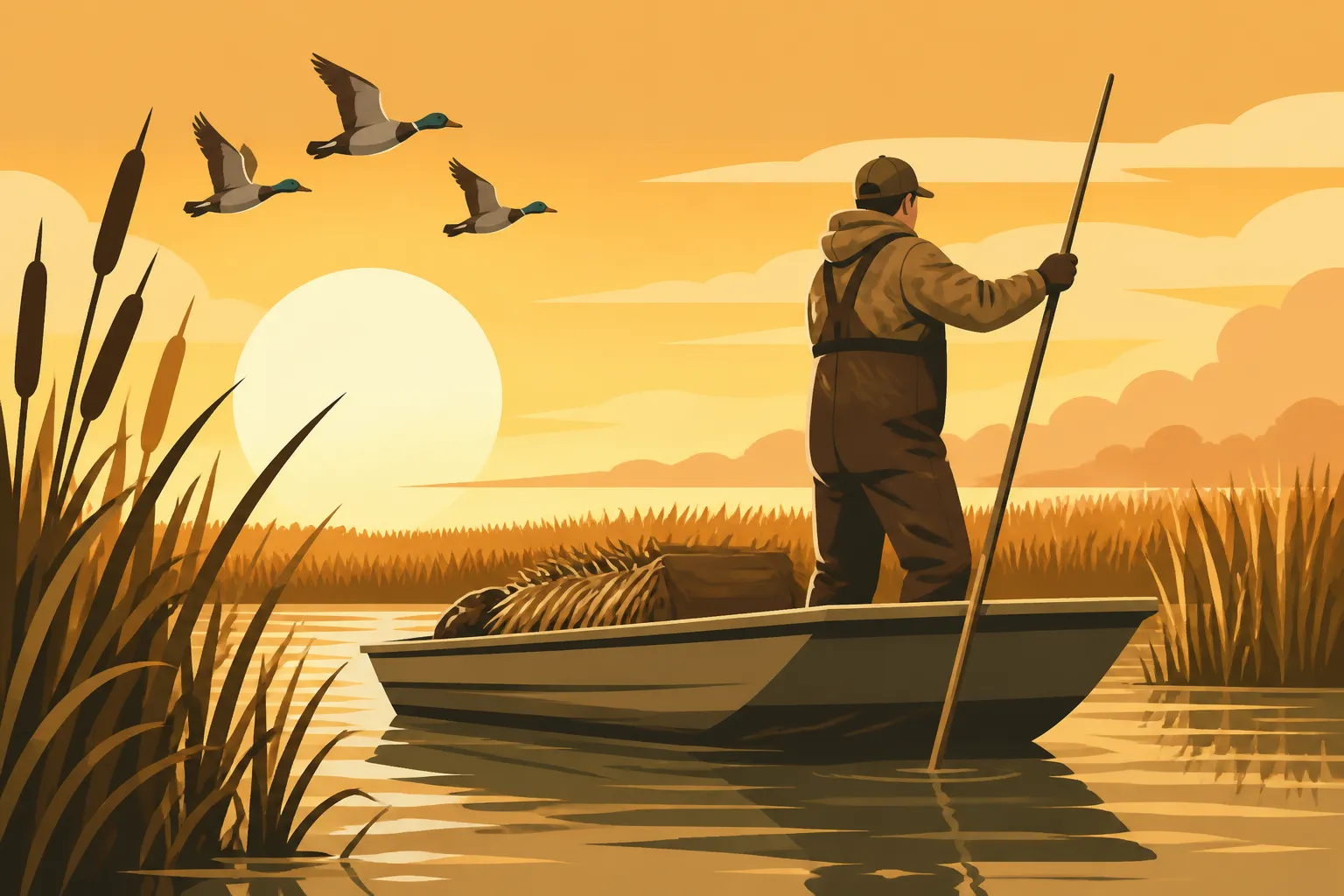
Marsh Boats and Push Poles
Trying to access those hidden pockets of prime waterfowl habitat in Minnesota's vast marshes and cattail sloughs can be a real headache. You know the spot – that untouched backwater, that quiet corner of a WMA, or that narrow channel through a sea of reeds that always seems to hold birds. But getting there? That's the challenge. Wading is often too deep, too muddy, or too noisy, and traditional boats just can't hack the shallow, weed-choked conditions. This guide is all about equipping you with the knowledge to navigate these tricky waters silently and effectively using marsh boats and push poles, opening up a whole new world of hunting opportunities.
Why Traditional Methods Fall Short in Minnesota's Waterfowl Heavens
We’ve all been there, standing on the edge of a promising marsh, looking out at acres of seemingly impenetrable cover, wondering how to reach those untouched spots. The reality of Minnesota's diverse wetlands, from the intricate channels of the Mississippi River backwaters to the dense expanses of our prairie potholes, is that they demand specialized access. Relying on standard hunting methods often leads to frustration, spooked birds, or simply being left on the bank.
The Limitations of Wading and Waders
While a good pair of chest waders is indispensable for many waterfowl scenarios, there comes a point where even the best waders simply aren't enough. Picture yourself trying to traverse a deep, mucky cattail slough in early November. One minute you're ankle-deep, the next you're waist-deep in cold water, sinking into the kind of silty bottom that threatens to pull your boots right off. The physical exertion alone can drain your energy long before you reach your desired spot, not to mention the very real risk of falling or getting stuck, especially when carrying decoys and a shotgun.
Beyond the physical challenge, wading through thick vegetation can be incredibly noisy. Every step through the submerged growth creates a disturbance, sending ripples and vibrations through the water, alerting ducks and geese to your presence long before you're in position. This is particularly true in still, calm conditions where sound travels far. Furthermore, some of Minnesota's wetlands have unpredictable depths, hidden stump fields, or old fence lines submerged beneath the surface, posing serious tripping hazards that wading simply cannot mitigate safely. It's a method best suited for shallower, more open water, not the deep, labyrinthine marshes that hold the most undisturbed birds.
Motorized Boats and Shallow Water Challenges
On the other end of the spectrum, many hunters rely on motorized boats to access their spots. While excellent for open water, crossing larger lakes, or running rivers, traditional outboards and even many mud motors quickly run into trouble in the true marsh environment. Regulations are a primary concern; many Wildlife Management Areas (WMAs) or federal refuges in Minnesota have restrictions or outright bans on motorized access in certain areas, particularly those managed for wildlife sanctuary or sensitive habitat. You might find yourself having to park your boat far from your intended hunting zone, leaving you with the same wading problem you started with.
Even where allowed, the mechanics of a propeller meeting thick vegetation are less than ideal. Cattails, wild rice, lily pads, and submerged timber can quickly foul a prop, leading to frustrating stops, damaged equipment, and the loud, disruptive sound of a struggling engine. The noise alone can clear out an entire section of marsh. Beyond that, the sheer bulk and draft of many motorized boats make navigating narrow channels or extremely shallow pockets an impossibility. You need something that glides silently over inches of water, not something that churns and pushes. This is where the marsh boat, combined with the silent power of a push pole, truly shines, offering an elegant solution to these common access dilemmas.
The Marsh Boat Advantage: Silent Access and Stability
When you’re staring out at a vast expanse of Minnesota cattails and know there are ducks hiding deep within, a specialized marsh boat is your ticket to getting there without making a ruckus. These aren't your typical duck boats designed for big water; they're purpose-built for silent, shallow-water navigation, giving you an unparalleled advantage in accessing those untouched honey holes. The stability they offer also means you can often shoot from the boat, a crucial advantage when you're tucked into thick cover.
Types of Marsh Boats for Minnesota Hunters
Choosing the right marsh boat really comes down to how you plan to hunt and the specific conditions you'll face. Each type has its own strengths, and understanding them will help you pick the best partner for your Minnesota adventures.
| Boat Type | Primary Advantage | Key Features | Ideal Minnesota Use | Considerations |
|---|---|---|---|---|
| Layout/Sneak Boat | Ultimate Concealment, Low Profile | Extremely shallow draft, often camouflaged, stable | Open water pockets, hidden channels, field edges for geese | Limited gear capacity, can be slow to pole |
| Pirogue/Skiff | Excellent for Poling/Paddling, Maneuverable | Narrow, lightweight, pointed bow/stern, low sides | Dense cattail beds, reed expanses, winding sloughs | Can be less stable than wider boats, lower capacity |
| Small Jon Boat | Versatile, Higher Capacity | Flat bottom, wide beam, durable, can accept small motor | Initial access with motor, then poling in shallows | Heavier, higher profile, less stealthy than others |
Layout Boats/Sneak Boats
These boats are the epitome of stealth. Their low profile makes them incredibly difficult for birds to spot, especially when brushed in with natural vegetation. Imagine hugging a subtle bend in a winding channel, completely invisible as ducks cup their wings into your decoys. Many are designed to be extremely stable, allowing you to comfortably sit up and shoot when the birds commit. While some are meant for lying down in open water, others are more like a small, low kayak or canoe designed to be paddled or poled into position, then concealed. They excel in spots where you can tuck into a slight depression or behind a small island, blending seamlessly into the environment. They might not carry a huge amount of gear, but for a minimalist approach to breaking into untapped pockets, they are hard to beat. Layout Blind Hunting Minnesota Farm Fields can give you some ideas on how to maximize concealment, even if it's a different setup.
Pirogues/Skiffs
If you envision yourself silently threading your way through dense cattails and reeds, a pirogue or a similar narrow skiff is likely your best friend. Originating from the bayous, these boats are designed for exceptional maneuverability and efficient poling through thick cover and shallow water. Their narrow beam and pointed ends allow them to slice through vegetation that would stop a wider boat dead in its tracks. They're typically lightweight, making them easier to transport to remote launch points and less fatiguing to pole over long distances. While not as inherently stable as a wider jon boat, a good pirogue offers enough stability for a hunter to pole effectively and shoot from a kneeling or seated position. They're perfect for navigating the winding, shallow sloughs and backwater channels found across Minnesota's hunting landscape, providing quiet access to areas that rarely see human pressure.
Jon Boats (modified for poling)
While often associated with small outboards, a smaller, lighter jon boat can be a surprisingly effective marsh tool when specifically set up for poling. Their flat bottom and wide beam provide excellent stability and an incredibly shallow draft, allowing them to glide over very little water. The key here is "smaller" and "lighter" – we're not talking about a 16-footer with a 25HP motor. Think more along the lines of a 10-12 foot aluminum model, perhaps even fitted with a low-horsepower mud motor for initial access across slightly deeper sections, before switching entirely to the push pole for silent infiltration. Their open design means they can carry a substantial amount of decoys, gear, and even a retriever, making them a versatile choice for hunters who need to haul a bit more equipment into their hidden spots. They may not be as sleek as a pirogue, but their workhorse nature and stability make them a solid option for many Minnesota waterfowl hunters.
Essential Features for a Minnesota Marsh Boat
No matter which style you lean towards, a good marsh boat for Minnesota hunting needs to tick a few critical boxes to ensure it performs when you need it most. These features are born from the demanding environment of our wetlands.
Durability and Material
A marsh boat leads a rough life. It’s going to encounter submerged stumps, unseen ice formations in late season, rocky edges, and countless brushes with dense vegetation. Therefore, the material needs to be lightweight enough for transport and poling, but incredibly tough. Rotomolded plastic boats are gaining popularity for their exceptional durability and seamless construction, shrugging off impacts that might dent aluminum or crack fiberglass. Fiberglass, while often lighter and stiffer, requires a bit more care. Aluminum is a classic choice, known for its ruggedness and ease of repair, though it can be noisier if you accidentally bump it. The bottom line is, invest in a boat that can take a beating and keep floating, because Minnesota marshes aren't gentle.
Shallow Draft
This is non-negotiable for a true marsh boat. The whole point is to access water that other boats can't. A shallow draft means the boat sits high on the water, requiring minimal depth to float and move. This allows you to glide over submerged logs, thick weed beds, and barely-wet mud flats, rather than getting stuck or plowing through. Look for flat-bottomed designs or those specifically engineered to minimize their footprint in the water. The ability to navigate inches of water can be the difference between reaching a pristine hunting spot and being stuck in the access channel watching birds fly over you.
Stability
Once you get to your spot, you need to be able to hunt effectively and safely. Stability is key for everything from standing to push pole through a tricky section, to deploying a large decoy spread, to raising your gun for a shot, and retrieving a downed bird. A stable platform reduces the risk of capsizing and allows you to move freely within the boat. Wider boats generally offer more initial stability, but even narrower pirogues can be designed with excellent secondary stability. Consider how you'll be using the boat – if you plan to shoot from it regularly, a very stable platform is paramount. This can make all the difference when you're bundled in cold-weather gear, trying to quickly pivot for a flock of mallards buzzing the decoys.
Capacity
While marsh boats prioritize shallow access, they still need to be practical. Think about what you typically bring on a waterfowl hunt: your shotgun, a blind bag, a couple dozen decoys, maybe a cooler for lunch and drinks, and critically, your trusty retriever. The boat needs enough internal space to accommodate all your gear without feeling cramped or overladen. Overloading a shallow-draft boat can compromise its performance and stability. Consider not just the weight capacity, but also the usable floor space and secure points for tying down gear. For some of the smaller, more minimalist sneak boats, you might need to adjust your decoy count or streamline your gear, but for others, carrying a full spread for Diver Hunting on Mille Lacs or a large number of puddle duck blocks is entirely feasible.
Camouflage
Finally, once you've made your silent approach, you need to disappear. Many marsh boats come in drab, earth-toned colors like olive green, brown, or marsh tan, providing a good base. However, the best marsh boats offer surfaces or attachment points for adding natural vegetation from the immediate surroundings. Think about zip-tying cattails, reeds, or corn stalks to the boat's edges to break up its outline. Some boats are even designed with integrated brush rails or blinds that fold down for travel and pop up for hunting. The goal is to make the boat indistinguishable from its environment, allowing you to set up your Decoy Spreads for Minnesota Divers and blend in completely, waiting for the birds to commit.
Mastering the Push Pole: Technique and Selection
A marsh boat is only as good as the push pole that propels it. This seemingly simple tool is the engine of silent, shallow-water navigation, and mastering its use is an art form. Without a well-chosen pole and proper technique, your marsh boat becomes little more than a stable platform stuck in the mud. For traversing thick Minnesota sloughs or stealthily approaching a hidden pothole, the push pole is absolutely indispensable, allowing you to move where no motor can.
Choosing the Right Push Pole
Just like choosing a fishing rod for a specific type of angling, selecting the right push pole for your Minnesota marsh adventures can make a huge difference in your efficiency and enjoyment. It's not a one-size-fits-all situation.
Material
Push poles come in a few common materials, each with its own pros and cons. Fiberglass poles are probably the most popular, offering a good balance of durability, reasonable weight, and flexibility. They can absorb some shock without breaking and are generally resistant to rot and water damage. Aluminum poles are often lighter, which can be a blessing on long pushes, but they can also be prone to bending if you hit something solid or apply too much force incorrectly. They can also be noisier if they bump against the boat's hull. Traditional wooden poles, while heavy, are incredibly quiet in the water and have a natural feel, but they require more maintenance to prevent rotting and warping. Ultimately, a good quality fiberglass pole is often the sweet spot for most Minnesota marsh hunters, offering a blend of performance and longevity.
Length
The length of your push pole is absolutely crucial. Too short, and you won't be able to reach the bottom in deeper sections, leaving you floundering. Too long, and it becomes unwieldy, difficult to store in the boat, and cumbersome to maneuver. A good rule of thumb is to choose a pole that’s about 2-3 feet longer than you are tall, or long enough to comfortably push off the deepest water you expect to encounter while standing. In Minnesota's varied wetlands, where depths can change rapidly, it's often better to err on the side of slightly longer, within reason. If you're consistently hunting very shallow water, a shorter pole might be more manageable, but for areas like Hunting the Mississippi River Backwaters where channels can deepen unexpectedly, a longer pole offers more versatility.
Foot Design
The "foot" of the push pole – the end that makes contact with the bottom – is vital for effective propulsion. The most common and versatile design is the "duck foot" or "forked" end. This broad, splayed design prevents the pole from sinking too deep into soft mud or silt, giving you a solid purchase to push off from. It disperses the pressure over a wider area, much like a duck's webbed foot, hence the name. For areas with harder bottoms, like gravel or firm sand, some poles feature a spiked tip for a more positive grip, but these will sink disastrously in soft mud. For the typical soft, mucky bottoms of Minnesota's cattail sloughs and river bottoms, a robust duck foot is almost always the preferred choice.
Grip
While often overlooked, a comfortable and secure grip on your push pole is important, especially when you're pushing for extended periods in cold, wet conditions. Many poles come with a textured grip section, or you can add marine-grade grip tape or shrink tubing. This ensures that your hands don't slip, even when wet, muddy, or gloved, preventing fatigue and maintaining control. A good grip means you can apply consistent pressure without having to constantly readjust your hands, making your poling more efficient and less tiring.
Push Poling Techniques for Efficiency and Stealth
A push pole is more than just a stick; it's a lever, a rudder, and an extension of your body. Mastering the subtle art of push poling will unlock silent, effortless movement through the marsh, giving you the edge you need for successful waterfowl hunting.
Stance and Balance
Maintaining a stable stance in your marsh boat is paramount. Generally, you'll want to stand with your feet spread slightly, giving you a broad base of support, and your knees slightly bent to absorb the boat's motion. If you're in a narrower pirogue, a kneeling position might offer more stability. The key is to keep your center of gravity low and centered. As you push, try to distribute your weight evenly and avoid sudden, jerky movements that can rock the boat. Think of yourself as part of the boat, moving fluidly with it. Practicing in calm, shallow water beforehand can build confidence and muscle memory.
Pushing Off
The ideal push is long, smooth, and powerful, not short and choppy. Plant the pole firmly on the bottom, lean into it with your body, and push. Extend your arms and use your body weight to propel the boat forward, letting the pole slide through your hands as you push. As the boat glides, retrieve the pole silently from the water, ready for the next push. Avoid digging the pole too deep, as this can create a sucking sound when you pull it out, which can spook birds. The goal is consistent momentum with minimal disturbance. This technique allows for stealthy, efficient progress through dense cover, much like Still-Hunting Minnesota Big Woods requires slow, deliberate movement to avoid detection.
Steering
The push pole isn't just for forward motion; it's also your primary steering mechanism. To turn, simply push off the opposite side of the boat in the direction you want to go. For example, to turn left, push off the right side of the boat. For subtle corrections, you can trail the pole lightly in the water off one side, using it as a rudder. In very tight quarters, you might use short, quick pushes from alternating sides. The beauty of the push pole is its precision, allowing you to navigate winding channels or skirt around obstacles with minimal splash or noise.
Navigating Vegetation
Minnesota's marshes are often choked with dense vegetation like cattails, wild rice, and submerged weeds. These are exactly the places ducks want to be, and exactly where a push pole excels. When pushing through thick cover, don't try to power through violently. Instead, aim for channels where the vegetation might be slightly sparser, or use a steady, firm pressure to part the weeds. Sometimes, it helps to keep the pole slightly angled to one side, using its shaft to help push the vegetation aside as the boat glides forward. For navigating exceptionally dense Hunting Minnesota Cattail Sloughs for Deer, remember that patience and consistent, smooth effort will get you through more effectively than brute force.
Silent Movement
This is perhaps the most critical aspect of push poling. The entire purpose is stealth. Every action must be deliberate and quiet. Avoid letting the pole clatter against the boat. When retrieving the pole from the water, do so smoothly to minimize splash. Even your own movements within the boat should be muffled – wear soft-soled boots and avoid dropping gear. Before you push, take a moment to survey your surroundings, listening for bird chatter and watching for movement. Sometimes, pausing your push and letting the boat glide for a bit can give you a better feel for your surroundings and allow you to cover ground with even less disturbance. For identifying subtle depth changes or hidden channels that might make for easier poling, a robust mapping app like GoHunt can be invaluable, helping you plot the most efficient and quiet route through the marsh.
Integrating Marsh Boats and Push Poles into Your Hunt Strategy
Having the right gear is one thing, but knowing how to integrate it into a comprehensive hunt strategy is where the true success lies. Marsh boats and push poles aren't just tools; they're enablers that unlock new possibilities for waterfowl hunting in Minnesota. From meticulous scouting to deploying decoys and ensuring safety, every aspect of your hunt benefits from their strategic use.
Scouting and Planning for Marsh Boat Hunts
Effective scouting is the foundation of any successful hunt, and it takes on an even greater importance when you're planning a marsh boat excursion. You're not just looking for birds; you're looking for navigable water, suitable cover, and safe access.
Using modern mapping tools, like those offered by GoHunt, is absolutely essential. Before you even set foot (or boat) in the marsh, pour over aerial photos and topographical maps. Look for subtle changes in vegetation that might indicate deeper channels, open pockets within dense cattails, or slightly elevated humps where you could set up. Pay attention to water flow patterns, especially in river systems like the Mississippi or its tributaries, as these can create natural access routes and dictate where ducks might congregate. Think about how the water levels might change, considering recent rainfall or lack thereof. What looks like a viable channel today might be a mud flat next week. This detailed planning can help you visualize your entry and exit routes, identify potential blind locations, and minimize the guesswork on hunting day. Much like Reading Aerial Photos for Big Woods Deer helps locate subtle terrain features, applying this to the marsh means looking for aquatic features that define movement and resting areas for waterfowl.
Decoy Spreads and Concealment from a Marsh Boat
Once you've silently poled your way into a prime location, your next challenge is to set up an effective decoy spread and disappear. The low profile of many marsh boats is a huge advantage here, allowing you to set up directly in or alongside dense cover without a towering blind.
When deploying decoys from a marsh boat, consider the wind direction and how the birds will approach. If you're tucked into a secluded pocket, a simple U-shape or J-hook spread can often be very effective, guiding birds directly into your shooting lane. You'll likely be deploying fewer decoys than you would in open water, so focus on quality and realistic movement. Once the decoys are out, the priority shifts to concealment. Use local vegetation – cattails, phragmites, or other marsh grasses – to completely break up the outline of your boat. Weave them into any existing blind loops or simply tuck them around the boat's edges. For even better concealment, you can augment your boat's camo with a small piece of camo netting to cover any gaps. The goal is to make your boat look like just another clump of vegetation, allowing birds to finish confidently over your spread. Learning to brush in a blind, similar to tactics in Brushing In a Blind on a Field Edge, can be adapted for marsh boat concealment, ensuring you're invisible to wary birds.
Safety Considerations on the Water
Hunting in Minnesota's marshes, especially from a small boat, comes with inherent risks. Cold water, unpredictable weather, and remote locations demand a proactive approach to safety. Your marsh boat is your lifeline, and responsible use is paramount.
Always, always wear a Personal Flotation Device (PFD). This isn't just a recommendation; it's a non-negotiable rule. Even if you're a strong swimmer, heavy hunting clothes and icy water can quickly lead to hypothermia and incapacitation. Inform someone of your hunting plans, including your exact location and expected return time. Carry essential safety gear: a whistle for signaling, a sharp knife, a first-aid kit, and a dry bag containing your phone, keys, and any other electronics. Be acutely aware of weather forecasts; strong winds can quickly turn a calm marsh into a hazardous expanse of whitecaps, making poling extremely difficult and creating dangerous conditions for small boats. Hunting with a partner, if possible, provides an extra layer of safety, offering assistance in case of an emergency. Understanding the limits of your boat and your own physical endurance, particularly in the biting cold of a Minnesota late season, is vital. Remember that while Minnesota Blaze Orange Requirements are important for land-based hunting safety, in a marsh boat, camouflage takes precedence, but your PFD should always be bright or contrasting for visibility in an emergency. Being prepared for the unexpected is just as important as being prepared for the shot itself.
Disclaimer
This article is for general informational purposes only and does not constitute professional advice. Laws, prices and regulations vary by location and change over time. Consult a qualified professional for guidance on your specific situation.