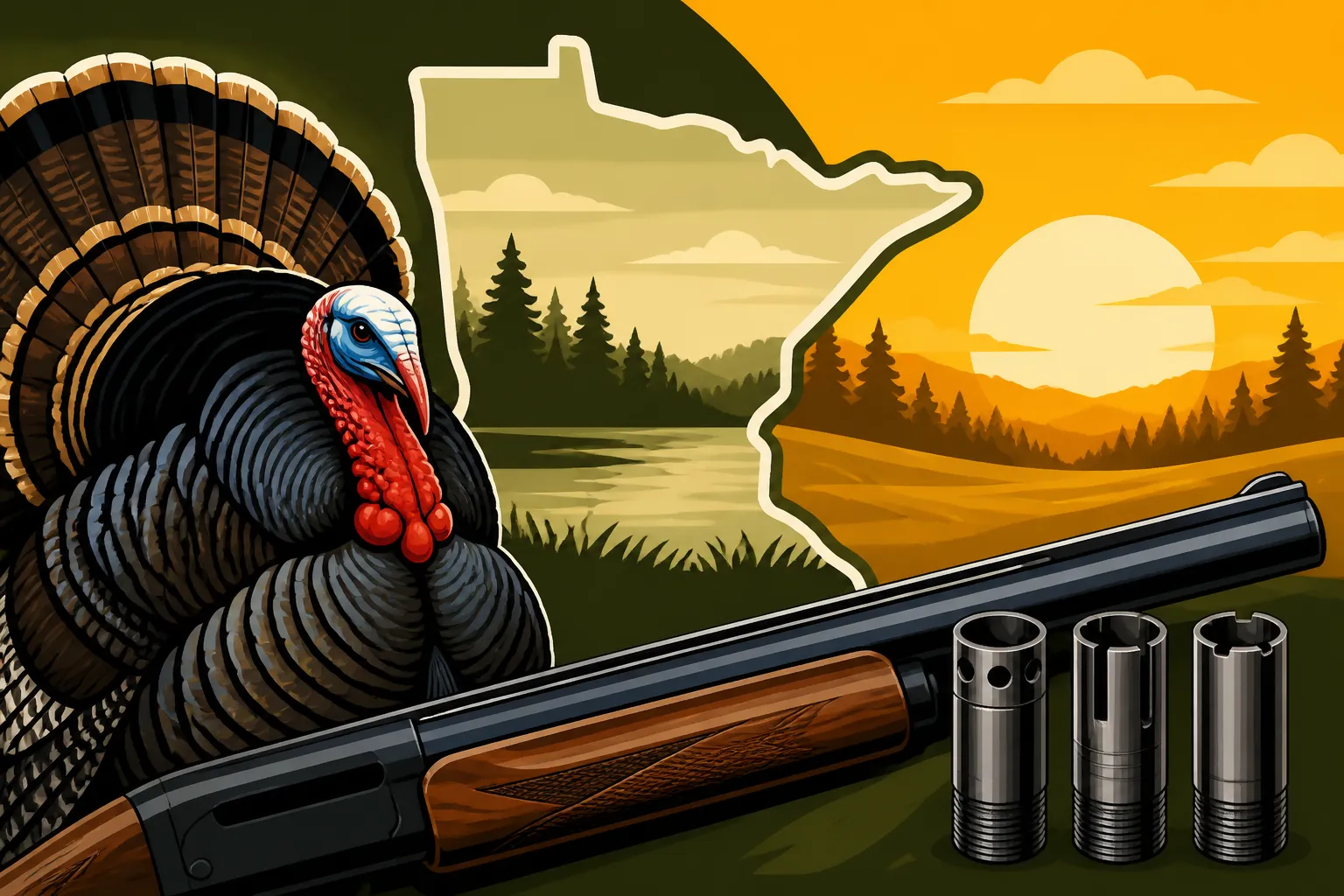
Turkey Shotguns and Chokes
For many Minnesota turkey hunters, the spring woods can be a place of immense anticipation mixed with a dash of frustration. You've done your scouting, practiced your calls, and put in the time, only to be left wondering if your gear is truly optimized for those crucial moments when a gobbler finally steps into range. This guide is here to dive deep into the world of turkey shotguns and chokes, helping you understand how to assemble a rig that gives you the confidence to seal the deal on that longbeard.
Understanding Your Turkey Shotgun's Foundation
Before we even talk about chokes, it's essential to understand the shotgun itself. It's the platform, the canvas on which your perfect turkey pattern will be painted. Choosing the right base model, or at least understanding its capabilities, is the first step toward consistent performance in the Minnesota turkey woods.
Gauge Considerations for Minnesota Turkeys
When it comes to gauges, you'll find a few common choices among turkey hunters, each with its own advantages and disadvantages. The 12-gauge has long been the undisputed king, and for good reason. It offers the most versatility in terms of load options, allowing for the heaviest payloads of shot, which translates to dense patterns and greater range. For hunters pursuing spring gobblers in Minnesota's varied terrain, from the farmlands of the south to the big woods up north, the ability to put a large number of pellets on target is paramount. It provides that margin of error, especially when a gobbler hangs up at 40 yards instead of strolling into 20.
However, the 20-gauge has seen a significant resurgence in popularity, especially with advancements in ammunition technology. Modern 20-gauge turkey loads, particularly those utilizing heavy-shot materials, can rival or even surpass older 12-gauge lead loads in terms of pattern density and effective range. Many hunters appreciate the lighter recoil and easier handling of a 20-gauge, which can be a real plus when you're carrying your gun across miles of public land or sitting for hours in a tight ground blind. It's a fantastic option for youth hunters or those who are sensitive to recoil, and don't underestimate its lethality. If you're wondering about fitting the entire family with hunting gear, consider looking into Minnesota Hunter Safety Requirements to ensure everyone is prepared and legal.
Less common, but still viable, are gauges like the .410 bore. This super-light option has truly benefited from the latest in tungsten-super-shot (TSS) technology, transforming it from a "beginner's gun" into a legitimate turkey slayer at reasonable ranges. For the seasoned hunter seeking a challenge or for those who prioritize minimal weight and recoil above all else, a .410 loaded with TSS can be surprisingly effective. That said, it demands precise shot placement and a deep understanding of your shotgun's pattern, leaving little room for error. The key takeaway here is that while the 12-gauge is versatile, don't dismiss the smaller gauges; they truly shine with the right ammunition.
Barrel Length and Mobility in the Woods
Barrel length is another critical factor influencing how your turkey shotgun handles in real-world hunting scenarios. Most dedicated turkey shotguns feature shorter barrels, often in the 20 to 24-inch range, and there's a good reason for this. Shorter barrels are inherently more maneuverable, which is a huge advantage when you're trying to pivot and get on a gobbler that comes in from an unexpected direction, or when you're tucked into thick brush or a pop-up blind. Imagine trying to swing a 28-inch duck gun in a cramped ground blind; it's just not ideal. The ability to quickly and quietly get your gun on target without snagging on branches or bumping the blind walls can make or break a shot opportunity.
While longer barrels traditionally offer a slight increase in muzzle velocity, for the ranges at which you'll be shooting turkeys, this difference is negligible. What matters far more is the quality of your pattern, which is primarily a function of choke and ammunition, not barrel length. The perceived accuracy benefit of a longer sight radius is also largely offset by modern sighting systems like red dot scopes, which we'll discuss later. A shorter barrel also generally results in a lighter overall gun, reducing fatigue during long treks through Minnesota's vast public lands. If you're covering a lot of ground in areas like state forests or Wildlife Management Areas, every ounce counts. Finding good public access can be challenging, but resources like GoHunt can provide detailed maps and overlays that help you identify state and federal land, aiding in your pre-season scouting and planning your approach.
However, a trade-off with shorter barrels can be increased muzzle blast and sometimes a slightly snappier recoil. If you're sensitive to these, a slightly longer barrel around 26 inches might offer a bit more comfort without sacrificing too much maneuverability. Ultimately, the sweet spot for most turkey hunters balances portability and handling with comfortable shooting. Consider the type of terrain you typically hunt—are you primarily in open fields, tight timber, or dense cattail sloughs? Your chosen environment should heavily influence this decision.
Action Types: Pump, Semi-Auto, and Single-Shot
The action type of your shotgun dictates how it operates and reloads, and each has its own loyal following among turkey hunters. Pump-action shotguns are renowned for their rugged reliability and affordability. They are mechanical workhorses, less prone to malfunctions in dirty conditions or extreme cold, making them a favorite for hunters who prioritize simplicity and dependability. The rhythmic shuck-shuck of a pump might be music to some ears, but it can also be a dead giveaway if you need a quick follow-up shot and haven't mastered quiet cycling. While a follow-up shot isn't usually necessary for turkeys, in rare circumstances, it can be, and the ability to operate your action smoothly and silently is a skill worth practicing.
Semi-automatic shotguns offer the distinct advantage of faster follow-up shots and significantly reduced felt recoil, thanks to their gas or inertia operating systems. This can be a huge comfort during patterning sessions at the range, where you might fire dozens of heavy turkey loads. The ability to quickly put another round on target if needed can provide a sense of security, though ideally, your first shot is all it takes. Modern semi-autos are incredibly reliable, but they do require more regular cleaning than pumps to maintain optimal performance, especially with varied ammunition types. They also tend to be a bit more expensive than their pump-action counterparts.
Finally, the single-shot shotgun is the epitome of simplicity. It's lightweight, inexpensive, and forces you to make every shot count. For some, this minimalist approach is part of the challenge and tradition of turkey hunting. There's no possibility of a second shot, so your focus on patterning, range estimation, and shot placement must be absolute. While less common for dedicated turkey setups today, especially with the affordability of modern pump guns, a single-shot can certainly be an effective tool in the hands of a disciplined hunter. Regardless of the action, remember to always handle your firearm safely and be acutely aware of Minnesota Legal Shooting Hours when you're in the field.
The Critical Role of Turkey Chokes
If the shotgun is the platform, the choke tube is the artist. This small, often overlooked component at the end of your barrel is arguably the most crucial piece of gear for optimizing your turkey setup. It dictates how tightly your shot pattern holds together, directly impacting your effective range and the lethality of your payload.
Fixed Versus Aftermarket Chokes
Many shotguns come with either fixed chokes or a set of interchangeable screw-in chokes, usually ranging from Cylinder to Full. For general hunting, these are perfectly adequate. However, when it comes to turkey hunting, you'll find that an aftermarket, dedicated turkey choke is almost universally recommended, and often essential, for maximizing your pattern density. A standard "Full" choke, while good for pheasants or ducks, simply isn't designed to constrict the modern heavy turkey loads tight enough for consistent head and neck shots at extended ranges. It's like trying to drink a milkshake through a regular straw—you want a smaller opening to keep everything together.
Aftermarket turkey chokes are specifically engineered with much tighter constrictions than standard chokes, often designated as "Extra Full," "Super Full," or by a specific numerical constriction (e.g., .665 inches). They are designed to manage the unique characteristics of turkey loads, including larger shot sizes and specialized materials like tungsten. These chokes often have a longer parallel section, different internal geometries, and sometimes even porting to strip the wad more efficiently and reduce recoil and muzzle jump. While they might seem like a small investment, the difference a quality aftermarket choke makes in pattern density and uniformity at 40 yards is often astounding. When planning your hunting excursions, especially if you're targeting specific zones, understanding Minnesota Spring Turkey Zones and Periods can help you time your hunts for the best opportunities.
Understanding Choke Constriction and Patterning
The term "constriction" refers to how much smaller the bore diameter is at the muzzle compared to the barrel's actual bore. The tighter the constriction, the more the shot charge is squeezed as it exits the barrel, resulting in a denser, narrower pattern at longer distances. However, there's a delicate balance. Too much constriction can actually damage the shot, deforming pellets and creating a "blown" or uneven pattern with holes in it. This is particularly true with traditional lead shot, where extreme constriction can flatten pellets, sending them flying erratically. Modern heavy-shot materials like TSS are much harder and more forgiving of tight constrictions, which is why they perform so well with specialized turkey chokes.
The only way to truly understand what choke works best with your specific shotgun and your chosen ammunition is to pattern it. This isn't just a suggestion; it's a mandatory step for any serious turkey hunter. You'll need to shoot your setup at various distances, typically 20, 30, and 40 yards, at large paper targets with a turkey head outlined on them. The goal is to find a choke/load combination that puts enough pellets into the vitals (the head and neck) to ensure a clean, ethical kill. Many hunters aim for at least 10-15 pellets in the head and neck region at their maximum desired range. Don't be surprised if you try several different chokes or loads before finding that perfect combination. Sometimes, a slightly less constricted choke will actually produce a better pattern than the tightest one you own. Every shotgun is a law unto itself, and what works for your buddy's gun might not work for yours. For more detail on this crucial step, check out Patterning a Turkey Gun at 40 Yards.
Choke Materials and Porting
Beyond constriction, the material and design of your choke tube can also influence performance and durability. Most factory chokes are made from blued or stainless steel. Aftermarket turkey chokes, however, are often crafted from tougher alloys, sometimes with specialized coatings, designed to withstand the pressures of modern turkey loads and provide a smoother transition for the shot. These tougher materials ensure the choke stands up to repeated firing and maintains its precise internal geometry.
Some turkey chokes feature "porting," which are small holes or slots drilled into the choke near the muzzle. The primary purpose of porting is to vent gases, which can help reduce felt recoil and minimize muzzle jump. While recoil reduction is always welcome, especially when dealing with heavy turkey loads, the effect is often subtle. The main benefit, arguably, is that reduced muzzle jump can help you get back on target slightly faster for a follow-up shot if one were ever needed, or simply make the shooting experience more comfortable. However, porting can also direct noise back towards the shooter, so ear protection is absolutely non-negotiable when patterning and always recommended in the field.
A Table of Common Choke Types and Their Characteristics:
| Choke Type | Constriction | Typical Pattern | Ideal Use | Notes |
|---|---|---|---|---|
| Cylinder | None to minimal | Very open | Close range, bird shot | Spreads quickly, not for turkeys |
| Improved Cylinder | Light | Fairly open | Close-mid range, bird shot | A bit tighter, still too open for turkeys |
| Modified | Medium | Moderate | Mid-range, all-around | Good for general hunting, not turkey-specific |
| Full | Tight | Tight | Longer range, waterfowl | Best standard choke for turkeys, but often insufficient |
| Extra Full / Turkey | Very tight | Very dense, narrow | Dedicated turkey hunting | Optimal for dense patterns with modern loads |
Ammunition: The Other Half of the Equation
Your choke tube might be the artist, but the ammunition is the paint. Without the right choice of pellets and powder, even the most perfectly matched shotgun and choke won't deliver the performance you need. Modern turkey loads have revolutionized the sport, making ethical kills at longer ranges more achievable than ever before.
Lead, Tungsten, and Beyond: Load Choices
For decades, lead shot was the standard for turkey hunting. It's affordable, effective, and readily available. However, lead is a relatively soft material, and when squeezed through a tight choke, pellets can deform. This deformation leads to flyers and an overall less uniform pattern, which limits its effective range compared to harder shot types. Lead loads are still perfectly capable of anchoring a gobbler, but they generally require closer ranges (e.g., within 30-35 yards) to ensure sufficient pattern density in the head and neck. For hunters on a budget or those who stick to close shots in the timber, good quality lead turkey loads remain a solid choice.
The real game-changer in recent years has been the widespread availability of tungsten-super-shot, or TSS. This material is incredibly dense and hard, much denser than lead (often 18 grams/cc vs. 11 g/cc for lead). Its hardness means pellets resist deformation when traveling through the choke and barrel, resulting in incredibly tight, consistent patterns. The extreme density means TSS pellets carry more energy and maintain their velocity better, delivering devastating power on target. This allows for smaller pellet sizes to be used effectively, meaning you can pack significantly more pellets into a given shell, further increasing pattern density. This translates to extended effective ranges, often pushing out to 50-60 yards or even beyond for those who are confident in their patterning. The main drawback? Cost. TSS is significantly more expensive than lead, making patterning sessions a bit pricier, but many hunters feel the increased performance and confidence are well worth the investment. GoHunt often features reviews of new gear and ammunition, which can be a great resource for seeing how different loads perform in various shotguns.
Other specialized loads, like buffered lead or copper-plated lead, aim to bridge the gap between traditional lead and expensive TSS. These loads use a buffering material (like a plastic powder) around the lead pellets or a copper coating to reduce deformation, improving pattern consistency compared to plain lead. They offer a performance boost without the premium price tag of TSS and can be an excellent choice for hunters looking for something better than basic lead but not quite ready to commit to tungsten.
Shot Size and Pellet Count for Turkeys
When selecting your ammunition, shot size is a critical consideration. For traditional lead loads, common turkey shot sizes range from #4 to #6. Many experienced hunters prefer #5 or #6 lead shot because these sizes offer a good balance of pellet count and individual pellet energy. Smaller pellets mean more pellets per shell, which can create a denser pattern, while larger pellets carry more individual energy. For TSS, the density allows for much smaller shot sizes, typically #7, #8, or #9. These tiny TSS pellets are so dense that an individual #9 TSS pellet carries more energy than a #5 lead pellet, and you can fit hundreds more into a 12-gauge shell. This is why TSS is so effective; you're essentially launching a cloud of tiny, super-dense wrecking balls.
The pellet count in your shell directly influences your pattern density. More pellets generally mean a higher probability of hitting the critical head and neck region of a turkey. However, it's not just about the total number of pellets on the paper; it's about the number of effective pellets in the vital zone. A pattern that puts 150 pellets on a 10-inch circle but only 5 into the brain/spine is less effective than one that puts 40 pellets squarely where they need to be. This reinforces the importance of patterning your specific shotgun, choke, and ammunition combination. You need to know how many pellets consistently land in that crucial target area at your maximum ethical range.
Patterning Your Shotgun System
Patterning is not just a suggestion; it's an absolute necessity. You wouldn't hunt deer without sighting in your rifle, and turkeys deserve the same respect. Patterning a Turkey Gun at 40 Yards is a process that involves shooting at large paper targets at various distances with a turkey head and neck outlined. Start at 20 or 25 yards to get a sense of where your pattern is centered, then move back to 30, 35, and 40 yards (and potentially 50+ if using TSS).
The goal is two-fold: first, to ensure your pattern is centered exactly where your sights are pointing. If your pattern is consistently high, low, or off to the side, you'll need to adjust your sights (more on that later). Second, you want to evaluate the density and uniformity of your pattern, specifically within the turkey's vital zone. Count the number of pellets that land in the head and neck. You're looking for a consistent, even distribution with no significant "holes" that a turkey's head could slip through. This process allows you to determine your maximum ethical range with your particular setup. Never guess your effective range in the field; know it precisely from your patterning efforts. Different combinations of choke and ammunition can drastically alter your pattern, so test everything you plan to use. This isn't just about ethical hunting; it's about ensuring a clean kill and a successful hunt.
Setting Up for Success: Sights and Accessories
Once you've got your shotgun, choke, and ammunition dialed in, it's time to think about how you'll aim and other accessories that enhance your hunting experience. Accurate aiming is just as vital as a dense pattern.
Iron Sights, Red Dots, and Scopes
Many shotguns come with a simple front bead sight. While this can work for close-range shots, it leaves a lot to be desired for precise head and neck shots on turkeys, especially as ranges increase. Some shotguns will feature "rifle sights," which consist of an adjustable rear sight and a front blade. These offer a significant improvement over a single bead, allowing for more precise aiming and adjustments for windage and elevation.
However, the overwhelming trend among serious turkey hunters is the use of optical sights, primarily red dot sights or low-power scopes. Red dot sights project a bright reticle (usually a dot) onto a lens, allowing for quick target acquisition and aiming with both eyes open. They are parallax-free within reasonable distances, meaning the point of impact doesn't change significantly if your eye position shifts slightly. This is a huge advantage when a gobbler suddenly appears and you need to get on target fast, or if you're contorted in a tight hunting position. Red dots are robust, relatively inexpensive, and excel in low light conditions often encountered during early morning turkey hunts.
Low-power scopes (e.g., 1-4x or fixed 2.5x) offer even greater precision, especially at longer ranges. They magnify the target, allowing you to pick out the exact spot on the turkey's head and neck. This can be particularly beneficial for hunters using TSS at extended ranges. However, scopes can be slower to acquire targets at close range, can be more prone to fogging, and often require a more consistent cheek weld. Many hunters feel that for typical Minnesota turkey ranges (out to 40-50 yards), a good red dot provides the best balance of speed, precision, and durability. Whichever you choose, ensure it's properly mounted and zeroed.
Slings, Camo, and Other Essentials
Beyond the aiming system, a few other accessories can significantly improve your turkey hunting experience. A comfortable, durable sling is absolutely essential. Whether you're still-hunting slowly through the hardwoods or making a long Run-and-Gun Turkey Tactics on Public Land trek across a WMA, carrying your shotgun for hours can quickly become exhausting. A good sling distributes the weight, frees up your hands for calling or carrying gear, and allows you to move more quietly. Look for a sling that is padded, adjustable, and made from non-slip material.
Camouflage is another obvious but crucial element. While your shotgun doesn't necessarily need to be wrapped in the latest camo pattern, a matte finish (either blued, cerakoted, or taped) is always preferable to a shiny, reflective surface. Turkeys have incredible eyesight, and a glint of sunlight off a barrel can be enough to spook a wary gobbler. Many hunters opt for camo tape or paint to break up the outline of their gun and eliminate glare. Similarly, you'll want to ensure your own clothing is appropriate. Turkey Vests With a Kickstand Seat can be a great way to carry your calls, decoys, and other essentials while providing a comfortable spot to sit.
Don't forget the small but mighty items: a reliable headlamp for walking in and out in the dark, a sharp knife for field dressing, and plenty of water. Planning for the unexpected is part of being prepared, and having a small first-aid kit is always a smart idea, especially when hunting in more remote areas of Minnesota's vast public lands.
Maintaining Your Turkey Rig
Just like any piece of hunting gear, your turkey shotgun needs regular maintenance to perform reliably. This is especially true for semi-automatic actions, which can become sluggish or jam if not kept clean. After each hunt, particularly if you've been out in wet or dusty conditions, take the time to wipe down your shotgun, clean the bore, and lightly oil moving parts. Pay special attention to the choke tube; remove it periodically, clean the threads in both the choke and the barrel, and apply a thin layer of anti-seize lubricant. This prevents the choke from seizing in the barrel, a common and frustrating problem if ignored.
Before the season, perform a more thorough cleaning and inspection. Check all screws for tightness, especially on scope mounts or red dot sights. Make sure your sling swivels are secure. If you're using a semi-auto, clean the gas system or recoil spring assembly according to the manufacturer's instructions. A well-maintained shotgun is a reliable shotgun, and reliability is paramount when that gobbler finally commits. You don't want a preventable malfunction to ruin your hunt after all the effort you've put into scouting and calling. Proper care also extends the life of your firearm, protecting your investment for many seasons to come.
Minnesota-Specific Considerations for Your Setup
Hunting turkeys in Minnesota presents a unique set of challenges and opportunities. Our diverse landscapes and weather patterns mean your gear choices need to be adaptable and robust. Thinking about these local factors can help you fine-tune your setup.
Public Land Pressure and Ethical Shots
Minnesota offers a wealth of public land opportunities for turkey hunting, from sprawling state forests to smaller Wildlife Management Areas. However, public land often means hunting pressure, especially during the early periods of Spring Turkey Hunting in Minnesota. This pressure can make gobblers warier and less likely to commit to calls, often hanging up just out of comfortable range. This is where a meticulously patterned shotgun and the confidence in your maximum ethical range become critically important. Knowing your absolute limit, and sticking to it, ensures you make clean, ethical shots when the opportunity finally arises. You can't afford to take a risky shot on a pressured bird that's already on high alert.
Furthermore, with other hunters potentially in the vicinity, being absolutely sure of your target and your backdrop is paramount. Your shotgun's ability to place a dense pattern precisely where you aim reinforces good judgment. Never shoot at sound or movement; positively identify your target as a legal gobbler and ensure no other hunters or non-target animals are in your line of fire. Resources like GoHunt can help you scout public lands, identify potential bedding and feeding areas, and even understand terrain features, which can aid in finding less pressured birds and planning safe shot angles. For insights into managing those crowded conditions, take a look at Hunting Pressure on Minnesota Public Land.
Varied Terrain: Woods, Fields, and Bluffs
Minnesota's turkey habitats are incredibly diverse. You might be hunting in the rolling bluff country of Southeast Minnesota, stalking field edges in the central farm country, or trying to lure a bird out of the vast timberlands up north. Each terrain type presents different demands on your gear. In the tight hardwoods and dense brush, a shorter, more maneuverable barrel shines. The ability to quietly bring your gun to bear without snagging on branches is a huge asset.
When hunting Turkey Tactics for Farmland Field Edges, you might find yourself needing to take slightly longer shots across open fields, making a precise aiming system (like a red dot or low-power scope) invaluable. In the rugged bluff country, you'll be doing a lot of climbing and hiking, so a lighter shotgun with a comfortable sling will be greatly appreciated. Understanding the specific characteristics of your chosen hunting area will help you tailor your setup for maximum effectiveness. You might even consider different setups if you hunt vastly different regions within the state.
Weather Impact on Gear Performance
Ah, Minnesota weather. It's notoriously unpredictable, especially during spring turkey season. You could start your morning in freezing temperatures, dealing with dew and fog, only for it to warm up considerably by midday. Your shotgun and choke setup needs to be able to handle these fluctuations. Condensation can be a real problem, especially for optics. Make sure your red dot or scope is fog-proof and has good quality lens coatings. If you're using iron sights, ensure they are bright and easily acquired even in dim, foggy conditions.
Rain and snow are always possibilities, and moisture can be a silent killer of reliability. Ensure your shotgun is well-oiled and protected from the elements. A good quality gun case for transport and a simple gun sock or cover in the field can go a long way in keeping your firearm dry. If hunting in a downpour, be extra diligent about cleaning and drying your shotgun afterward to prevent rust. Cold temperatures can also affect battery life in electronic sights, so always carry a spare. Thinking ahead about the weather, whether it's Muzzleloader Tactics in December Cold or a wet spring morning, prepares you for whatever Mother Nature throws at you.
By carefully considering your shotgun, choke, and ammunition, and then pairing them with the right accessories, you can build a turkey rig that will stand up to Minnesota's diverse challenges and give you the confidence to put that longbeard down for good.
Disclaimer
This article is for general informational purposes only and does not constitute professional advice. Laws, prices and regulations vary by location and change over time. Consult a qualified professional for guidance on your specific situation.