Sabot Versus Conical for Deer
The crisp, cold air of Minnesota's muzzleloader season brings a unique challenge and a deep sense of tradition. But when you’re standing at the sporting goods counter, staring at shelves packed with different black powder projectiles, a common frustration surfaces: what in the world is the difference between a sabot and a conical, and which one is actually going to put venison in your freezer this December? This guide cuts through the confusion, helping you understand the nuances of each projectile type so you can make an informed choice for your Minnesota deer hunt.
The Core Difference: Sabots Versus Conicals
Deciding between a sabot and a conical projectile for your muzzleloader can feel like choosing between apples and oranges, but understanding their fundamental design and how they interact with your rifle's barrel is the first crucial step. Each has its own strengths and weaknesses, making them suitable for different hunting styles and equipment setups here in Minnesota.
Sabot Projectiles: Speed, Accuracy, and Modern Performance
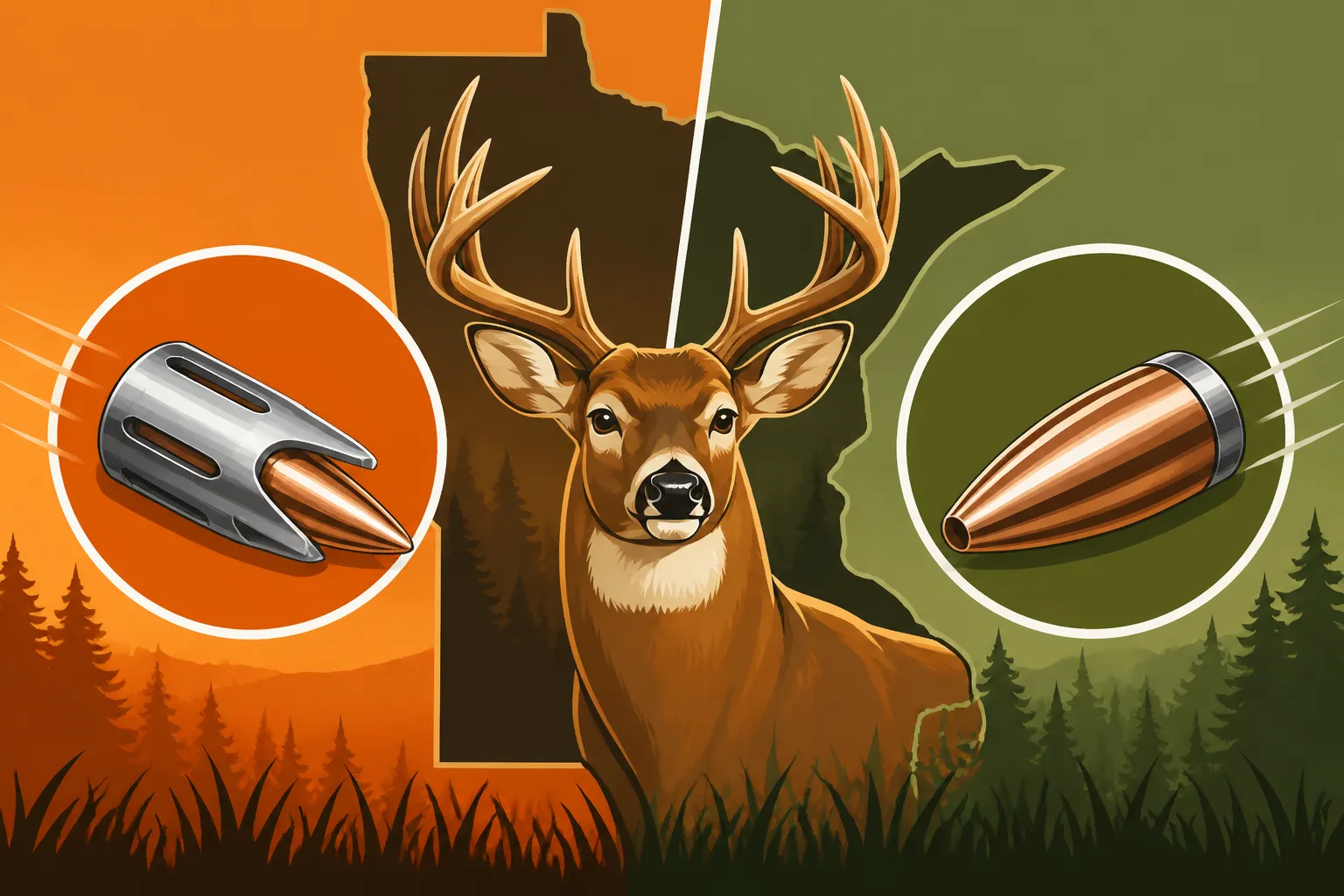
Sabots are often seen as the modern answer to muzzleloader ballistics, aiming to give you rifle-like performance from your front-stuffer. The word "sabot" itself is French for "shoe," which perfectly describes how these projectiles work. A smaller-diameter bullet, typically a .40, .44, or .45 caliber, is encased in a plastic sleeve, or "sabot," that matches the bore diameter of your muzzleloader, commonly a .50 caliber. When you fire, the plastic sabot grips the rifling, imparting spin to the bullet. Once the projectile leaves the barrel, the sabot peels away, leaving the aerodynamic bullet to continue its flight toward the target.
This design brings a host of advantages that appeal to many Minnesota deer hunters. Because the actual bullet itself is smaller and often more streamlined than a full-bore conical, it boasts a better ballistic coefficient. This means it retains velocity and energy more effectively downrange and flies a flatter trajectory. For those hunting in more open areas of Minnesota, like the edges of a sprawling cornfield or a large clear-cut, where a shot might stretch out to 100 yards or even a bit further, the flatter shooting characteristics of a sabot can be a real game-changer. Accuracy is often perceived as higher with sabots, especially when paired with a modern inline muzzleloader that has a faster twist rate in its barrel, mimicking the precision of a cartridge rifle.
However, sabots aren't without their drawbacks. The plastic sabot itself can be a source of frustration. They can be notoriously difficult to load, especially after a shot or two when the barrel starts to foul with powder residue. Imagine trying to force a tight plastic sleeve down a cold, dirty barrel on a frigid December morning in the woods—it's not always a pleasant experience. The plastic can also leave significant fouling in the rifling, requiring more diligent cleaning between shots or at least more robust swabbing. Furthermore, sabots need to be matched to your muzzleloader's twist rate and bore diameter precisely. A loose sabot won't spin correctly, leading to poor accuracy, and a too-tight one can be impossible to load.
Conical Projectiles: Simplicity, Power, and Traditional Feel
Conical projectiles represent a more traditional approach to muzzleloading. Unlike sabots, these are full-bore bullets, meaning their diameter matches the bore of your muzzleloader (e.g., a .50 caliber conical for a .50 caliber rifle). They are typically made of lead or a lead alloy and engage the rifling directly as they are loaded and fired. Think of classic "Maxi-Balls" or "PowerBelts" (though PowerBelts have a unique skirted design, they still engage the rifling directly rather than relying on a separate sabot). These projectiles are often heavier for their caliber than sabot-encased bullets.
The primary advantages of conical projectiles often center around their simplicity and hard-hitting power at closer ranges. Loading a conical, particularly a slightly undersized or softer lead one, tends to be much easier, even in a fouled or cold barrel. This can be a huge relief when your hands are numb from the Minnesota chill. For hunters who prioritize ease of loading and a quick follow-up if needed, conicals often win out. They also tend to perform well in older muzzleloaders or those with slower twist rates (like 1:48" or 1:60"), which might not stabilize a sabot effectively. Their heavier weight, even at lower velocities, can deliver a substantial punch upon impact, which can be reassuring for close-range timber hunting where breaking bone might be necessary. You can research different conical designs on platforms like GoHunt to see user experiences with various styles.
On the flip side, conicals generally have a poorer ballistic coefficient compared to sabots. This means they lose velocity and energy much faster and exhibit a more pronounced "rainbow" trajectory. While perfectly adequate for shots within 75-100 yards, pushing them much further than that often requires significant holdover and precise range estimation, making them less ideal for those longer shots across a field. Accuracy can also be more variable, and their softer lead construction can sometimes deform on impact, which might affect penetration, though modern conical designs have greatly improved in this area.
Here's a quick comparison of the two:
| Feature | Sabot Projectile | Conical Projectile |
|---|---|---|
| Description | Smaller bullet in plastic sleeve (sabot) | Full-bore, often lead, bullet |
| Loading Ease | Can be tight, harder, especially when fouled | Generally easier, even in fouled/cold barrels |
| Ballistics | Flatter trajectory, better long-range energy | More arching trajectory, drops faster |
| Accuracy (General) | Often higher, especially in modern inlines | Can be more variable, good in slower twists |
| Range Suitability | Better for 100+ yards | Best within 75-100 yards |
| Barrel Fouling | Plastic residue, can be significant | Less plastic fouling, mainly powder |
| Cost | Generally more expensive per shot | Often more affordable |
| Best For | Open terrain, modern muzzleloaders, longer shots | Dense timber, older rifles, ease of loading, close shots |
Matching Your Muzzleloader to Your Projectile
Choosing between a sabot and a conical isn't just about personal preference; it's heavily influenced by the specific muzzleloader you're shooting. Understanding your rifle's characteristics, particularly its twist rate, and how different projectiles load in varying conditions, is paramount to consistent accuracy and a frustration-free hunting experience in Minnesota.
Understanding Twist Rates and Barrel Compatibility
The "twist rate" of your muzzleloader's barrel refers to how quickly the rifling inside makes one full rotation. It's usually expressed as a ratio, like 1:28" or 1:60". A 1:28" twist means the rifling makes a complete turn in 28 inches of barrel length, while a 1:60" twist takes 60 inches. This twist rate is designed to stabilize the projectile as it travels down the barrel, much like a quarterback spins a football. Without proper spin, a bullet will wobble and tumble, resulting in abysmal accuracy.
Generally speaking, modern inline muzzleloaders often feature faster twist rates, typically in the 1:28" to 1:32" range. These faster twists are specifically engineered to stabilize the shorter, more aerodynamic, and often lighter bullets found in sabot designs. If you have a modern inline, especially one with a scope mounted on it, it's highly likely it will shoot sabots very well, allowing you to maximize their inherent ballistic advantages for potential longer shots in open country. Trying to shoot a heavy, full-bore conical out of a fast-twist barrel might lead to over-stabilization, which can actually degrade accuracy in some cases, or simply not yield the best performance.
Conversely, many traditional percussion or flintlock muzzleloaders, and even some older inline models, were designed with slower twist rates, often in the 1:48" to 1:66" range. These slower twists are ideal for stabilizing longer, heavier, full-bore conical projectiles like Maxi-Balls. The longer length of a conical requires less spin to remain stable, and a slower twist rate is perfect for this. Trying to push a light, short sabot bullet through a slow-twist barrel often results in poor accuracy because the bullet isn't being spun fast enough to stabilize properly. Before you even buy a box of projectiles, check your muzzleloader's manual or look for markings on the barrel to determine its twist rate. This single piece of information will often narrow down your choices significantly.
Loading and Fouling Considerations in the Field
Beyond twist rates, the practical act of loading your muzzleloader in cold, potentially stressful hunting conditions cannot be overstated. Anyone who has hunted Minnesota's late muzzleloader season in December knows that frigid temperatures can make handling small components and manipulating a ramrod a genuine challenge. Muzzleloader Tactics in December Cold often depend on efficient handling.
Sabots, by their very nature, create a tight seal in the barrel to ensure proper rifling engagement and gas sealing. This tight fit, while great for accuracy, can become a significant hurdle in the field. After just one shot, the residue from burning black powder or a black powder substitute begins to coat the rifling. Trying to force a snug sabot down a fouled, cold barrel can be incredibly difficult, sometimes even impossible without considerable effort and a cleaning swab. This can be a critical disadvantage if you need a quick follow-up shot or if you simply want to reload efficiently after a missed opportunity. Many hunters who opt for sabots carry a small cleaning jag and solvent-soaked patches to swab the barrel between shots, even when hunting, to maintain consistent loading pressure.
Conicals, on the other hand, often offer a more forgiving loading experience. Because they are typically softer lead and engage the rifling directly, they tend to slide down the barrel with less resistance, even if there's some fouling. While you still want to keep your barrel as clean as possible for best accuracy, a conical will often load more easily through a "seasoned" (lightly fouled) barrel than a tight sabot. This ease of loading can be a significant comfort when you're bundled up in layers, battling the elements, and trying to remain focused on the hunt. For hunters who prioritize simple, reliable loading under less-than-ideal conditions, conicals often shine. Remembering that Keeping a Muzzleloader Dry in Lake-Effect Snow is just as important as the projectile choice itself will also save you headaches.
Real-World Performance for Minnesota Deer Hunters
Once you understand the basic mechanics of sabots and conicals, the next step is to consider how they perform where it truly matters: in the diverse hunting environments of Minnesota and on the deer themselves. Our state offers everything from dense northern timber to expansive southern farmlands, and your projectile choice should reflect the realities of your hunting ground and your shot expectations.
Ballistics and Range for Diverse Minnesota Terrain
Minnesota's landscape demands versatility from its hunters. A deer hunt in the vast, thick woods of the 100 series permit areas might involve a shot under 50 yards, almost point-blank. Meanwhile, a hunt on the edge of a standing cornfield in southern Minnesota could present a shot out to 120 or 150 yards. This is where the ballistic differences between sabots and conicals truly come into play.
Sabots, with their smaller, more aerodynamic bullets, generally offer a much flatter trajectory and retain more energy at extended ranges. If your hunting setup, like a modern inline with a quality scope, allows for accurate shooting out to 150 yards, a good sabot load can significantly extend your effective range. This can be particularly beneficial if you hunt open areas where deer might not present themselves within traditional muzzleloader distances. They buck the wind better and require less "hold over" compensation, simplifying the shot. When planning a hunt with a longer shot potential, you can use resources like GoHunt to research ballistic tables for various sabot loads and see how they compare to the terrain you'll be covering. Knowing your limits and the projectile's capabilities is key.
Conicals, while powerful at close range, exhibit a more pronounced parabolic trajectory. Their heavier, less aerodynamic design means they shed velocity and drop significantly faster beyond 75-100 yards. This isn't a flaw if you're hunting dense cover where shots are almost always under 75 yards. In fact, for such scenarios, the simplicity and knockdown power can be an advantage. However, if you attempt a 120-yard shot with a conical zeroed at 50 yards, you'll need a substantial amount of holdover, and any misjudgment in range can lead to a missed shot or, worse, a wounded animal. Understanding your specific hunting area – whether it's tight woods, a swamp edge, or a vast agricultural field – should heavily influence whether the flatter-shooting sabot or the close-range power of a conical is more appropriate. Many hunters will be concerned about Minnesota Muzzleloader Season Dates which are often in colder, late-season conditions, where deer might be found in open food sources, pushing the range limits.
Terminal Performance: Impact and Ethical Harvest
Ultimately, the goal is a clean, ethical harvest. Both sabots and conicals, when properly chosen and placed, are highly effective on Minnesota whitetails. The difference lies in how they achieve that effectiveness.
Sabot-encased bullets are often designed to perform much like modern rifle bullets, with controlled expansion. Many feature polymer tips, bonded cores, or other technologies to ensure good mushrooming upon impact, creating a larger wound channel and transferring energy efficiently to vital organs. Because they typically retain more velocity at range, they can also maintain reliable expansion even after a longer flight. This controlled expansion is critical for rapid, humane kills, ensuring the bullet does its job inside the animal.
Conical projectiles, especially those made of softer lead, tend to transfer their energy differently. Their heavier mass and often larger frontal area can create a significant shockwave and tear upon impact. While they might not "mushroom" in the same way a high-tech sabot bullet does, the sheer momentum and weight of a conical can be devastating, especially at close range. They are particularly effective at breaking bone, which can be a huge advantage if a shoulder shot is presented in thick cover. Some newer conical designs feature hollow points or soft tips to encourage expansion, blending some of the benefits of sabots with the traditional advantages of conicals. Regardless of which you choose, consistent shot placement, aiming for the vitals, is always the most critical factor. Remember, you can't blame the projectile if you don't do your part. Muzzleloader Deer Hunting in Minnesota demands responsible hunting.
Making the Choice and Field-Testing for Success
The decision between sabots and conicals isn't one-size-fits-all. It's a personal choice influenced by your gear, your hunting style, and the terrain you're hunting in. But once you've considered the variables, the most critical step remains: getting to the range and seeing what truly works for your muzzleloader.
Factors Guiding Your Decision
When standing in the gun shop aisle or browsing online, here's a mental checklist to run through, thinking about your specific Minnesota hunting plans:
- Your Muzzleloader's Twist Rate: This is arguably the most important factor. If you have a fast-twist (1:28" to 1:32") inline, sabots are likely to be your best bet for accuracy. If you have a slower twist (1:48" or slower) or a more traditional rifle, conicals will probably perform better. Don't fight your rifle's design.
- Expected Shot Distances: Do you primarily hunt dense timber where 75 yards is a long shot? Conicals could be ideal. Do you anticipate shots out to 120-150 yards across open fields or clear-cuts? Sabots will offer a flatter trajectory and more retained energy.
- Ease of Loading (especially in cold): The Minnesota Muzzleloader Season Tactics often involve extreme cold. If you struggle with dexterity in freezing temperatures or need the ability for quick follow-up shots without extensive barrel cleaning, conicals generally offer an easier loading experience.
- Budget: Sabots, with their often more complex bullet designs and plastic components, tend to be more expensive per projectile than most lead conicals. Factor this into your practice budget.
- Personal Preference and Confidence: Ultimately, if you don't have confidence in your load, you won't shoot it well. Some hunters simply prefer the feel and "thump" of a traditional conical, while others want the modern performance of a sabot.
Minnesota's regulations are generally broad regarding muzzleloader projectiles, allowing both types, but it's always wise to briefly review current guidelines. Also, consider browsing user reviews on a platform like GoHunt for specific brands and models of sabots or conicals that others are having success with in similar conditions.
The Critical Step: Range Time and Practice
No matter how much research you do or how many opinions you gather, nothing replaces actual range time with your muzzleloader and your chosen projectile. This isn't just about zeroing your scope; it's about learning your system's capabilities and limitations.
Start by trying a few different brands and weights of both sabot and conical projectiles that are appropriate for your muzzleloader's twist rate. Purchase a few small packs if possible, and meticulously test them. Pay attention to group size, consistency, and how easy or difficult they are to load. Keep detailed notes on powder charge, projectile type, and group results. When Sighting In a Rifle for Minnesota Woods Ranges, you'll want to focus on typical shot distances you expect.
Shoot from a bench for initial accuracy, but also practice from hunting positions – off a set of shooting sticks, leaning against a tree, or kneeling. How does the projectile load when your hands are cold? How does the point of impact shift if your barrel has a few shots through it without cleaning? These are crucial details that can make or break a hunt. Understanding your muzzleloader's trajectory with your chosen load at various distances (50, 75, 100, 125, 150 yards) is paramount. Don't assume. Measure it. Learn your holdovers.
The more you practice, the more confident you'll become. That confidence, combined with a projectile that's perfectly matched to your muzzleloader and your hunting style, will significantly increase your odds of a successful and ethical harvest during Minnesota's unique muzzleloader season. Use a platform like GoHunt to track your range data, compare loads, and stay informed about new products that might enhance your setup.
Disclaimer
This article is for general informational purposes only and does not constitute professional advice. Laws, prices and regulations vary by location and change over time. Consult a qualified professional for guidance on your specific situation.