Hunting Minnesota Now That Rifles Are Legal Statewide
For years, Minnesota deer hunters faced a patchwork of regulations, with some zones restricting them to shotguns or muzzleloaders while others allowed rifles. This created confusion, limited gear choices, and often meant owning multiple specialized firearms. Now, with rifles legal statewide for big game hunting, the landscape has fundamentally changed, opening up new opportunities and simplifying equipment decisions for hunters across the Gopher State. This comprehensive guide will walk you through everything you need to know about hunting Minnesota now that rifles are legal statewide, helping you adapt your gear and tactics for a more effective and enjoyable season.
The End of the Shotgun Zone Era in Minnesota
For generations, the notion of "shotgun zones" was deeply ingrained in the Minnesota hunting psyche. It was just how things were, and while many understood the rationale, it also created a unique set of challenges and limitations for hunters.
Understanding the Historical Context
If you've hunted in Minnesota for any length of time, you likely remember the days when vast swathes of our beautiful state were designated as "shotgun-only" zones for deer hunting. These restrictions were largely rooted in population density concerns and safety. The idea was that in more populated areas, or those with smaller, fragmented cover, a shotgun slug would travel a shorter distance than a rifle bullet, theoretically reducing the risk of a projectile accidentally hitting a home, vehicle, or person far beyond the intended target. It made sense on paper, especially when you considered the farming communities and sprawling suburbs that dot much of southern and central Minnesota. Hunters in these areas adapted, becoming experts with slug guns, experimenting with different loads, and pushing the ethical range of their firearms. Many of us grew up with the roar of a 12-gauge slug gun in November, and the distinct thwack of a good slug hitting its mark. The deer in these areas certainly learned to adapt to the limitations of shotgun hunters, often holding tight in cover or slipping away before a hunter could get within their effective range.
The Shift to Statewide Rifle Hunting
However, over the years, firearms technology evolved dramatically. The introduction of highly accurate rifled slug barrels transformed shotguns into much more precise instruments, blurring the lines between their practical range and that of many traditional deer rifles. Simultaneously, "straight-wall cartridges" gained popularity in other states with similar restrictions. These cartridges, typically used in lever-action rifles, revolvers, or single-shot firearms, have a case whose diameter is largely consistent from rim to mouth, meaning the bullet diameter is usually the same as the case diameter. Because they are often lower velocity and have different ballistic properties compared to bottlenecked rifle cartridges, many states deemed them safe for areas where traditional rifles were prohibited.
This technological evolution, combined with a growing movement among hunters and conservation groups, led to extensive discussions and legislative efforts in Minnesota. The argument was often that a hunter's responsibility and judgment, coupled with modern ballistics, were more important than an arbitrary firearm restriction. Finally, in a monumental shift, the law changed. As of 2023, rifles chambered in traditional bottlenecked cartridges (like the venerable .30-06 or .270) became legal for deer hunting statewide, even in the former shotgun zones. This change also solidified the legality of straight-wall cartridges everywhere, effectively ending the old shotgun-only designations. It was a huge relief for many who felt constrained by the previous rules and a welcome opportunity for others to simplify their hunting arsenal. If you're wondering about the specifics, check out our guide on Why Straight-Wall Rifles Are Now Legal Statewide.
What "Statewide Rifle Hunting" Actually Means
This change isn't just a minor tweak; it's a significant overhaul that impacts everything from how you choose your firearm to how you approach your hunting grounds. Understanding the nuances is key to making the most of this new era.
Key Changes and New Opportunities
The most obvious and impactful change is the ability to use a traditional rifle, chambered in a bottlenecked cartridge, anywhere in Minnesota for big game. This means that if you've always hunted the farm country of southwestern Minnesota with a slug gun, you can now bring your trusted .308 or 6.5 Creedmoor. This immediately extends your effective range significantly, giving you more confidence on those longer shots across fields or through more open timber. For many, it means they no longer need to own a dedicated slug gun or limit themselves to a muzzleloader if they prefer a rifle. This can simplify gear choices, reduce costs, and allow hunters to become more proficient with a single, versatile firearm.
Consider a scenario where a buck is skirting the edge of a standing cornfield, just out of effective slug range. Previously, you might have watched him walk away. Now, with a rifle, that 150-yard shot might be well within your comfortable and ethical range. This also changes how deer might behave. Deer that previously learned to stay just outside slug range might find those safe zones shrinking. This opens up opportunities for hunters to consider different stand placements, approach strategies, and even hunt larger tracts of land that were previously challenging with shorter-range firearms. It's truly a game-changer for many of us.
Counties Retaining Shotgun-Only Ordinances
Now, here's a crucial point that can trip up even experienced hunters: while state law now permits rifles statewide, individual counties still have the option to maintain their own local ordinances restricting firearms to shotguns with slugs, muzzleloaders, or straight-wall cartridge rifles. It’s important to understand that these local ordinances supersede the general statewide rule. As of recent updates, there are still a handful of counties that have chosen to keep these restrictions in place.
These remaining counties are typically those with higher population densities, more fragmented landscapes, or those where local communities felt strongly about retaining the older rules. For example, some of the counties closer to the Twin Cities metropolitan area or those with a mix of suburban development and rural land might fall into this category. Before you head out, especially if you're hunting in a new area or near a metropolitan center, it is absolutely essential to verify the specific regulations for that county. There's nothing worse than getting into the woods only to realize your chosen firearm isn't legal, or worse, facing a citation. Always do your homework. A quick search on the county sheriff's department website or a call to the local DNR office can clear things up. We even have a dedicated guide on Checking Your County's Shotgun-Only Ordinance to help you navigate this. You might also want to check out Minnesota's New Statewide Rifle Rules for a broader overview of these important regulatory shifts.
Choosing the Right Rifle and Caliber for Minnesota
With the new freedom to use rifles across the state, selecting the right firearm and cartridge for your specific hunting style and local terrain becomes even more important. It's not just about what's legal, but what's most effective and ethical.
Optimal Calibers for Minnesota Deer
Minnesota offers a wide variety of hunting environments, from the dense, tangled cover of the "Big Woods" up north to the vast agricultural fields and rolling hills of the south. This diversity means that while many calibers can work, some are simply better suited to certain conditions.
For the thick timber and aspen cuts of northern Minnesota, where shots are often 100 yards or less, cartridges like the .30-30 Winchester, .35 Remington, or even the new straight-wall options are perfectly adequate. They deliver plenty of knockdown power at close ranges and perform well in brushy conditions. However, with statewide rifle legality, many hunters are now opting for more versatile cartridges that can handle both the woods and longer shots if they find themselves in more open terrain. The .30-06 Springfield and .270 Winchester have long been classic choices for their flat trajectory and excellent terminal performance on deer-sized game. The .308 Winchester is another fantastic option, offering similar performance in a more compact cartridge, making it popular for lighter rifles. If you're looking for something with less recoil but excellent ballistics, the 6.5 Creedmoor has become incredibly popular. Its flat shooting nature and impressive accuracy make it a great choice for across-field shots, and it still performs admirably in the woods. Ultimately, the "best" caliber is one you shoot accurately and confidently. For more detailed insights, definitely read our guide on the Best Rifle Caliber for Minnesota Deer. And if you're leaning towards that popular 6.5, we've got a deep dive on the 6.5 Creedmoor for Minnesota Big Woods.
Straight-Wall Cartridges and Their Place
Even with traditional bottlenecked rifles legal statewide, straight-wall cartridges still hold a very important place in the Minnesota hunting scene. They were the original solution that paved the way for more flexibility in the old shotgun zones, and they continue to offer distinct advantages.
Popular straight-wall options include the .450 Bushmaster, .350 Legend, .44 Magnum, and .45-70 Government. These cartridges are renowned for their significant knockdown power at moderate ranges (typically 150-250 yards, depending on the cartridge and rifle). The .450 Bushmaster and .350 Legend, in particular, have been incredibly popular for their AR-platform compatibility and relatively flat trajectories for straight walls. The .44 Magnum, often shot in lever-action rifles, is a classic choice for dense cover, offering a quick-handling package. The .45-70 Government, a historic round, delivers a heavy punch for those who prefer big, slow bullets.
One of the primary benefits of straight-wall cartridges now is their versatility. If you hunt in one of the few remaining counties that have maintained a local shotgun/straight-wall ordinance, these cartridges are still your go-to rifle choice. They also offer a middle ground for hunters who want more range and accuracy than a shotgun slug but might prefer a firearm with different recoil characteristics or a specific rifle platform. For hunters who enjoy hunting multiple states with varying regulations, a straight-wall rifle can often serve as a compliant option across a wider range of jurisdictions. Many hunters, even with the new statewide rules, simply prefer the feel and performance of their straight-wall rifles and will continue to use them with great success.
Optics and Accessories for Minnesota Rifle Hunting
With the increased range and precision that rifles offer, your choice of optics and accessories becomes more critical than ever. Whether you're peering into dark timber or scanning a distant field edge, the right gear makes all the difference.
Scopes for Varying Terrain and Light Conditions
A good rifle scope is paramount for accurate and ethical shooting. In Minnesota, where conditions can range from dense forest to open prairie, and light can shift dramatically from dawn to dusk, versatility in your optic is key.
For hunting the thick, dark timber of the Northwoods or heavily wooded river bottoms, a scope with a lower magnification range and excellent low-light gathering capabilities is ideal. Something like a 1.5-5x, 2-7x, or 3-9x variable power scope with a large objective lens (40mm or 42mm) will serve you well. These scopes provide a wide field of view for quick target acquisition at close range, while still offering enough magnification for slightly longer shots. An illuminated reticle can be a huge asset in those deep shadows or during the critical first and last minutes of legal shooting light. On the flip side, if you find yourself hunting vast cut cornfields or open prairie land in southwestern Minnesota, where shots might extend to 200 yards or more, a scope with a higher maximum magnification, like a 3-9×40, 3-12×40, or even a 4-12×50, might be more appropriate. These scopes allow for more precise aiming at longer distances. However, remember that "more power" isn't always better. A good balance of magnification range, clarity, and robust construction is what you're after. Look for optics from reputable brands known for their durability and repeatable adjustments. Dive deeper into this topic with our guide on Rifle Scopes for Low-Light Timber.
Rangefinders and Binoculars for the Northwoods and Farmland
Beyond your scope, a quality pair of binoculars and a reliable rangefinder are indispensable tools for any Minnesota rifle hunter, especially now that longer shots are a possibility.
Binoculars are your primary scouting tool. In the sprawling deciduous and conifer forests of northern Minnesota, an 8x or 10x magnification binocular (e.g., 8×42 or 10×42) allows you to pick apart thick cover, identify deer, and spot subtle movements without having to constantly raise your rifle. They're critical for observing deer behavior, spotting other hunters, and generally being aware of your surroundings. In open farmland, higher magnification (10x or even 12x) can be beneficial for spotting distant deer. When it comes to a rangefinder, its importance cannot be overstated. Estimating distance, especially beyond 100 yards, is incredibly difficult, and a few yards off can mean a missed shot or, worse, a wounded animal. In the Northwoods, where shooting lanes can be tight and distances deceptive, a rangefinder allows you to quickly and accurately measure the distance to a tree, a rock, or a natural opening where you anticipate a deer might appear. On open farmland, it's absolutely crucial for confirming the range on those longer shots across fields, allowing you to make precise holdover adjustments if necessary. Even if you only plan to shoot within 100 yards, a rangefinder gives you confidence in that distance. Brands like Leupold, Vortex, and Sig Sauer offer excellent rangefinders that are compact, durable, and provide rapid, accurate readings, often with angle compensation features useful in Minnesota's bluff country.
Sighting In and Practice for Minnesota Ranges
Having the right rifle and optics is only half the battle. True proficiency comes from consistent practice and ensuring your gear is perfectly sighted in for the conditions you'll face.
Zeroing for Close-Quarters Timber and Longer Shots
One of the biggest advantages of statewide rifle legality is the extended effective range. However, this means you need to be meticulous about how you zero your rifle. For close-quarters timber hunting, where most shots are under 100 yards, many hunters choose to zero their rifle at 50 or 75 yards. This gives them a "point blank" range where the bullet trajectory is relatively flat, and they can aim dead-on for most shots. For instance, a rifle zeroed at 75 yards might be only an inch or two high at 50 yards and slightly low at 100 yards, making holdover minimal.
However, if you anticipate shots out to 150, 200, or even 250 yards, a 100-yard or even 200-yard zero might be more appropriate. A 200-yard zero, for many common deer cartridges, means the bullet will typically be a few inches high at 100 yards but then return to zero at 200. Understanding your specific cartridge's ballistic data and how it performs at various ranges is essential. The key is to practice at all the distances you might encounter, not just your chosen zero distance. For the majority of Minnesota deer hunters, a 100-yard zero provides a versatile balance for both timber and farmland, allowing for holdover or holdunder adjustments that are manageable within typical hunting ranges. Don't just shoot at a single target distance; test your rifle at 50, 100, 150, and 200 yards to see its full trajectory. Our article on Sighting In a Rifle for Minnesota Woods Ranges offers some excellent tips.
Practicing Ethical Shots in Real-World Scenarios
Accuracy on the range is great, but hunting rarely presents a perfect, stationary target at a known distance. Ethical hunting demands that you can make a clean kill in real-world conditions. This means moving beyond bench rest shooting.
Practice shooting from various positions: standing, kneeling, sitting, and using natural rests like tree trunks or shooting sticks. These are the positions you'll likely find yourself in when a deer finally presents an opportunity. Simulate quick shots: practice shouldering your rifle, finding your target, and acquiring the sight picture smoothly. Time yourself, aiming for speed and accuracy. Many ranges allow for drills where you engage multiple targets or move between shooting positions. Pay attention to how your body position affects your accuracy and recoil management. Practicing with hunting clothing on (including your thickest November layers) is also beneficial, as it can affect your cheek weld and overall comfort. Knowing your personal ethical range—the maximum distance at which you can consistently place a shot in a deer's vitals under hunting conditions—is paramount. If you're not confident in a 200-yard shot, don't take it. This might mean passing on an animal, which is part of responsible hunting. Consistency and confidence come from repetition, so make range time a priority well before opening day.
| Caliber | Typical Range (Deer) | Big Woods Suitability | Farmland Suitability | Common Bullet Weights | Key Characteristics |
|---|---|---|---|---|---|
| .30-30 Winchester | 150 yards | Excellent | Fair | 150-170 gr | Classic lever-action, good brush penetration, moderate recoil. |
| .308 Winchester | 250+ yards | Good | Excellent | 150-180 gr | Versatile, accurate, moderate recoil, compact. |
| .30-06 Springfield | 300+ yards | Good | Excellent | 150-180 gr | Powerful, flat-shooting, widely available, more recoil. |
| .270 Winchester | 300+ yards | Good | Excellent | 130-150 gr | Flat-shooting, high velocity, moderate recoil. |
| 6.5 Creedmoor | 300+ yards | Good | Excellent | 120-147 gr | Low recoil, high ballistic coefficient, very accurate. |
| .450 Bushmaster | 200 yards | Excellent | Good | 250-300 gr | High knockdown power, popular straight-wall, AR compatible. |
| .350 Legend | 175 yards | Excellent | Good | 145-180 gr | Low recoil straight-wall, affordable, AR compatible. |
Adapting Hunting Tactics to the New Rifle Rules
The statewide legality of rifles isn't just about changing your firearm; it opens up new tactical possibilities and requires a re-evaluation of your existing hunting strategies, whether on public land or private.
Public Land Strategies with Increased Range
Public lands in Minnesota, from the vast national forests to our numerous Wildlife Management Areas (WMAs), often present unique challenges: heavy hunting pressure in some spots, dense cover, and sometimes long distances between access points. The ability to use a rifle changes how you might approach these areas.
First, consider how the increased range of a rifle affects your stand placement. In the past, you might have felt constrained to tighter shooting lanes. Now, you can potentially set up on higher ground overlooking a clear-cut, a marsh edge, or a long logging road, knowing you can ethically make a shot if a deer appears further out. This can be particularly beneficial in areas where deer have learned to avoid close-range encounters. Scouting becomes even more important to identify those longer shooting lanes and travel corridors. Tools like the GoHunt app can be invaluable for identifying terrain features, mapping out potential shooting zones, and understanding property lines, helping you visualize these new opportunities. When still-hunting or doing deer drives on Minnesota public land, a rifle also means the "blockers" might be able to cover wider areas or take shots that were previously impossible with a shotgun. However, with increased range comes increased responsibility. Always know what's beyond your target, and never take a shot unless you have a clear, safe backdrop. Being able to shoot further doesn't mean you should shoot further if the conditions aren't safe or if you're not confident in the shot. For more ideas on hunting public land effectively, check out our guide on Hunting Minnesota's Firearm Deer Season by Zone.
Hunting Private Land and Farm Country with Rifles
The impact of statewide rifle legality on hunting private land, particularly in Minnesota's expansive farm country, is arguably even more pronounced than on public land. Historically, these areas were largely shotgun or muzzleloader territories, where deer would often hold up in thick cattail sloughs, woodlots, or standing crops, knowing they had a relatively safe buffer beyond 75-100 yards.
Now, with a rifle, those long-range opportunities across sprawling agricultural fields or large pastures become very real. This means hunters on private land can cover more ground visually from a single stand or blind. Food plot edges, creek bottoms, and fence lines that were previously just outside effective range can now become prime shooting opportunities. This might necessitate a different style of hunting, perhaps focusing more on elevated stands that provide commanding views, or strategically placed ground blinds along field edges where deer transition. When Hunting Minnesota Farmland Deer, a rifle provides the versatility to shoot deer moving across an open bean field at 200 yards, or to quickly engage a deer slipping through a narrow treeline at 50. It’s a huge advantage. However, on private land, especially in agricultural areas, safety remains paramount. Be acutely aware of farmsteads, livestock, and roads. While a rifle offers more range, it doesn't diminish your responsibility to know your target and what's beyond it. Always communicate your hunting plans and shooting lanes with landowners to ensure everyone is on the same page.
Legalities, Safety, and Ethical Considerations
The new statewide rifle rules bring exciting opportunities, but they also underscore the importance of understanding all legal aspects, prioritizing safety, and upholding ethical hunting practices.
Understanding Minimum Caliber and Ammunition Laws
While rifles are now generally legal for deer hunting statewide, there are still specific regulations regarding acceptable calibers and ammunition types that all hunters must adhere to. The Minnesota DNR specifies that all firearms used for deer hunting must be centerfire rifles of .22 caliber or larger, with expanding bullets. This means that rimfire rifles (like a .22LR) or non-expanding military-style full metal jacket (FMJ) ammunition are not legal for deer. The purpose of the expanding bullet rule is to ensure a humane kill by causing sufficient tissue damage and blood loss, preventing unnecessary suffering for the animal.
While the new law generally allows bottlenecked rifle cartridges, it's always good to double-check the latest DNR regulations annually, as minor changes or clarifications can occur. For example, some specific straight-wall cartridges might have minimum case length requirements. It's also important to note that certain areas, such as state parks (unless specifically opened for special hunts), wildlife refuges, or within specific municipal boundaries, may have their own unique firearm restrictions regardless of statewide or county laws. Always confirm these details for your specific hunting location. Ignorance of the law is never an excuse, and a quick check can save you a lot of headache.
Blaze Orange and General Safety Guidelines
Safety is, and always will be, the number one priority in hunting. The new statewide rifle rules do not change the fundamental safety principles that every hunter must follow. In Minnesota, hunters are required to wear blaze orange (or blaze pink) during the firearm deer season. This includes an outer garment above the waist and a hat, visible from all sides. The general rule is that this material must be a minimum of 50 percent blaze orange or pink. This is a critical safety measure, ensuring that hunters are highly visible to each other in the woods, especially as shots might now be taken at longer distances and across more varied terrain. Even if you're not actively hunting, but are in the woods during firearm season, wearing blaze orange is a wise precaution. For a full rundown, refer to our comprehensive guide on Minnesota Blaze Orange Requirements.
Beyond blaze orange, always remember the four fundamental rules of firearm safety:
- Treat every firearm as if it were loaded.
- Always point the muzzle in a safe direction.
- Be sure of your target and what is beyond it. (This is even more critical with rifles and their increased range!)
- Keep your finger off the trigger until you are ready to shoot.
Never hunt under the influence of alcohol or drugs. Be mindful of your hunting companions' locations, especially during deer drives. Carry a first-aid kit, a map or GPS (the GoHunt app is great for this!), and know how to use them. Always let someone know where you are hunting and when you expect to return. Responsible gun handling and awareness are the bedrock of a safe and successful hunting experience.
Maximizing Your Minnesota Rifle Hunting Experience
With the legal landscape now favoring rifles statewide, it's time to refine your approach and ensure you're doing everything possible to have a successful and memorable hunt.
Pre-Season Scouting and Preparation
Effective scouting is the foundation of any successful hunting season, and with rifles now legal statewide, your scouting efforts might need a slight adjustment. Instead of just looking for close-quarters sign, you'll also be identifying longer shooting lanes and vantage points. Start by utilizing digital tools like the GoHunt app or other mapping software to analyze aerial photos. Look for natural funnels, pinch points, bedding areas, and food sources. Identify potential stand locations that offer clear shooting lanes at distances you're comfortable with, keeping in mind the increased range of your rifle. Pay attention to contour lines that might create subtle changes in elevation, offering a better shot angle. Consider how you'll approach and exit these areas without disturbing deer. Check out our guide on Reading Aerial Photos for Big Woods Deer for some excellent strategies.
Once on the ground, look for fresh sign: rubs, scrapes, tracks, and droppings. Identify primary travel corridors. If you're hunting farmland, scout field edges, standing corn, soybean fields, and hidden woodlots. Look for pinch points where deer will funnel between cover and food. Don't forget to scout for fresh water sources, especially during early season. Pre-season preparation also extends to your physical conditioning. Long walks through the woods, dragging a deer, or sitting still in cold weather all require a certain level of fitness. Practice shooting from various positions. Ensure your rifle is clean, sighted in, and that you have ample ammunition. Double-check all your gear: warm clothing, reliable boots, a good pack, and essential safety items.
Post-Harvest Care and Registration
The moment of truth arrives, and you've successfully harvested a deer. What happens next is just as crucial for honoring the animal and ensuring your meat is of the highest quality. With the new rifle rules, the recovery process might sometimes involve longer distances, so be prepared.
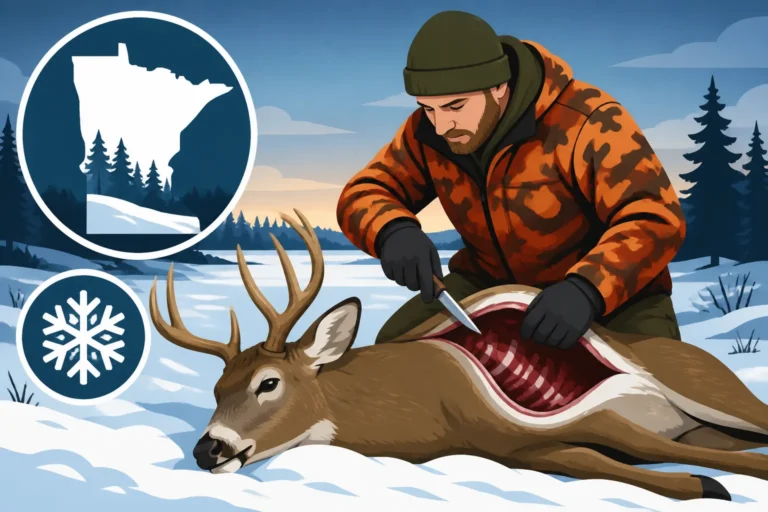
First, take a moment to reflect and appreciate the experience. Then, begin the process of field dressing your deer as quickly and efficiently as possible to start the cooling process. If you're in a remote area or facing warm temperatures (common during early archery and even some firearm openers), getting the guts out swiftly is key to preserving the meat. Our detailed guide on Field Dressing a Deer in Cold Weather offers essential tips for cooler temperatures, but the core principles apply regardless of the mercury. Have sharp knives, gloves, and a plan for how you'll get the animal out of the woods. This might involve a deer cart, a sled (if snow is present), or boning out the animal and packing it out in game bags, especially if you're deep in public land.
Once the deer is recovered, you must register your harvest with the Minnesota DNR. This is a crucial step for conservation and data collection. The DNR offers several convenient ways to register: online, via phone, or at designated registration stations. The process is straightforward, requiring information about the permit area, date of harvest, sex of the deer, and type of antler (if any). Ensure you complete registration within 24 hours of harvest and before the deer is transported out of the permit area. Failure to register can result in penalties. Properly handling your deer after the shot ensures that you'll have delicious, high-quality venison for your family and friends, truly completing the hunting experience.
Disclaimer
Please note that hunting regulations, permit requirements, and season dates can change. While every effort has been made to provide accurate and up-to-date information, it is the hunter's responsibility to consult the current Minnesota Department of Natural Resources (DNR) hunting regulations prior to heading afield. This guide is for informational purposes only and should not be considered legal advice.