Diver Ducks on Lake Winnibigoshish
There's nothing quite like the rush of a diver duck screaming across the expanse of a big lake, wings locked, heading straight for your decoy spread. But if you’ve ever tried to hunt diver ducks on a massive body of water like Lake Winnibigoshish, you know it's a completely different ballgame than sneaking into a cattail slough for puddle ducks. The sheer scale, the unpredictable weather, and the unique habits of these fast-flying, deep-diving birds present a thrilling yet often frustrating challenge that this guide aims to help you conquer.
Understanding Diver Duck Behavior on Big Water
Hunting diver ducks on a lake the size of Winnibigoshish requires a completely different mindset and set of tactics than hunting dabblers in a small pothole. These birds are built for big water, for deep dives, and for fighting strong winds. To be successful, you first have to understand them and their world.
Key Diver Species You'll Encounter
When you’re setting up on Lake Winnibigoshish, you’re primarily targeting a handful of incredible diver species, each with its own quirks. Knowing who you're hunting helps immensely in your setup and calling strategy.
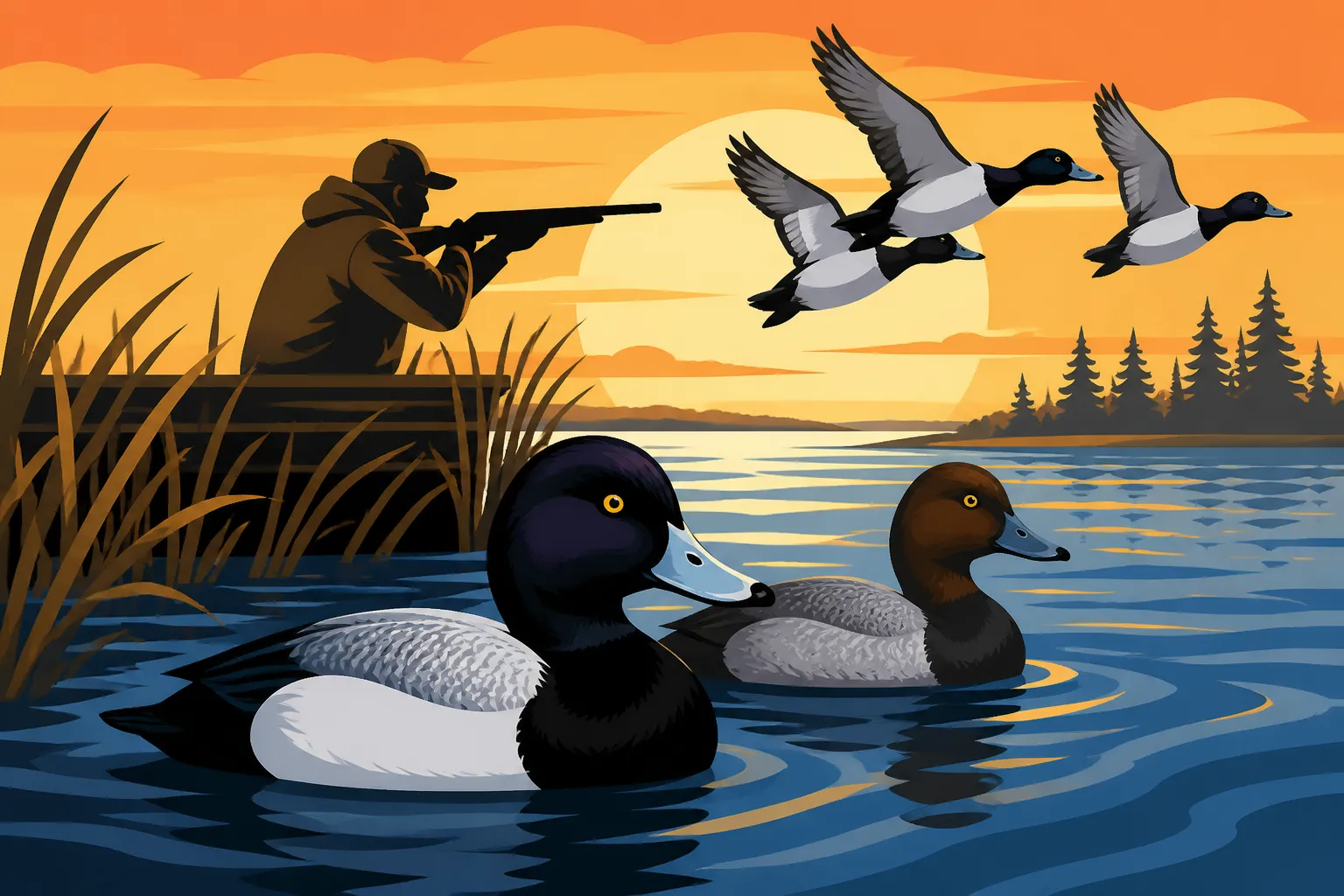
Canvasbacks, for instance, are the king of divers for many. They are large, fast, and often fly in impressive V-formations. They love deep water and feed heavily on tubers and rhizomes of aquatic plants, which they dive down to retrieve. When they commit to a spread, it's a sight to behold, but they're notoriously wary. Then you have the Redheads, another beautiful bird, often found with Canvasbacks. They tend to be a little less skittish and will decoy readily if your spread looks right. They're strong divers and feed on similar vegetation. Bluebills, or Scaup, are incredibly numerous in the Mississippi Flyway and often show up in massive rafts on big water. Both greater and lesser scaup are found here, and they're usually easier to decoy than canvasbacks. They feed more on mollusks and aquatic insects in addition to plant matter. Finally, Ring-necked Ducks are a common sight, often found in smaller flocks, and they too are strong divers that prefer deeper water than puddle ducks, feeding on seeds and tubers. Understanding these differences helps you tailor your spread and calling.
Why Lake Winnibigoshish is a Diver Magnet
Lake Winnibigoshish isn't just a big lake; it's a big lake with the right ingredients to draw and hold diver ducks during migration. Its vast open water offers safety from predators, which is paramount for these birds that spend so much time exposed. The lake's substantial depth in many areas provides the habitat for the aquatic plants and invertebrates that divers feast upon. While Winnibigoshish is well-known for its abundant wild rice beds in its shallower bays and tributaries, which are a huge draw for puddle ducks, it's the deeper sections and underlying food sources that truly attract the divers. As the season progresses and colder temperatures arrive, divers seek out these larger, deeper bodies of water that freeze later, providing crucial resting and feeding grounds. You'll find them concentrating in certain areas, often where prevailing winds push food sources or create calmer pockets, or near underwater structure like reefs and points that serve as navigation markers and feeding locations. Minnesota Waterfowl Migration Timing is a huge factor, and Winnibigoshish is a critical stopover.
Essential Gear and Setup for Big Water Diver Hunting
Diving into big water hunting without the right gear is a recipe for a bad day, or worse. Lake Winnibigoshish can be incredibly unforgiving, and the birds themselves demand a specific approach.
Boats and Safety on Lake Winnibigoshish
First and foremost, you need a substantial, stable boat. This isn't the time for a small jon boat or a canoe, unless you're sticking to very sheltered bays on a dead-calm day. Lake Winnibigoshish can kick up quickly, turning a pleasant morning into a white-knuckle ride in minutes. A robust fiberglass or aluminum boat, ideally 16 feet or longer with a strong outboard motor, is essential. Safety is paramount: always wear your life jacket, especially when running or setting decoys in choppy water. Carry reliable communication devices, like a marine radio and a fully charged cell phone (though cell service can be spotty in some areas). Multiple anchors, a bailing bucket, flares, and a first-aid kit are non-negotiable. Don’t ever underestimate the power of big water. Checking the marine forecast is as important as checking the duck forecast.
Decoy Strategies for Diver Ducks
Diver ducks are flock birds, and they feel safety in numbers. This means you need a lot of decoys to make your spread look appealing on big water. While you might get by with a dozen for puddle ducks, diver hunting on Winnibigoshish often calls for spreads of 50, 100, or even more decoys. The sheer size of the lake makes smaller spreads look insignificant.
You'll want to deploy them in long lines or large, loose "J" or "U" formations, giving birds plenty of landing room in the middle. Divers typically land into the wind, so understanding your wind direction is crucial for how you orient your spread relative to your blind. Mix in different species of diver decoys—canvasbacks, redheads, scaup—to create a natural-looking raft. Weighted keels are a must to keep your blocks from blowing around in heavy winds and current. Don't forget motion decoys; even on big water, a subtle ripple or movement can draw attention. A few spinning-wing decoys positioned strategically can also help, especially on calmer days. For scouting prime locations to set up your spread, advanced mapping tools can be a game-changer. Using an app or software like GoHunt, you can analyze underwater contours, historical duck concentrations, and even wind patterns to pick the perfect spot for your long lines. Decoy Spreads for Minnesota Divers can make or break your hunt.
Shotguns, Chokes, and Ammunition
Diver ducks are tough birds, built with dense feathers and thick bone structure. This means your shotgun, choke, and ammunition choices are critical. A 12-gauge shotgun is almost universally preferred for diver hunting due to its knockdown power and payload capacity.
As for chokes, divers are typically shot at longer ranges than puddle ducks, often decoying just outside of typical close-range puddle duck shots, or simply swinging wide. A modified or improved modified choke is a popular choice, offering a good balance of pattern density and spread at typical engagement distances. Full chokes can be too tight for fast-moving birds at moderate ranges, while open chokes might not deliver enough energy for clean kills.
For ammunition, nontoxic shot is legally required for waterfowl hunting throughout Minnesota, so steel, bismuth, or tungsten-based loads are what you'll be using. Steel shot is common, but it's lighter than lead, meaning you often need to go up a shot size or two (e.g., using BB or 1 instead of 2 or 3 for lead) to achieve sufficient energy. Bismuth and tungsten are denser, performing more like lead, but come at a higher cost. Shot sizes 1, BB, or BBB are popular for divers due to their penetration and retained energy on these hardy birds. Always pattern your shotgun with your chosen load and choke before the season to know your effective range and build confidence. Waterfowl Loads for Minnesota Divers are essential for success.
Tactics for Success on Lake Winnibigoshish
Successfully hunting diver ducks on Lake Winnibigoshish is about more than just having the right gear; it’s about understanding the environment and the birds, and adapting your strategy accordingly.
Reading the Wind and Water
The wind is arguably the most critical factor in big water diver hunting. Divers almost always land and take off into the wind. This dictates where you set your spread and position your blind. You want your decoys to be "working" naturally with the wind, and for birds to approach from a direction that presents a good shot. A strong wind can also create significant waves, making boat handling and decoy deployment challenging, but it also helps ducks fly lower and commit harder.
Setting up on points, reefs, or even just subtle depth changes can be highly effective, as these areas often concentrate food sources or act as migration funnels. Pay attention to how the current, driven by wind, moves water across these structures. Anchoring in deep water requires heavier anchors and plenty of line, and it’s a physically demanding task. If you're using a layout blind on open water, you'll need a stable boat or platform to deploy and retrieve it safely, especially if the wind picks up. Hunting Mille Lacs and Big-Water Divers shares similar principles that apply to Winnibigoshish.
Scouting and Location Selection
You can’t just pull up to any spot on Lake Winnibigoshish and expect to find divers. Pre-season scouting is invaluable. Look for areas where divers are consistently feeding or resting. This might involve glassing large sections of the lake with binoculars or a spotting scope from shore or from a safe distance in your boat. What are they eating? Where are they sitting?
Mapping tools, such as the detailed topographic maps available through platforms like GoHunt, are incredibly useful for identifying potential hot spots. Look for underwater contours, subtle reefs, points, and sudden drop-offs. These features can act as natural navigation points or feeding areas for divers. Once the season starts, don’t be afraid to move if a spot isn't producing. Divers are dynamic; their patterns can shift based on weather, food availability, and hunting pressure. A spot that was hot last week might be barren this week, so staying adaptable is key.
Blind Concealment and Calling
On open water, concealment is tough. Divers have excellent eyesight, and they're used to seeing vast, unobstructed horizons. Your blind needs to be low-profile and blend seamlessly with the environment. Layout blinds are incredibly effective for this, allowing you to lie flat and virtually disappear into the water or shore. If you're hunting from a boat, meticulous brushing in with natural vegetation from the shoreline is crucial to break up your outline. Avoid sky-lighting yourself—don't sit too high, and ensure your head isn't silhouetted against the open sky.
When it comes to calling, diver ducks generally respond to a different calling cadence than puddle ducks. While some divers, particularly redheads, can be quite responsive to consistent, confident quacks, others like canvasbacks are more stoic. Less can often be more. A soft, continuous confidence chuckle can work wonders, simulating contented feeding birds. Don’t overdo it with loud hail calls; divers are often already high and moving fast, and they'll either see your spread or they won't. The goal is to reassure them, not demand their attention. A good mix of diver and coot decoys can add realism, as coots are often found feeding alongside divers.
| Diver Species | Key ID Features | Typical Behavior on Winnibigoshish | Decoying Tendencies | Preferred Choke/Shot |
|---|---|---|---|---|
| Canvasback | Red head, sloped black bill, white body | Fast, high flyers, deep divers. Wary. | Can be tough; need realistic spread. | Mod/IM, Steel BB-BBB |
| Redhead | Red head, blue bill with black tip | Strong flyers, good divers. Less wary. | Respond well to calling & decoys. | Mod, Steel 1-BB |
| Greater/Lesser Scaup (Bluebill) | Black head/chest, gray back, blue bill | Often in large rafts, active divers. | Decoy readily, can be persistent. | Mod, Steel 2-1 |
| Ring-necked Duck | Black back, white ring at bill base, gray sides | Smaller flocks, fast flight, good divers. | Decoy fairly well. | Mod, Steel 2-1 |
Navigating the Challenges of Big Water
Lake Winnibigoshish is stunning, but it demands respect. Understanding and preparing for its challenges is as vital as knowing your duck species.
Weather Extremes and Hunter Safety
Minnesota weather, especially around the large open water of Winnibigoshish, can be notoriously fickle. A beautiful, calm morning can quickly give way to a howling wind and whitecaps. Cold fronts bring even colder temperatures, and the risk of hypothermia is always present, even on seemingly mild days. Layer your clothing, ensuring you have waterproof outer layers. Clothing for a Minnesota November is always a good starting point for cold-weather waterfowl hunting.
Later in the season, ice becomes a factor. Never venture onto thin ice, and be acutely aware of changing ice conditions. Open water can freeze overnight, trapping boats or making launching/retrieving impossible. Always check multiple weather forecasts before heading out, and if conditions deteriorate, pack up. No duck is worth risking your life.
Duck Retrieval on Open Water
One of the biggest frustrations of big water diver hunting is retrieving downed birds. Divers are often shot over open water, and if a bird is only winged, it can dive and swim an incredible distance, making recovery nearly impossible. A strong current or a choppy lake can quickly carry a dead bird away, leaving you watching your prize drift into the distance.
This is where a well-trained retriever dog truly shines. A dedicated waterfowl dog can make quick work of retrieving birds, even in rough conditions. If you don't have a dog, a reliable boat partner is essential. One person can handle the boat and keep an eye on the bird while the other quickly steers towards it. Even with a dog or a partner, lost birds are a real concern on big water, which is why a clean, ethical kill shot is so important. Make sure you’re ready to react instantly to retrieve a downed bird before it disappears.
Disclaimer
This article is for general informational purposes only and does not constitute professional advice. Laws, prices and regulations vary by location and change over time. Consult a qualified professional for guidance on your specific situation.