Entry Routes Through a Cattail Slough
The impenetrable nature of a Minnesota cattail slough can feel like a major barrier when you're trying to reach that prime hunting spot or sneak up on a cagey whitetail. It’s frustrating to know deer are using these thick havens, but feeling like you can't get to them without making a racket or getting soaked. This guide is all about finding and creating those stealthy entry routes, turning a frustrating obstacle into a strategic advantage for your hunt.
Why Cattail Sloughs Are Deer Magnets in Minnesota
Cattail sloughs, those dense, often soggy expanses of towering reeds and marsh grasses, might seem like nothing more than a barrier to us. But for Minnesota whitetails, especially the mature bucks that have seen a few hunting seasons, they are absolute sanctuaries. Understanding why deer gravitate to these areas is the first step in appreciating the value of finding a hidden path through them.
Unbeatable Cover and Thermal Protection
Think about it from a deer's perspective: a cattail slough offers an incredible amount of visual and scent-blocking cover. When the leaves have fallen in the hardwoods, or the farm fields have been cut clean, these sloughs remain a tangled fortress. Deer can literally disappear in them, moving through with remarkable stealth, unseen by predators or hunters. This dense vegetation also acts like a natural insulated blanket, offering significant thermal protection during those biting cold fronts that roll through Minnesota in late fall and winter. A buck bedded deep within a cattail marsh is shielded from brutal winds and can conserve energy, making it a prime bedding area.
Beyond just the physical cover, the complex structure of a cattail slough often creates a microclimate that diffuses human scent, making it harder for a deer to pinpoint the source of an approaching hunter. The sheer volume of organic material, water, and varied plant life contributes to a broken scent cone, which can be a hunter's worst nightmare but a deer's best friend. This makes these spots particularly appealing for mature bucks looking to avoid pressure, and why they'll often hold tight even when surrounding areas are disturbed.
Hidden Food Sources and Water Access
While cattails themselves aren't typically a primary deer food source, the margins of these sloughs and the scattered pockets of higher ground within them often harbor a variety of desirable forage. Tender grasses, various sedges, and the young shoots of emergent plants can provide sustenance. More importantly, sloughs are almost always associated with water, offering deer a consistent and reliable hydration source without having to venture far from their dense cover. This combination of security, food, and water creates an irresistible package for whitetails, cementing their role as critical habitat, especially when external food sources like agricultural fields are sparse or frozen over.
These wet environments also often contain submerged vegetation and tubers that, while not always obvious to us, can be a vital part of a deer's diet. During dry spells, the damp soil at the edges of a slough can still support lush growth that might be absent elsewhere. Deer will often browse along these edges, using the cover of the slough to move discreetly as they feed. Knowing that deer are finding food and water within these areas reinforces the idea that getting into or near these sloughs is paramount for success, particularly when hunting in Minnesota's Muzzleloader season.
Sanctuary from Hunting Pressure
Perhaps the most compelling reason deer seek out cattail sloughs is the respite they offer from hunting pressure. Most hunters shy away from the arduous task of slogging through chest-high, water-logged cattails. The noise, the effort, the mud, and the sheer difficulty of seeing anything beyond a few yards make them less appealing to many. This human aversion creates a natural fortress where deer, especially big bucks, can escape the constant disturbance of the traditional woods.
Deer learn quickly where they are safe, and these difficult-to-navigate wetlands become prime refuge areas. During the regular firearm season, when the pressure is at its peak, you'll often find that the biggest, smartest bucks have simply retreated into the nearest unapproachable slough and won't leave until after dark or until the pressure subsides. Learning to navigate these areas quietly and efficiently gives you access to animals that other hunters simply cannot reach, offering a significant advantage. This concept ties into Finding Ground Others Walk Past, which can be key to consistent success.
Scouting Your Slough: Finding the Path of Least Resistance
Before you even think about putting on waders and hacking your way through a cattail jungle, thorough scouting is absolutely essential. Rushing into a slough blindly is a recipe for disaster, both for your hunt and your personal safety. You need a plan, and that plan starts with careful observation, both from afar and on the ground.
Aerial Intelligence with Mapping Tools
Modern hunting apps and online mapping tools are a game-changer when it comes to breaking down seemingly impenetrable terrain like cattail sloughs. Before you ever set foot on the ground, spend significant time poring over satellite imagery. Look for subtle variations in color or texture within the slough that might indicate slightly higher ground, drier sections, or even existing deer trails that appear as faint lines. These often represent natural "islands" or old creek beds that provide firmer footing. Tools like GoHunt are excellent for this, allowing you to zoom in with high resolution and mark potential entry and exit points.
Pinpoint any visible fingers of timber, brush, or even ditches that extend into or along the slough. These can act as natural funnels or hidden travel corridors that deer are already using. Pay close attention to the perimeter of the slough as well; often, there will be a transition zone between the dry land and the wet marsh where deer trails are more defined before they plunge into the dense cover. Mark these observations as waypoints on your GoHunt app or other mapping software. This initial digital reconnaissance will save you countless hours of difficult physical scouting and help you prioritize where to focus your efforts when you hit the field. Understanding how to use Reading Aerial Photos for Big Woods Deer is a transferable skill that applies perfectly here.
On-the-Ground Reconnaissance in the Off-Season
While aerial maps give you a fantastic overview, there's no substitute for getting boots on the ground, ideally during the late winter or early spring when the vegetation is flattened or not yet fully grown. This is your chance to physically walk the perimeter and even cautiously venture into the slough at points you identified from your maps. Look for actual deer tracks and trails entering and exiting the slough. These trails will be packed down and might even be slightly elevated, indicating a preferred route.
During this off-season scouting, you can more easily identify areas of firmer ground, old beaver runs, or drainage ditches that might provide a slightly less arduous path. Take note of water depth. Is it knee-deep, or are there sections that are only ankle-deep? Use a stick to probe ahead, testing for soft spots or unexpected holes. This is also the time to identify potential stand locations along the edges or on those higher ground islands within the slough. Remember, Scouting Minnesota Public Land Before Season is not just for the woods, it's vital for these overlooked wetland areas too.
Reading the Wind and Thermals for Optimal Access
Once you've identified potential entry routes, the next critical step is to understand how wind and thermals will affect your approach, especially when dealing with the unique dynamics of a wetland environment. Flat, open sloughs can be tricky because surface winds can swirl, and thermals can be less predictable than in hilly timber. Generally, early mornings will see thermals pulling scent downhill or into lower areas (like a slough), while evenings will see them rising. However, the presence of standing water and dense vegetation can alter this.
You want your entry route to consistently keep your scent out of the primary bedding or travel areas within the slough. This might mean approaching from an unconventional direction or taking a longer, more circuitous path. Always consider the prevailing wind direction for the time of day you plan to hunt. If you're heading in before dawn, a morning thermal might carry your scent into the slough, whereas an evening exit might pull it up and away. Using a wind checker during your on-the-ground scouting can help you understand the subtle air currents in different parts of the slough, allowing you to fine-tune your approach for optimal stealth. The principles of Wind and Thermals on a Minnesota Ridge apply here, just with a flatter, wetter twist.
Crafting Your Stealthy Entry Route
Once you’ve put in the time scouting and have a good idea of where deer are entering and exiting the slough, it’s time to think about making your own path. The goal is always stealth and minimal disturbance. You don’t want to announce your presence to every deer in the county just by trying to get to your stand.
Manual Clearing vs. Natural Pathways
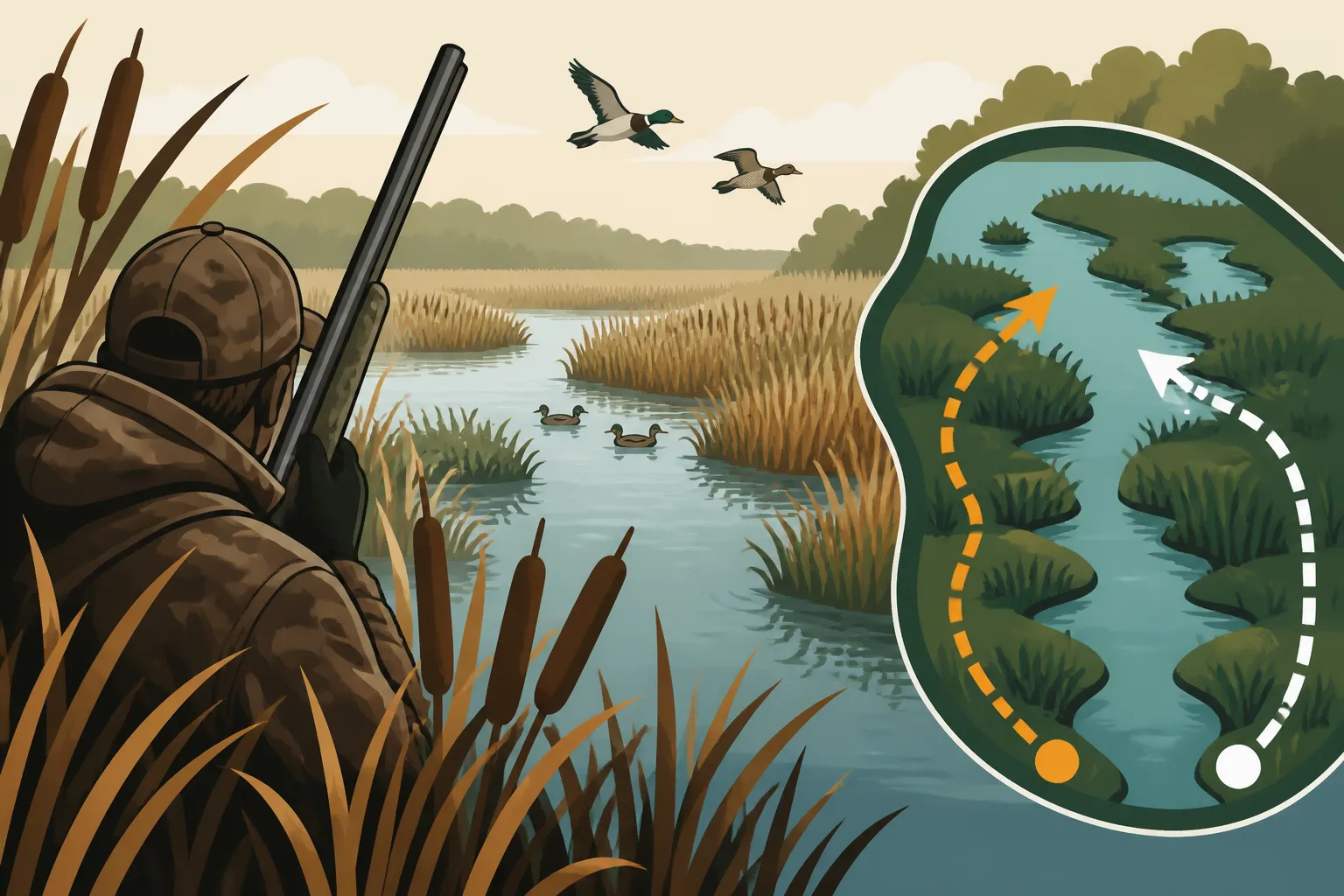
When it comes to creating an entry route, you have a couple of options: working with nature or giving it a gentle nudge. The absolute best-case scenario is to find an existing game trail that deer are already using. If you can simply follow one of these, you’re halfway there. These trails are typically firmer, quieter, and deer are accustomed to movement along them. Your job then becomes staying on the trail and moving silently.
However, often you'll need to create or enhance a path. This is where manual clearing comes in. Using a small folding saw, loppers, or even a machete, you can carefully snip and bend cattails and other vegetation to create a narrow, waist-high path. The key here is "narrow" and "waist-high." You don't want to create a highway; you want a tunnel that allows you to slip through silently. Avoid cutting too much; just enough to allow quiet passage. This work is best done in the off-season, giving the deer time to get used to the minor disturbance and ensuring your scent dissipates long before hunting season. Remember to wear rubber boots like those designed for Boots for Minnesota Swamps and Snow to keep your feet dry and minimize scent.
| Clearing Method | Pros | Cons | Best Use Case |
|---|---|---|---|
| Existing Deer Trails | Minimal effort, deer accustomed to route, quiet movement | May not lead directly to desired stand, can be winding | Ideal if available, for silent, established travel |
| Manual Clipping/Bending | Creates tailored, stealthy path, low impact | Time-consuming, physical effort, minor initial disturbance | When a direct, quiet route is needed through dense cover |
| Mechanical Clearing (e.g., ATV path) | Fast, easy to create wider path | Highly disruptive, noisy, obvious to deer and other hunters | Generally not recommended for stealthy deer access |
Minimizing Disturbance and Scent Contamination
Every time you enter a slough, you leave a trace. Minimizing this disturbance and scent contamination is paramount for successful hunting. When you're clearing a path, do it efficiently and quickly. Don't linger. Wear rubber boots and gloves to reduce the amount of human scent you deposit. If possible, avoid doing this work right before the season, giving the area time to "normalize."
During the actual hunt, approach your entry route slowly and deliberately. Use rubber boots or waders that are clean and scent-free. Avoid touching vegetation unnecessarily. If you have to push through, do it gently. Consider using a scent-eliminating spray on your outer layers, though nothing beats playing the wind correctly. The goal is to move like a ghost, leaving as little evidence of your passing as possible. For bowhunters, especially during Bowhunting Minnesota's Long Archery Season, silent entry is critical for close-range opportunities.
Marking Your Route for Low-Light Navigation
Cattail sloughs can be disorienting, especially in the pre-dawn darkness or post-dusk twilight. It’s incredibly easy to get turned around, even on a clear day. Therefore, subtly marking your route is crucial. Forget about brightly colored ribbons or reflective tape that will be obvious to other hunters or even spook deer. Instead, opt for extremely subtle markers.
Small pieces of dark, non-reflective surveyor's tape tied low to cattails, or even a small piece of flagging tape on the underside of a branch along the edge, can work. Another technique is to slightly bend or break a cattail stalk every 10-15 yards in a specific, unique pattern that only you will recognize. Remember to keep these markers barely visible, just enough for you to pick up with a headlamp set on a low red-light setting. You can also rely on your GoHunt app, using the waypoints you set during scouting to navigate precisely, ensuring you can find your way to and from your stand without getting lost or making unnecessary noise.
Hunting Strategies for Slough-Edge Success
Having a stealthy entry route into or along a cattail slough is just the beginning. The real magic happens when you pair that access with smart hunting strategies that capitalize on the slough's unique qualities.
Stand Placement on the Edge of Opportunity
Your treestand or ground blind placement relative to the slough is critical. Often, the best spot isn't inside the thickest part of the slough, but right on its edge, or on a small island within it. Deer will often skirt the very edge of the dense cover, using it as a screen while still being able to detect what's happening in the more open areas. A stand placed overlooking a primary deer trail as it enters or exits the slough can be deadly. Look for points where a finger of dry land extends into the marsh, or where the slough narrows, creating a natural pinch point.
When setting up your stand, consider your shooting lanes. While you want to be close to the thick cover, you also need clear shots at deer moving in and out. This might involve a little extra trimming of small branches during the off-season. If you're using a ground blind, brush it in thoroughly to blend with the natural surroundings. Remember, Brushing In a Blind on a Field Edge also applies to the edge of a cattail slough – you want to disappear into the landscape.
Using the Slough as a Natural Funnel
Cattail sloughs, especially larger ones, are rarely uniform. They often have subtle points, peninsulas, or constricted areas that naturally funnel deer movement. By identifying these funnels, you can predict where deer are most likely to travel. A narrow strip of dry ground between two arms of a slough, or a crossing point where the water is shallower, can be an absolute goldmine. Deer, being creatures of efficiency, will almost always take the path of least resistance.
Your entry route should ideally lead you to a stand that covers one of these natural funnels. During the rut, bucks will cruise these edges, scent-checking for does, and often using the slough as a secure travel corridor between larger blocks of timber. Understanding how deer utilize these features can give you incredible insight into their movement patterns. This is akin to Hunting a Funnel Between Two Sloughs, where the terrain naturally guides deer into predictable locations.
Dealing with the Challenges of Retrieval
The unfortunate reality of hunting near or in cattail sloughs is that if you make a successful shot, you might have to contend with a difficult retrieval. Deer often seek refuge in the thickest cover when wounded, and a slough provides ample opportunity for them to disappear. This is why shot placement is absolutely critical when hunting these areas. Aim for a clean, ethical kill that drops the deer quickly or leaves a good blood trail.
If you do have to track a deer into a slough, go slow and mark your path. The ground can be soft and challenging, and blood trails can be difficult to follow in the dense vegetation and standing water. Consider bringing a friend to help, especially if you have to Dragging a Deer Out of a Slough. A deer sled can be invaluable if the water isn't too deep, or if you can find firmer ground to pull it across. Having a plan for retrieval before you ever climb into your stand can save you a lot of headache and heartbreak if you're lucky enough to punch your tag.
Disclaimer
The information provided in this guide is for educational and informational purposes only and is not intended to be a substitute for professional advice. Always consult with the Minnesota Department of Natural Resources (DNR) for the most current hunting regulations, safety guidelines, and permit requirements before engaging in any hunting activities. Hunting involves inherent risks, and individual responsibility for safety and adherence to all applicable laws is paramount.