Barrel Length for Walking Thick Cover
If you've ever found yourself deep in Minnesota's dense woods, trying to slip through a thick popple cut or navigate a tangled alder stand, you know the struggle: that moment your rifle barrel snags on a branch, making a tell-tale snap that echoes through the quiet forest, or when you can't quite get your shotgun pointed fast enough at a flushing grouse because the barrel keeps catching. It's frustrating, it's noisy, and it can absolutely ruin a hunt. This guide is all about understanding how your firearm's barrel length impacts your ability to move, shoot, and succeed in Minnesota's truly thick cover, helping you choose the right tool for the job.
The Core Challenge: Maneuvering in Minnesota's Dense Cover
Hunting in Minnesota isn't always about wide-open fields or long-range shots. Often, especially if you're chasing deer in the Big Woods, ruffed grouse in a recent clear-cut, or even rabbits in a brushy ditch, you're going to find yourself in cover so thick you can barely see your boots. This is where the physical dimensions of your firearm, particularly its barrel length, become a critical factor.
Why Short Barrels Shine in Thick Stuff
Imagine trying to push a 26-inch barreled shotgun through a stand of dense young aspen, where branches seem to grab at everything. Or picture still-hunting through a pine plantation, trying to quietly slip past knee-high thickets of balsam fir. A longer barrel is, quite simply, a liability in these situations. It snags on branches, whips around unexpectedly, and makes it incredibly difficult to maintain a quiet, controlled movement. That extra six inches or so might not sound like much on paper, but when you're trying to thread the needle through dense cover, it feels like an eternity.
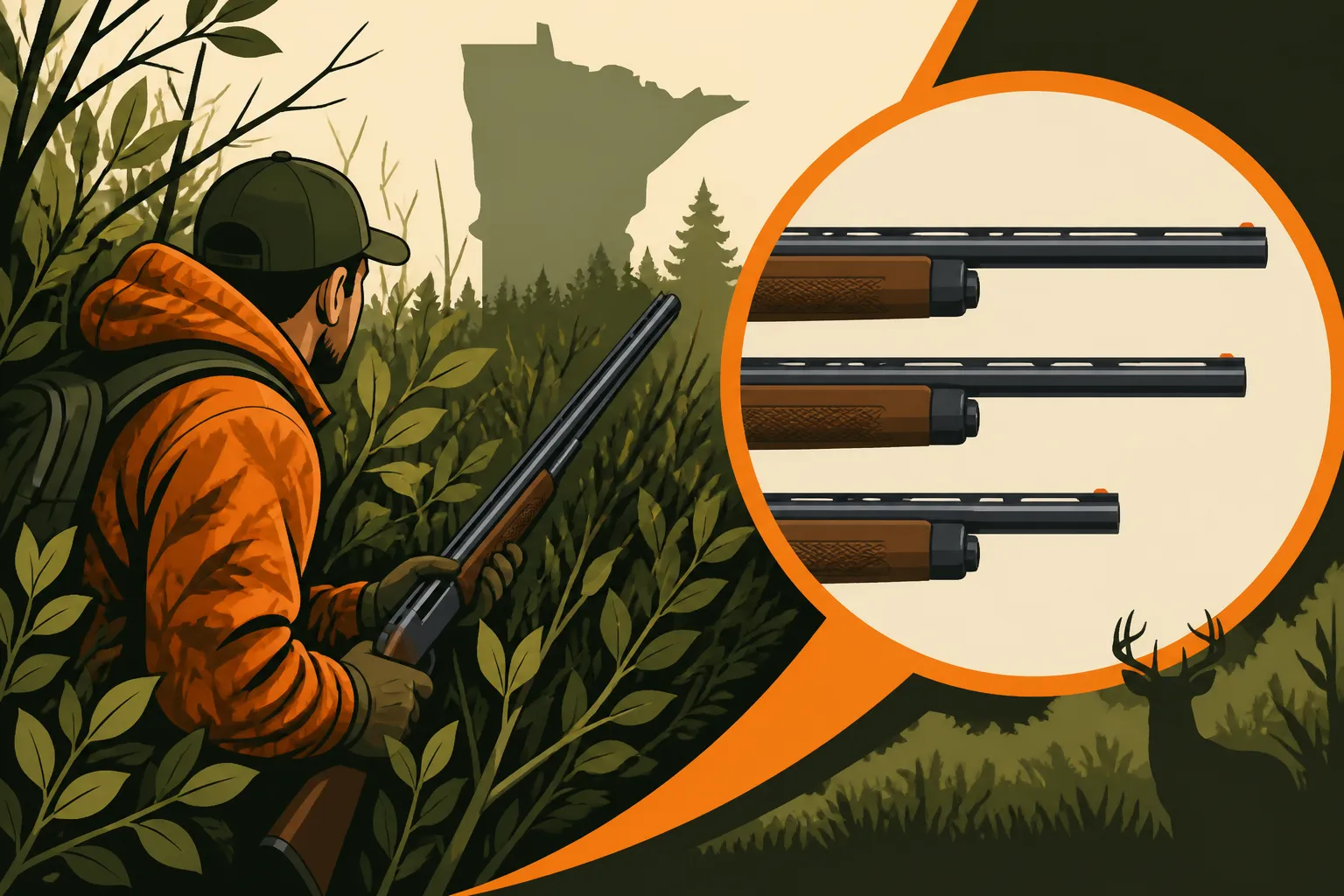
Shorter barrels, typically in the 18-22 inch range for rifles and shotguns, offer a much more compact package. This increased maneuverability translates directly into several hunting advantages. First, you can move more quietly and efficiently. Less barrel to snag means less noise and less effort expended fighting the brush. This is crucial when you're trying to sneak up on a bedded buck or get into position for a quick shot at a flushing bird. Second, and perhaps most critically, a shorter barrel allows for faster, more natural target acquisition. When a grouse explodes from cover just feet away, or a whitetail ghosts through a small opening, you need to get your gun on target now. A shorter barrel swings faster and points more instinctively in tight quarters, giving you those precious milliseconds that can make the difference between a clean shot and a missed opportunity. This is especially true for hunters who enjoy Grouse Hunting Minnesota Popple Cuts where quick reflexes are paramount.
The Trade-Offs: Accuracy and Velocity at Longer Ranges
Now, it's only fair to acknowledge that shorter barrels do come with some theoretical trade-offs, primarily concerning muzzle velocity and, by extension, potential long-range accuracy. A longer barrel allows for a more complete burn of propellant, which generally translates to higher bullet speeds. Higher speeds can mean a flatter trajectory and more energy delivered downrange, which are desirable qualities for very long shots.
However, in the context of Minnesota's thick cover, these theoretical disadvantages are often negligible, if not entirely irrelevant. Most shots in dense woods, whether it's for deer, bear, or upland birds, are taken at relatively close distances – often well under 100 yards, and frequently much closer. At these ranges, the difference in velocity between a 20-inch and a 24-inch barrel is rarely enough to significantly impact bullet drop or energy transfer to the point of ethical concern, assuming you've chosen an appropriate caliber and bullet construction for the game you're pursuing. Many hunters find that Sighting In a Rifle for Minnesota Woods Ranges means accepting that shots will be close, making the velocity debate less critical.
As for accuracy, the idea that shorter barrels are inherently less accurate is largely a myth for quality firearms. Barrel length primarily affects velocity, not intrinsic mechanical accuracy. A well-made short barrel can be just as accurate as a well-made long barrel at typical hunting distances. Any perceived difference in accuracy is often more about the shooter's ability to hold a longer, heavier, more unwieldy gun steady, especially in awkward positions, rather than the barrel's inherent capability. For the vast majority of hunting scenarios in Minnesota's dense woods, the benefits of maneuverability far outweigh any minor, often unnoticeable, sacrifices in long-range ballistics.
Common Barrel Lengths and Their Applications in Minnesota
When you're shopping for a new firearm or just considering what you already have in the safe, understanding the typical barrel lengths available and how they align with specific hunting styles in Minnesota can be a real eye-opener. It's not a one-size-fits-all situation, and what works beautifully for open country might be a nightmare in a thick swamp.
Rifles and Shotguns for Upland and Big Game
Let's talk about rifles first, now that Minnesota's New Statewide Rifle Rules make them an option almost everywhere. For deer hunting in the "Big Woods" of northern Minnesota, or even still-hunting in bluff country where the terrain can be incredibly steep and dense, a rifle with an 18 to 20-inch barrel is often a fantastic choice. These compact "brush guns" are a joy to carry all day, slip through the timber effortlessly, and come to the shoulder quickly when that buck steps out at 40 yards. Calibers like the .30-30, .350 Legend, or .450 Bushmaster, often found in these shorter configurations, are perfectly adequate for the ranges encountered in these environments. Contrast that with a 24-inch or longer barrel often favored for western hunting or open farmland; that extra length would be a constant annoyance in the thick stuff.
For shotguns, especially those used for upland birds like grouse, pheasants, or woodcock, barrel length is also a key consideration. While skeet or trap shooters might prefer longer barrels for a smoother swing on consistent targets, a bird hunter walking thick cover needs something different. A shotgun with a 20 to 22-inch barrel is often ideal for Grouse Hunting Minnesota Aspen Cover. It's quick to shoulder, fast to swing on those explosive flushes, and much less likely to get tangled in the alders or poplars. A 26-inch or 28-inch barrel, while excellent for waterfowl over decoys or doves in an open field, can feel incredibly cumbersome when you're busting through shoulder-high brush all day.
Here's a quick look at common barrel lengths and their general applications:
| Barrel Length Range | Common Firearm Type | Typical Minnesota Use Case | Pros in Thick Cover | Cons (less relevant for thick cover) |
|---|---|---|---|---|
| 18-20 inches | Compact Rifles, Slug Guns | Deer in Big Woods, Hunting Minnesota Cattail Sloughs for Deer, Bear | Excellent maneuverability, quick handling, lightweight | Slightly reduced velocity (often negligible at close range) |
| 20-22 inches | Upland Shotguns, Carbine Rifles | Grouse, Woodcock, Rabbits, Hunting Minnesota Farmland Deer | Fast swing, easy to carry, less snagging | Might not "point" as smoothly for long-range clay shooting |
| 22-24 inches | General Purpose Rifles, Longer Shotguns | Deer in mixed cover, open woods, turkey hunting | Good balance of maneuverability and ballistic performance | Can be a bit long in extremely dense situations |
| 26-28+ inches | Magnum Rifles, Waterfowl Shotguns | Open field deer, long-range predator calling, waterfowl | Maximized velocity, smooth swing for long-range moving targets | Very cumbersome in thick brush, slow to acquire close targets |
The Sweet Spot: Finding Your Ideal Balance
Ultimately, the "sweet spot" for barrel length in Minnesota's thick cover hunting comes down to a balance of maneuverability, ballistic performance for the game you're pursuing, and your personal ergonomics. For many hunters, especially those who spend a lot of time in the Big Woods or chasing upland birds, that sweet spot tends to be on the shorter side of the spectrum. An 18 to 20-inch rifle barrel or a 20 to 22-inch shotgun barrel often provides the best blend of features for the challenges of Minnesota's landscapes.
Consider your primary hunting method. If you're Still-Hunting Minnesota Big Woods or driving deer with a group, you're constantly moving, weaving through trees, and potentially taking quick shots. A compact firearm is your friend. If you're primarily sitting in a stand overlooking a field edge, a longer barrel might be fine, but if that stand is tucked deep in the pines, getting in and out without knocking your scope out of alignment or making a ruckus is still a consideration. When researching gear, platforms like GoHunt can offer insights into what other successful hunters are using in similar conditions, providing valuable real-world perspectives on balancing barrel length with field performance.
Also, think about the overall length of your firearm. If you're considering adding a muzzle brake or, where legal, a sound suppressor, that will add several inches to your barrel, making an already long gun even more unwieldy. Starting with a shorter barrel gives you more flexibility if you plan on adding accessories that increase the overall length of the firearm, ensuring it remains practical for the dense cover you'll be navigating.
Practical Considerations for Barrel Length on Minnesota Hunts
It’s easy to get caught up in ballistic charts and theoretical performance, but out in the woods, practical concerns often trump everything else. How easily can you carry your gun? Can you move through brush without making a sound? Will you be able to get a shot off quickly when the opportunity arises? These are the real questions that barrel length helps to answer.
Vehicle and Treestand Navigation
Think about the simple act of getting to your hunting spot. Many Minnesota hunts involve driving down narrow, overgrown forest roads, parking the truck, and then hiking in. Trying to extract a long-barreled rifle from a vehicle, especially if you've got other gear, can be a clumsy affair. It's easy to ding the muzzle, snag the stock, or make unnecessary noise if you're trying to be stealthy. A more compact firearm slides in and out of a truck or ATV much more gracefully, reducing the chances of damage or alerts to nearby game. This is especially true if you're accessing public land that might have restricted vehicle access, requiring you to park and walk a considerable distance.
The same principle applies to hunting from an elevated position. Whether you're climbing into a traditional fixed treestand or using a portable setup for Saddle Hunting in Minnesota Oaks, a long barrel can be a massive hindrance. Trying to haul a lengthy firearm up a tree, or maneuvering it into position once you're settled, is difficult and prone to making noise. A shorter, more manageable rifle or shotgun is easier to hoist up a rope, less likely to snag on branches during the ascent, and simpler to position for a shot once you're elevated. It reduces movement and potential noise, which are critical for staying undetected by keen-eyed whitetails.
Quick Shots and Target Acquisition
In thick Minnesota cover, hunting often becomes a game of fleeting glimpses and rapid reactions. Whether it's a ruffed grouse bursting from an alder thicket, a deer slipping silently through heavy undergrowth, or a coyote trotting briefly across a small opening, opportunities are frequently measured in seconds. This is where the balance and quick-handling characteristics of a shorter-barreled firearm truly shine.
A shorter barrel means a lower moment of inertia, allowing the gun to swing and point much faster. This is vital for taking those quick, instinctive shots at moving targets in tight spaces. You're not trying to lead a target at 300 yards; you're trying to put your sights on something that might be 20 or 30 yards away and only visible for a fraction of a second. The ability to snap the gun to your shoulder, find the target, and send the shot before the animal disappears again is a huge advantage. This improved target acquisition isn't just about speed; it's also about accuracy under pressure, as a naturally pointing gun leads to less fumbling and more consistent aim when time is of the essence. You'll feel the difference when you're trying to quickly pivot for a shot when Hunting the Minnesota Rut in Early November and a buck cruises by faster than anticipated.
Many hunters pair these quick-handling firearms with optics designed for fast acquisition, such as low-magnification scopes or red dot sights, further enhancing their effectiveness in dense cover. The combination of a short, nimble firearm and a fast-acquisition optic creates a highly effective system for the close-quarters challenges that define much of Minnesota's woodland hunting.
Legalities and Personal Comfort
Beyond the pure performance aspects, there are also some practical and legal considerations related to barrel length that every hunter should be aware of. While most commercially available hunting firearms won't push these limits, it's good to understand the baseline.
Minimum Legal Barrel Lengths
On a federal level, and therefore universally in Minnesota, there are minimum legal barrel lengths for firearms. For rifles, the barrel must be at least 16 inches long, and for shotguns, it must be at least 18 inches long. These regulations are in place to define what constitutes a standard firearm versus a short-barreled rifle (SBR) or short-barreled shotgun (SBS), which fall under the purview of the National Firearms Act (NFA) and require special licensing and taxation.
However, for the vast majority of hunters, this isn't something to worry about. Nearly all commercially manufactured hunting rifles and shotguns sold in the United States, and certainly those readily available through Minnesota retailers, come with barrels well exceeding these minimums. You'll find hunting rifles commonly starting around 18 inches and going up, while hunting shotguns generally start at 20 inches and extend much longer. So, while it's good to be aware of the rules, you're highly unlikely to accidentally purchase an illegal barrel length for a standard hunting firearm. The key is to avoid any custom modifications or surplus purchases without thoroughly understanding the legal implications.
Ergonomics and Carrying Comfort
Finally, let's talk about something often overlooked: how the gun feels in your hands and on your shoulder after a long day in the field. Hunting Minnesota's thick cover can be physically demanding. You're walking, sometimes scrambling, through uneven terrain, climbing over downed logs, and pushing through brush. The last thing you want is a firearm that feels like a boat anchor or is constantly off-balance.
A shorter-barreled firearm, by nature, often feels lighter and more balanced, especially when carried with a good sling. This translates to less fatigue over hours of walking, stalking, and pausing to scan for game. When you're spending your day exploring Finding Ground Others Walk Past on public land, every ounce and every inch matters. It’s not just about the weight, but how that weight is distributed. A compact rifle tends to carry closer to your body, reducing the leverage that makes longer guns feel heavier and more cumbersome.
This ergonomic advantage isn't just about comfort; it can also contribute to better shooting. A less fatigued hunter is a more focused hunter, able to hold steady for a shot rather than shaking from exhaustion. Choosing a firearm with a barrel length appropriate for the dense cover hunting common in Minnesota means you'll spend less time fighting your gear and more time enjoying the hunt, ultimately leading to a more positive and potentially more successful experience. When preparing for a long haul, remember to check out resources like GoHunt for gear reviews that consider comfort and practicality for extended use in the field.
Disclaimer
This article is for general informational purposes only and does not constitute professional advice. Laws, prices and regulations vary by location and change over time. Consult a qualified professional for guidance on your specific situation.