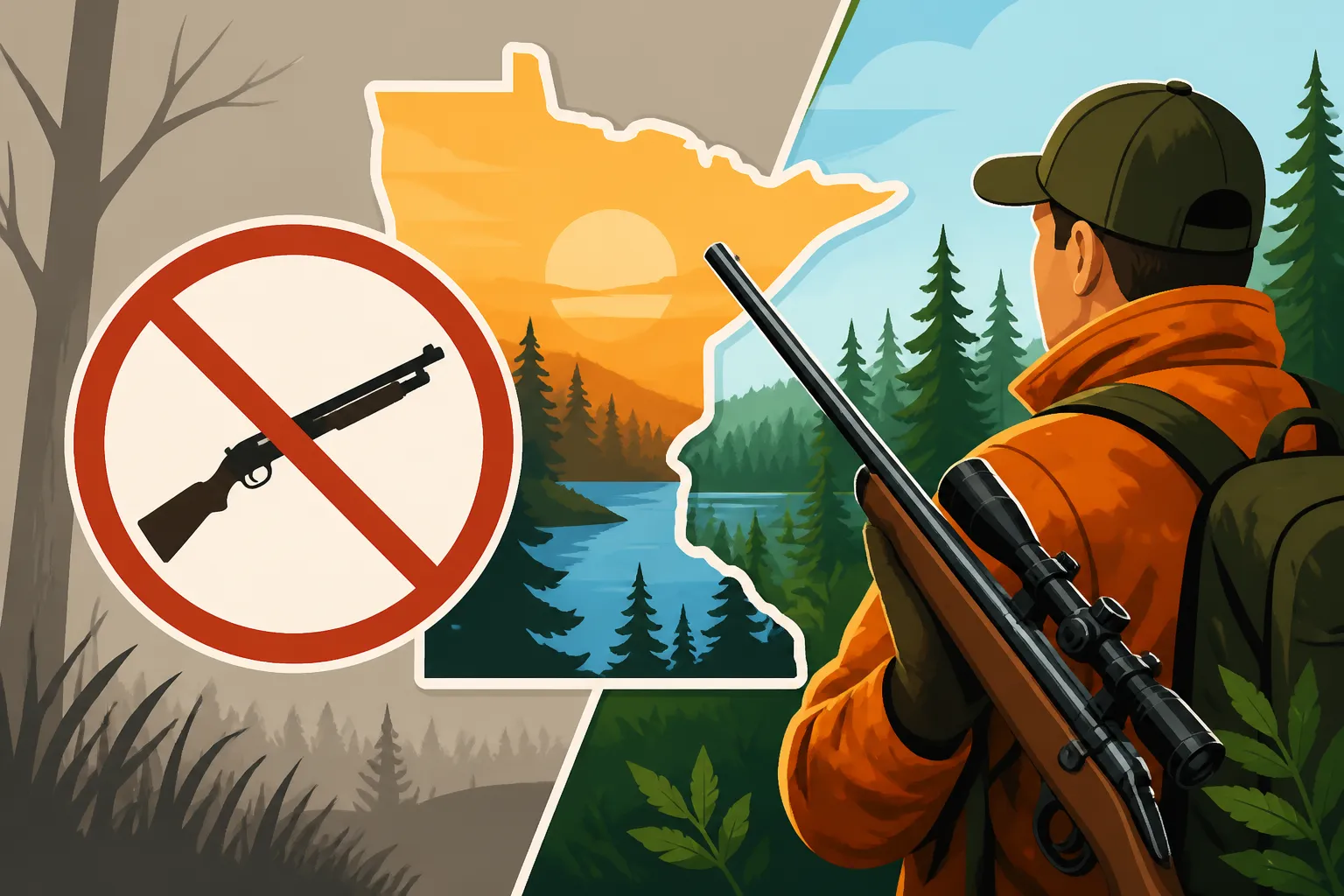
Choosing a Rifle Now That Shotgun Zones Are Gone
For years, Minnesota deer hunters grappled with a patchwork of regulations, forcing many in the southern and central parts of the state to rely on shotguns and straight-wall cartridge rifles, even when they yearned for the versatility of a traditional bottleneck rifle. That frustration is largely a thing of the past with the statewide legalization of conventional rifles for deer hunting. Now, the new challenge isn't if you can use a rifle, but which rifle will best suit your hunting style and the diverse landscapes Minnesota offers. This guide will walk you through everything you need to know to make that crucial choice.
Understanding Minnesota's New Rifle Landscape
The shift to statewide rifle legality marks a significant evolution in Minnesota's hunting regulations, opening up new possibilities for hunters who previously felt limited by equipment restrictions. It’s a big deal, and it’s important to fully grasp what this means for your hunting approach.
The End of Most Shotgun-Only Zones
For decades, many of us in the farmland and transition zones knew the frustration of checking those maps, figuring out if our favorite hunting spot fell into a "shotgun-only" area. We bought slug guns, spent time at the range patterning expensive sabot rounds, and often felt like we were at a disadvantage compared to our buddies up north with their tack-driving rifles. Well, that era is largely over. The Minnesota Department of Natural Resources (DNR) made the monumental decision to permit the use of conventional centerfire rifles for deer hunting across most of the state. This change acknowledges the effectiveness of modern firearms and provides a more consistent regulatory framework for hunters.
The reasoning behind the original shotgun-only zones often revolved around population density and safety concerns, with the idea that slugs wouldn't travel as far as rifle bullets. However, advances in slug technology, especially rifled barrels and sabot slugs, meant that effective shotgun range often mirrored or even exceeded typical deer hunting distances in many rifle zones. The old distinctions became less relevant. This change has been met with widespread enthusiasm, simplifying gear choices and expanding opportunities. While the vast majority of the state now allows rifles, it’s still crucial to be aware that there are Thirteen Remaining Shotgun-Only Counties. These counties, mostly situated close to urban centers, maintain the shotgun-only rule (along with muzzleloaders and legal pistols) due to local considerations and population density. Always make sure you're up-to-date on your specific hunting location.
What "Rifle Legal Statewide" Really Means
When we say "rifles are legal statewide," it refers to a broad category of firearms, but there are still specific parameters you need to be aware of. Primarily, this change allows for the use of traditional bottleneck cartridges like the venerable .30-06 Springfield or .270 Winchester, which were previously restricted to the northern "rifle zones." Alongside these, straight-wall cartridge rifles, which were already legal in the former shotgun zones, remain perfectly valid options.
The key distinction lies in the cartridge design. Bottleneck cartridges have a case that tapers down to a smaller diameter at the neck, holding a smaller bullet. This design is highly efficient for generating velocity and accuracy over longer distances, making them ideal for open fields or longer shots through timber. Straight-wall cartridges, on the other hand, have cases that maintain a consistent diameter from base to mouth, like a pistol cartridge or a shotgun slug. These were historically favored in areas with perceived shorter shot distances, and they still offer excellent performance within their effective ranges. The legal changes essentially say, "If it's a centerfire rifle firing a legal caliber, and it's not one of those specific remaining shotgun-only counties, you're good to go." This means hunters now have the freedom to choose from an immense array of calibers, actions, and rifle platforms. For a deeper dive into the specific legalities, you might want to look into Why Straight-Wall Rifles Are Now Legal Statewide. Understanding the nuances of these regulations is the first step in making an informed decision about your new hunting rifle.
Factors to Consider When Choosing Your Minnesota Deer Rifle
Choosing a new rifle is an exciting prospect, but it’s more than just picking the first one that catches your eye. Minnesota's diverse landscapes and varied hunting conditions demand thoughtful consideration. Your personal hunting style, where you typically hunt, and even your physical comfort with the rifle itself all play a huge role in finding the perfect match.
Hunting Environment: Big Woods vs. Farmland
Minnesota offers an incredible range of hunting environments, from the dense, dark timber of the "Big Woods" up north to the sprawling agricultural fields and scattered woodlots of the southern farm country. The terrain you hunt most often should heavily influence your rifle and caliber choice.
In the Big Woods, shots are often close and fast. Deer might appear suddenly in a thick aspen stand or slip through dense balsam fir. Here, maneuverability is key. A shorter barrel (say, 20-22 inches) on a rifle is less likely to snag on brush or get cumbersome in a tight treestand. Calibers that deliver significant energy at shorter ranges, even if their long-range ballistic coefficients aren't stellar, are perfectly suitable. Think of the classic .30-30 Winchester in a lever-action, or even a .308 Winchester with its compact efficiency. Penetration through light brush is sometimes a consideration, though a well-placed shot with any adequate caliber trumps all. Hunters here often prioritize quick handling and reliable knockdown power within 150 yards. On the flip side, the vast open fields and long sightlines of Minnesota's farmland areas, particularly in the southwest, might present shot opportunities at significantly longer distances. Here, a rifle with a longer barrel (22-24 inches or more) can wring out extra velocity and improve accuracy at those extended ranges. Calibers known for their flat trajectory and superior ballistic performance, such as the .270 Winchester, .30-06 Springfield, or the ever-popular 6.5 Creedmoor, shine in these environments. These cartridges minimize bullet drop and wind drift over hundreds of yards, making those 200-300 yard shots more manageable. Even with the capability for longer shots, ethical hunting still means knowing your personal limits and the limits of your rifle, ensuring clean, humane kills. Many hunters use apps like GoHunt to scout different terrains, helping them visualize potential shot distances before even stepping foot in the woods.
Target Species and Range
While this guide focuses on deer, it's worth a moment to consider if you might occasionally pursue other game with the same rifle. For Minnesota deer, the vast majority of shots occur within 200 yards, regardless of the perceived "long-range" capability of modern cartridges. However, having a rifle and caliber capable of ethical shots out to 300-400 yards provides a distinct advantage in open country.
When considering a specific caliber, you'll want something that delivers sufficient kinetic energy at the point of impact to ensure a quick, clean kill. For whitetail deer, this generally means at least 1,000 foot-pounds of energy at impact, though more is certainly better. Most common deer calibers easily achieve this at typical hunting ranges. If you envision using this rifle for other species, such as bear or even coyotes, that might subtly shift your thinking. For instance, a .243 Winchester is excellent for coyotes and adequate for deer, but many hunters would prefer something larger for Minnesota's black bears. Conversely, a heavier-hitting round like the .30-06 is more than capable for bear and deer, but might be overkill (and more recoil) for smaller predators. It's a balance. Always consider the realistic maximum range you are comfortable shooting accurately in field conditions, not just at the bench. A bullet's trajectory and energy retention are critical at varying distances, and understanding your chosen cartridge's performance at different ranges is paramount for ethical hunting.
Hunter Comfort and Recoil Tolerance
This might be the most overlooked, yet critical, factor in choosing a rifle. The fanciest, most powerful rifle in the world is useless if you can't shoot it accurately due to discomfort or fear of recoil. A rifle that fits you well and produces manageable recoil will be one you enjoy shooting, which means you'll practice more, and ultimately, you'll be a more effective hunter.
Recoil is a physical force, and while some hunters are more sensitive to it than others, excessive recoil leads to flinching, poor trigger control, and missed shots. This is especially true in the adrenaline-fueled moment of a hunting shot. If you find yourself consistently flinching or anticipating recoil at the range, it's a clear sign that the rifle or caliber might be too much for you. Modern rifle stocks often feature adjustable length-of-pull and comb height, allowing for a custom fit that can significantly improve comfort and reduce perceived recoil. Recoil pads have also come a long way, with advanced materials that absorb much of the kick. For those particularly sensitive, or for younger hunters, starting with a lighter-recoiling caliber like a .243 Winchester or a straight-wall .350 Legend can be a game-changer. Even experienced hunters often choose a moderate-recoiling caliber that they can shoot all day without fatigue. Remember, accuracy is king, and comfort directly impacts accuracy. Don't let ego dictate your choice; choose what allows you to shoot your best.
Popular Rifle Calibers for Minnesota Deer Hunting
With the new statewide rifle legality, the choices for deer calibers in Minnesota have truly opened up. While the "best" caliber is always a hot topic of debate, there are certainly some tried-and-true options and modern innovations that stand out for their performance and suitability for Minnesota's hunting conditions.
Tried-and-True Performers
These calibers have been putting venison in freezers for generations, and for good reason. They are versatile, powerful, and readily available.
- ** .30-06 Springfield**: The quintessential American hunting cartridge, the .30-06 is a jack-of-all-trades and master of many. It handles a wide range of bullet weights (typically 150-180 grains) making it incredibly versatile. For the Big Woods, a 180-grain bullet provides excellent penetration on a heavy-bodied buck, while a 150-grain bullet will reach out across farmland with a relatively flat trajectory. Recoil is manageable for most adult hunters, and ammunition is available everywhere. It’s hard to go wrong with a .30-06 as a do-it-all Minnesota deer rifle. Its reliability and widespread availability of components for handloaders make it a perpetual favorite.
- ** .308 Winchester**: Often considered the younger, more compact brother of the .30-06, the .308 Winchester offers very similar performance in a shorter cartridge, allowing for lighter, more compact rifles. It’s incredibly efficient, known for its inherent accuracy, and produces slightly less recoil than the .30-06. The .308 is an excellent choice for both dense timber and open fields, making it a fantastic all-around Minnesota deer cartridge. Bullet weights typically range from 150-180 grains, offering ample power for any whitetail you'll encounter. For those looking at Best Rifle Caliber for Minnesota Deer, the .308 is almost always at the top of the list for its balance of power and shootability.
- ** .270 Winchester**: A legendary flat-shooting cartridge, the .270 Winchester is a favorite among hunters who prioritize long-range accuracy and minimal bullet drop. It typically fires lighter bullets (130-150 grains) at very high velocities, making it devastating on deer at extended ranges. In the open landscapes of southern Minnesota, where shots can stretch, the .270 truly shines. While its lighter bullet weight might sometimes be seen as a disadvantage in super thick cover, a well-constructed .270 bullet provides more than enough penetration and energy for Minnesota whitetails. Recoil is similar to the .30-06. When comparing .308 Versus .270 for Whitetails, it often comes down to a preference for a flatter trajectory (270) versus more bullet weight/frontal area (308).
Modern Favorites and Straight-Wall Options
The hunting world doesn't stand still, and new cartridges are constantly being developed or gaining popularity. These options offer distinct advantages for specific Minnesota hunting scenarios.
- ** 6.5 Creedmoor**: Perhaps the most popular new cartridge in recent memory, the 6.5 Creedmoor has taken the hunting world by storm due to its exceptional accuracy, mild recoil, and outstanding ballistic performance. It fires sleek, high-ballistic-coefficient bullets (typically 120-140 grains) that resist wind drift and retain energy incredibly well, making it superb for longer shots in open country. Its mild recoil means hunters can shoot it more accurately, which translates to more ethical kills. While some traditionalists might balk at its smaller bullet diameter, its performance on deer is undeniable. It's quickly become a top contender for a 6.5 Creedmoor for Minnesota Big Woods rifle, as its accuracy benefits still apply even at shorter ranges.
- ** .350 Legend**: This straight-wall cartridge was specifically designed to meet the legal requirements of areas that previously restricted bottleneck cartridges. It offers a low-recoil, high-velocity alternative to slug guns, making it incredibly popular in former shotgun zones. Firing a .357-inch bullet (typically 150-180 grains) at respectable velocities, it's effective out to 200-250 yards. For hunters in those 13 remaining shotgun-only counties, or those who simply prefer a straight-wall design due to familiarity or perceived recoil, the .350 Legend is an outstanding choice. It's often compared to a "modern .30-30" in terms of its effective range and role.
- ** .450 Bushmaster**: Another powerful straight-wall option, the .450 Bushmaster delivers a significant punch. Firing a heavy .452-inch bullet (typically 250-300 grains), it generates substantial kinetic energy, making it a powerhouse for close to medium-range shots. Recoil is notably heavier than the .350 Legend, but its knockdown power is impressive. It's particularly well-suited for dense timber or situations where you want maximum energy transfer within 150-200 yards. Like the .350 Legend, it serves as an excellent option for areas requiring straight-wall cartridges and for those transitioning from slug guns who want a bit more raw power.
Considering Smaller Calibers
While big-game hunting often conjures images of large-caliber rifles, there's a place for smaller, more manageable options, especially for specific hunters or hunting styles.
- ** .243 Winchester**: The .243 Winchester is often the first "deer rifle" for many youth hunters or those sensitive to recoil. Firing a lighter, faster bullet (typically 80-100 grains), it is extremely accurate and a pleasure to shoot. For smaller-bodied deer and hunters who prioritize shot placement over raw power, the .243 is perfectly adequate. It's a fantastic caliber for open country where precise shots are possible, but its energy can drop off more quickly than larger calibers at extended range. Ethical limits are critical here; while it can kill a deer at 300 yards, a smaller margin for error means many hunters prefer to limit shots to 200 yards or less, especially on larger bucks. It's also an excellent choice for varmints and coyotes, offering versatility for mixed-bag hunting. If you're wondering Is a .243 Enough for Minnesota Whitetails?, the answer is generally "yes, with good bullet choice and shot placement."
Here's a quick comparison of some popular calibers for Minnesota deer hunting:
| Caliber | Bullet Weight Range (Grains) | Typical Recoil (Foot-lbs) | Effective Deer Range (Yards) | Best For |
|---|---|---|---|---|
| .30-06 Springfield | 150-180 | 17-22 | 300+ | All-around, versatile, heavy timber/open land |
| .308 Winchester | 150-180 | 14-18 | 300+ | All-around, compact rifles, accuracy |
| .270 Winchester | 130-150 | 16-20 | 350+ | Open country, long-range, flat trajectory |
| 6.5 Creedmoor | 120-140 | 11-15 | 300+ | Accuracy, mild recoil, long-range |
| .350 Legend | 150-180 | 8-12 | 200-250 | Straight-wall zones, low recoil, brush |
| .450 Bushmaster | 250-300 | 20-25+ | 150-200 | Straight-wall zones, maximum close-range power |
| .243 Winchester | 80-100 | 7-10 | 250 (ethical) | Youth/recoil sensitive, varmints, smaller deer |
Note: Recoil values are approximations and can vary greatly depending on rifle weight, stock design, and specific ammunition load.
Rifle Features and Optics for Minnesota Conditions
Beyond the caliber itself, the actual rifle platform and the optics you choose are paramount to success in Minnesota's diverse hunting conditions. A rifle is a system, and each component plays a role in its overall effectiveness.
Action Types and Barrel Length
The action type of your rifle refers to how it loads, fires, and ejects cartridges. Each has its pros and cons, influencing speed, reliability, and feel.
- Bolt-Action: This is arguably the most popular and ubiquitous action for hunting rifles, and for good reason. Bolt-action rifles are renowned for their inherent accuracy, reliability, and strength. The manual operation allows for precise loading and extraction, minimizing moving parts that can interfere with accuracy. They are generally slower to cycle than semi-automatics, but for deer hunting, where often one well-placed shot is all you get (or need), this isn't usually a disadvantage. Most modern hunting rifles from manufacturers like Savage, Remington, Ruger, and Tikka are bolt-actions.
- Lever-Action: A classic, iconic action, particularly in Minnesota's northern woods. Lever-action rifles are fast to cycle for follow-up shots and often very compact, making them excellent for thick brush or saddle scabbards. They're typically associated with cartridges like the .30-30 Winchester, but modern lever guns are available in more potent calibers too. While they might not offer the same benchrest accuracy as a bolt-action at extreme ranges, they are incredibly effective and fun to shoot within their design parameters, usually under 200 yards.
- Semi-Automatic: Modern sporting rifles (MSRs), such as those based on the AR-10 platform chambered in .308 Winchester or 6.5 Creedmoor, are legal for deer hunting in Minnesota. They offer rapid follow-up shots and often feature modular designs for customization. While highly effective, some hunters find them heavier or bulkier than traditional bolt-action rifles.
- Barrel Length: Barrel length significantly impacts a rifle's maneuverability and velocity. Shorter barrels (18-20 inches) are fantastic for hunting dense timber, thick brush, or from a treestand where space is limited. They are quicker to shoulder and less prone to snagging. However, a shorter barrel typically results in a slight reduction in muzzle velocity, which can affect bullet performance at very long ranges. Longer barrels (22-24 inches) allow cartridges to achieve their full velocity potential, which can translate to a flatter trajectory and more energy on target at longer distances. They are generally preferred for open farmland hunting where long shots are more common. The choice often comes down to balancing handling characteristics with ballistic performance for your primary hunting environment.
Scopes for Low Light and Timber
Selecting the right optic is just as crucial as choosing the right rifle. In Minnesota, hunting often happens at dawn and dusk, or in the low light of dense timber, demanding optics that perform exceptionally well in challenging conditions.
- Magnification Range: For most Minnesota deer hunting, a variable power scope with a lower magnification range is ideal. Something like a 2-7x, 3-9x, or 2.5-10x offers excellent versatility. The lower power settings (2x-3x) are perfect for fast, close-range shots in thick timber, providing a wide field of view to quickly acquire a moving deer. The higher power settings (7x-10x) are more than adequate for identifying and precisely placing a shot on a deer across a food plot or open field at 200-300 yards. Ultra-high magnification scopes (e.g., 4-16x or higher) are often overkill for deer and can be detrimental in low light or close quarters due to their narrower field of view and bulk.
- Objective Lens Size: The objective lens (the front lens of the scope) largely dictates how much light the scope can gather. Larger objective lenses (e.g., 40mm, 42mm, 50mm) gather more light, which translates to a brighter image in low-light conditions. This is a significant advantage during legal shooting hours at dawn and dusk. However, larger objective lenses also make the scope heavier and require higher scope rings, which can affect the rifle's balance and how your cheek rests on the stock. A good balance for Minnesota is often a 40mm or 42mm objective lens, providing excellent light gathering without excessive bulk. For more detail, check out Rifle Scope Magnification for Minnesota Deer and Rifle Scopes for Low-Light Timber.
- Illuminated Reticles: An illuminated reticle can be a game-changer in low-light conditions or when a deer is in dark shadows. It allows the reticle (crosshairs) to stand out sharply against a dark background, preventing it from getting "lost." This can provide a critical advantage for quick target acquisition and precise shot placement. Many quality scopes from brands like Leupold, Vortex, and Sig Sauer offer this feature. When researching gear, platforms like GoHunt can be useful for comparing scope features and reading user reviews to see how they perform in real-world low-light scenarios.
Ergonomics and Weather Resistance
Hunting in Minnesota means dealing with all sorts of weather conditions – from crisp, sunny fall days to cold, driving rain or even early snow. Your rifle needs to be able to handle it all, and it needs to feel good in your hands.
- Stock Materials and Finish: Synthetic (polymer or fiberglass) stocks are incredibly durable, lightweight, and impervious to weather fluctuations. They won't warp, crack, or swell like wood can when exposed to moisture, making them an excellent choice for a hard-use hunting rifle. Modern synthetic stocks also come with textured grips and often incorporate recoil-absorbing features. Wood stocks, on the other hand, offer classic aesthetics and a warm feel, but require more care to protect against moisture. Metal components are typically finished with bluing, cerakote, or stainless steel. Stainless steel offers superior corrosion resistance, ideal for wet or snowy conditions, while cerakote provides a highly durable and protective coating in a variety of colors.
- Weight and Balance: A rifle that's too heavy can be a burden on long walks into public land or when still-hunting. A rifle that's too light can exacerbate recoil. Aim for a rifle that feels well-balanced and comfortable when shouldered. This is where getting hands-on with different models at a sporting goods store is crucial. Lift them, shoulder them, cycle the action, and see how they feel.
- Sling: A good quality sling is not an optional accessory; it's essential. It frees your hands for navigating difficult terrain, carrying other gear, or retrieving a deer. Padded slings distribute weight comfortably, and non-slip materials keep the rifle securely on your shoulder. When you're spending hours still-hunting or walking miles through the woods, a comfortable sling makes a huge difference.
Transitioning from Shotgun to Rifle Hunting
For many Minnesota hunters, the shift from a slug gun to a conventional rifle is a big one. It's more than just a change in equipment; it's a change in mindset, a recalibration of skills, and an opportunity to become a more effective and versatile hunter.
Recalibrating Shot Distances and Ballistics
If you've spent years hunting with a shotgun, your mental "max range" for an ethical shot might have been around 75-100 yards, maybe 125 with a highly accurate slug gun. With a modern rifle, that dramatically expands.
- Understanding the New "Zone": A typical deer rifle in a common caliber like .308 or .270 can be ethically accurate out to 250-350 yards for a skilled shooter. This means that once-impossible shots across a large CRP field or a wide cut are now potentially on the table. However, this increased capability comes with increased responsibility. You need to understand your chosen caliber's ballistics intimately. Learn its drop at 100, 200, 300, and even 400 yards. Use a good rangefinder on every potential shot, and mentally, or physically, practice holding over for different distances. Services like GoHunt often have ballistic calculators integrated, which can be invaluable for understanding your specific load's performance.
- Wind Drift: This is a major factor often overlooked by shotgun hunters. Rifle bullets, especially at longer ranges, are significantly affected by crosswinds. A 10-mph crosswind can push a bullet several inches off target at 200 yards, and even more at 300+. Learning to read the wind, using vegetation, flags, or a Kestrel device, becomes a critical skill for longer shots.
- Bullet Construction: Shotgun slugs are generally designed for massive energy transfer at close range. Rifle bullets are more varied. For deer, you'll want expanding bullets (soft point, polymer tip) that mushroom reliably to create a wide wound channel. Match your bullet weight and construction to the game you're hunting and the ranges you expect to encounter.
Practice, Practice, Practice
Owning a rifle doesn't automatically make you a rifle hunter. Becoming proficient takes dedicated practice and a commitment to understanding your equipment.
- Range Time is Essential: Don't just sight in your rifle and call it good. Spend time at the range, shooting from various positions (prone, kneeling, sitting, off-hand) that mimic real-world hunting scenarios. Practice quick target acquisition. Shoot at different distances to confirm your rifle's zero and understand bullet drop. Many hunters sight in at 100 or 200 yards, which often creates a "point blank range" where the bullet stays within a few inches of the aim point out to a considerable distance. For example, Sighting In a Rifle for Minnesota Woods Ranges offers specific advice on this.
- Simulate Hunting Scenarios: Practice with your hunting clothing on, including your jacket and gloves. If you hunt from a treestand, practice shooting from an elevated position. Simulate cold hands, a rapid heart rate, and limited time. The more you can replicate hunting conditions at the range, the more confident and accurate you'll be when that big buck steps out.
- Shot Placement: Regardless of caliber, ethical shot placement is paramount. Practice aiming for the vital zone (heart/lungs) on a deer target. Understand bullet trajectory and how it interacts with bone and tissue. A well-placed shot from a smaller caliber is always more effective than a poorly placed shot from a magnum.
Ammunition Selection for Optimal Performance
Choosing the right ammunition is just as important as choosing the right rifle. Not all bullets are created equal, and matching your ammunition to your hunting conditions and target species will maximize your success.
- Bullet Type: For deer, you generally want an expanding bullet.
- Soft Point (SP): A traditional choice, with a lead tip that initiates expansion on impact. Reliable and effective.
- Polymer Tip/Ballistic Tip: These bullets have a plastic tip that aids in aerodynamics and forces rapid expansion upon impact. Excellent for quick, clean kills, especially in open country. Brands like Hornady (ELD-X, SST), Federal (Fusion), and Winchester (Deer Season XP) are popular choices.
- Bonded Bullets: These bullets have the lead core chemically bonded to the copper jacket, ensuring high weight retention and deep penetration, even through heavy bone. Great for larger deer or if you anticipate quartering shots. Federal's Trophy Bonded Tip or Barnes TSX/TTSX are examples.
- Grain Weight: Most popular deer calibers offer a range of bullet weights. Lighter bullets tend to be faster and shoot flatter, while heavier bullets carry more energy and offer deeper penetration. For example, in a .30-06, a 150-grain bullet might be chosen for open farmland, while a 180-grain bullet could be preferred for dense timber or larger-bodied deer. Experiment at the range to see which grain weight your rifle shoots most accurately.
- Ammunition Availability: With the shift to statewide rifle legality, demand for certain calibers may fluctuate. Always ensure you have enough practice and hunting ammunition. It’s also wise to buy a few boxes of the exact same lot number for hunting, as slight variations between lots can affect point of impact. For a new rifle, try a few different brands and bullet types to see what your specific firearm "likes" best – rifles can be surprisingly particular about ammunition. And don't forget the required Minnesota Blaze Orange Requirements when heading out for the season!
Disclaimer
Always consult the current Minnesota Department of Natural Resources (DNR) regulations before heading into the field. Hunting laws and regulations can change, and it is every hunter's responsibility to know and follow all applicable rules. This guide provides general information and should not be considered a substitute for official DNR publications or legal advice.