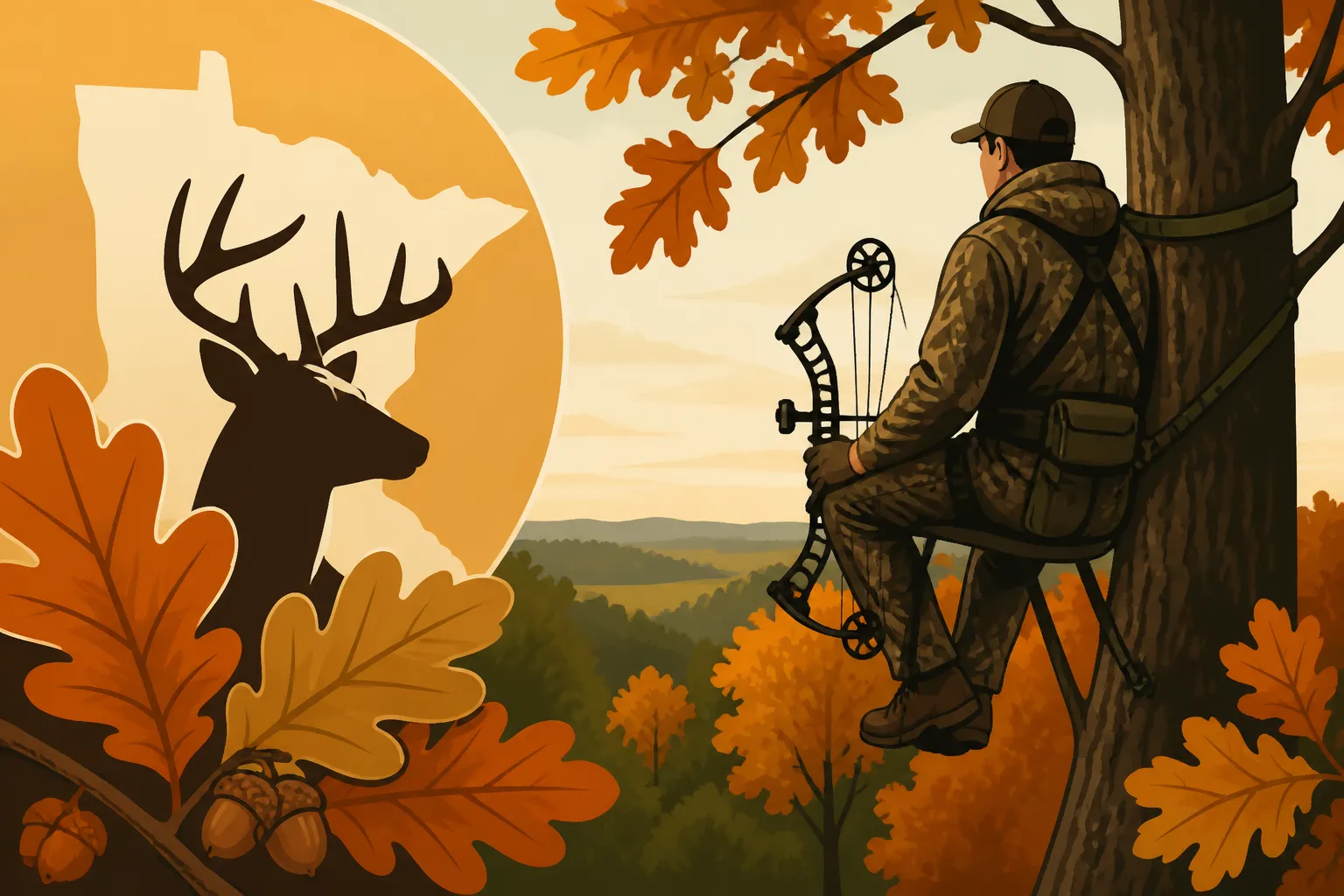
Saddle Hunting in Minnesota Oaks
For years, I dragged heavy hang-on stands through thick Minnesota timber, trying to find that one perfect, straight tree with good cover and clear shooting lanes. It was a constant struggle, especially in our gnarled oak forests where every tree seems to have a personality all its own. If you've ever felt the frustration of setting a stand only to realize your shooting lanes are choked, or the tree is just a bit too crooked, then you know the feeling. This guide is all about how saddle hunting can transform your approach to those challenging Minnesota oak woods, offering unparalleled mobility, concealment, and a whole new perspective on deer hunting.
Why Saddle Hunting Shines in Minnesota's Oak Forests
Our Minnesota oak forests are magnificent, but they can be a real headache for traditional treestand hunters. The irregular growth patterns, the dense canopy, and the scattered nature of productive mast trees often mean that finding that "perfect" spot to hang a fixed stand feels more like a lottery win than a predictable scouting outcome. This is precisely where saddle hunting doesn't just offer an alternative; it often becomes the superior method.
The Challenge of Traditional Stands in Oak Canopy
Think about it: you've finally pinpointed a promising white oak ridge, littered with fresh deer sign. You haul in your hang-on stand and sticks, sweating through the underbrush, only to discover that every oak with decent girth also has a cluster of limbs at 15 feet, or a slight lean that makes your stand feel less than secure. Traditional fixed stands demand a fairly straight, clear trunk and often limit your shooting angles to a 90-degree arc directly in front of you. This can be incredibly frustrating when a wary buck skirts your setup just out of range, or approaches from an unexpected direction you simply can't cover. The sheer effort of moving and re-hanging a heavy stand is enough to deter many hunters from adapting to changing deer patterns or unexpected wind shifts.
Advantages of a Saddle for Oak Hunting
This is where the saddle truly shines. Its inherent design allows you to operate around the tree, rather than just from it. Imagine having a full 360-degree range of motion, letting you pivot, lean, and shoot comfortably in any direction. This capability is absolutely invaluable in a timber setting where deer often appear silently from dense cover. Not only does it open up more shooting opportunities, but it also dramatically increases your concealment. By using the tree trunk itself as cover, constantly adjusting your position to keep the tree between you and an approaching deer, you essentially become part of the woods. Plus, the minimal profile of a saddle and climbing sticks makes for a much quieter, faster, and more versatile setup process. You can move quickly, adapt to conditions, and hunt the "right" tree, not just the "hottest" tree that happens to have a perfectly straight trunk.
Comparing Saddle Hunting to Other Portable Methods
When we talk about portable hunting methods in Minnesota, hang-on stands and climber stands are the usual suspects. A hang-on, while offering stability, is heavy, cumbersome to move, and typically requires a specific tree that fits its bracket and doesn't have too many lower limbs. You also lose that precious 360-degree shooting capability. Climber stands, bless their hearts, are fantastic for perfectly straight, limbless trees like pines or certain maples, but they are utterly useless in the vast majority of our gnarly Minnesota oak stands. Trying to ascend a crooked oak with low branches using a climber is a recipe for frustration, if not outright danger. The saddle, on the other hand, embraces the irregularities of the oak. With the right climbing sticks or ropes, you can ascend trees with significant leans, multiple trunks, or branches, transforming what would be a non-option for other stands into a prime hunting location. This versatility is a game-changer for hunting those hard-to-reach, mast-heavy oak pockets. Treestand Setups in Minnesota Hardwoods can give you more context on different types.
Essential Gear for Your Minnesota Oak Saddle Setup
Embracing saddle hunting means rethinking your gear, but the beauty of it is that much of it is lightweight and designed for maximum efficiency. You’ll want gear that allows for quiet, quick setups and takedowns, letting you remain agile and adaptable in our often-unpredictable Minnesota woods.
The Core Saddle System Components
At its heart, a saddle system consists of three main parts: the saddle itself, the tree tether, and the lineman's belt. The saddle is what you wear, distributing your weight comfortably and providing the attachment points for your other safety lines. There's a range of saddles out there, from minimalist, lightweight designs perfect for long hauls to more padded, comfort-focused models for those all-day sits. The tree tether is your primary connection to the tree once you're at hunting height. It loops around the tree and clips into your saddle, allowing you to lean back and maneuver. Crucially, the lineman's belt is what keeps you safely secured to the tree as you climb up and down. It allows you to wrap yourself around the trunk, hands-free, as you set each climbing stick or step. Investing in high-quality, comfortable components here is paramount, as your safety and comfort directly impact your ability to focus on the hunt. Make sure everything is rated for your weight and inspect it regularly for wear and tear.
Climbing Aids and Platforms
To get up that oak tree, you'll need reliable climbing aids. The most common choices are climbing sticks, screw-in steps, or various rope-based systems. Climbing Sticks for Minnesota Hardwoods are incredibly popular because they're relatively lightweight, packable, and adaptable to many tree shapes. Look for sticks with silent attachments and non-slip steps. Screw-in steps offer a more minimalist, though sometimes slower, approach and leave little trace. Rope-based methods, like the SRT (Single Rope Technique), are advanced but offer incredible stealth and versatility once mastered. Once at height, you'll need a platform or small set of steps to stand on, allowing you to lean comfortably into your saddle and provide stability for shooting. Some hunters prefer small, minimalist platforms that barely extend beyond the tree, while others opt for slightly larger, portable platforms for more foot room. The key is to find a system that is quiet, efficient, and provides stable footing for those crucial moments of the shot. A platform allows you to shift weight, stretch, and reposition without making noise. Sites like GoHunt often feature gear reviews and comparisons for these climbing aids, which can be a valuable resource for finding what suits your hunting style best.
Essential Accessories for Oak Country
Beyond the core system, a few accessories can make a world of difference when saddle hunting Minnesota oaks. A sturdy, silent haul rope is essential for pulling up your bow, backpack, and any other gear after you've climbed. You don't want to carry your bow up with you if it means making noise or risking a fall. A quiet, streamlined backpack is also key, as you'll be wearing it or hanging it close to your body. Look for one with external straps or pockets for easy access to calls, rangefinder, or a water bottle. Many saddle hunters also utilize a bow holder that attaches to their platform or directly to the tree, keeping their weapon at the ready without having to hold it constantly. Quiet clothing layers are vital, especially for cold Minnesota mornings. Choose fabrics that won't rustle against the tree or your gear as you subtly shift positions. Remember, every piece of gear should contribute to stealth and efficiency; excess weight or noisy items will only hinder your success when trying to outsmart a whitetail in its natural habitat.
Tactics for Successful Saddle Hunting in Minnesota Oaks
Saddle hunting isn't just about different gear; it's about a different mindset. It’s a dynamic, adaptive approach that allows you to be more proactive in your setup and more responsive to deer movement, which is particularly effective in varied oak terrain.
Scouting for the Perfect Oak Setup
Successful saddle hunting starts long before you ever step foot in the woods with your gear. It begins with meticulous scouting. In oak country, this means identifying areas with strong mast production. Are the white oaks dropping heavily? Are there visible squirrel cuttings under specific trees? These are indicators of prime feeding areas. Look for rub lines and scrape lines that indicate buck travel routes, especially those that funnel deer through or past these feeding oaks. Aerial maps are invaluable for identifying oak ridges, transition zones, and potential funnels. Tools like GoHunt's mapping features can help you pinpoint these areas from home, allowing you to plan your ground scouting more efficiently. Spend time on foot, observing wind directions and thermals in relation to these potential oak setups. Scouting Minnesota Public Land Before Season is crucial, as you're not just looking for deer sign, but for the right tree within that sign.
Stealthy Access and Tree Selection
The beauty of saddle hunting is the "mobile ambush" it provides. You're not tied to a single, pre-set stand. This means you can react to current conditions, recent sign, or even a sudden wind shift. Approaching your chosen oak setup with absolute stealth is paramount. Walk slowly, pick your steps, and avoid breaking branches or rustling leaves. Once you're in the general area, take your time to choose the exact tree. Don't just pick the biggest one. Look for an oak that offers excellent natural cover from small limbs or dense clusters of leaves, a clear path for your ascent, and most importantly, shooting lanes in the directions you anticipate deer movement. Even an irregularly shaped oak, which would be a nightmare for a fixed stand, can be an advantage for a saddle hunter because its unique contours provide more natural breaks in your silhouette. You want a tree that allows you to remain hidden while still having clear shot opportunities.
Managing Your Shot Angle and Concealment
This is where the 360-degree capability of a saddle truly shines. Once you're in the tree, you can continually adjust your position, keeping the tree trunk between you and an approaching deer. If a deer approaches from your left, you simply pivot around the tree to that side, using the trunk as cover. This dynamic concealment is a huge advantage over being locked into a fixed position. When it comes to taking a shot, the ability to lean, brace yourself, and achieve an ethical shot angle from nearly any direction is liberating. Practice shooting from various positions and angles, including slightly awkward ones, at a ground level before you head afield. You'll likely find that what feels like an unconventional shot from a traditional stand is entirely comfortable and steady from a saddle. Pay attention to how the light hits your position and adjust to stay in the shadows as much as possible. Wind and Thermals on a Minnesota Ridge are always a key factor, but with a saddle, your ability to shift means you can often adapt to swirling winds better than if you were confined to a fixed platform.
| Factor | Saddle Hunting in Oaks | Traditional Hang-on Stand in Oaks | Climber Stand in Oaks |
|---|---|---|---|
| Mobility | Excellent; quick setup/takedown, lightweight to pack in. | Good; can be heavy to move, slower setup. | Poor; limited to straight, limbless trees, often not oaks. |
| Tree Versatility | High; adapts to crooked, multi-trunk, limby oaks. | Moderate; requires relatively straight, limbless sections. | Very Low; requires perfectly straight, limbless trunks. |
| Concealment | Excellent; uses tree trunk for 360-degree cover, low profile. | Moderate; fixed position limits dynamic concealment. | Moderate; fixed position limits dynamic concealment. |
| Shooting Angles | 360-degree range; can shoot around the tree. | Limited; typically 90-180 degree frontal arc. | Limited; typically 90-180 degree frontal arc. |
| Setup Time | Moderate (once proficient); quieter ascent. | Moderate to Slow; can be noisy with chains/straps. | Fast (on ideal trees); can be noisy. |
| Weight | Low to Moderate (saddle + sticks/steps). | Moderate to High (stand + sticks). | High (stand is one heavy unit). |
Staying Safe and Comfortable High in an Oak
Hunting from any elevated position carries inherent risks, and saddle hunting is no exception. However, with proper training, reliable gear, and a commitment to safety protocols, it's an incredibly secure and comfortable way to hunt. Our Minnesota hunting seasons can bring anything from warm early autumn days to bitter December cold, so preparing for all conditions is part of the game.
Prioritizing Safety in a Saddle
Safety is always the number one priority when hunting from a tree, and with a saddle, there are specific considerations. Always, and I mean always, remain attached to the tree with your lineman's belt during ascent and descent, and with your tree tether when at hunting height. This commitment to being tethered 100% of the time is non-negotiable. Before each hunt, take a moment to inspect all your gear: ropes, carabiners, saddle fabric, and climbing sticks. Look for any signs of wear, fraying, or damage. Practice setting up and climbing at low heights in your yard before the season, ensuring you're comfortable and efficient with your system. Cold weather can affect dexterity and focus, so be extra cautious as temperatures drop. Ensure your carabiners are easy to operate with gloved hands, and that all connection points are secure. It's also smart to carry a small first-aid kit, especially when heading into more remote areas.
All-Day Comfort and Cold Weather Considerations
While saddles are inherently more active than traditional stands, allowing for more movement, staying comfortable during long sits is still key, especially during a chilly Minnesota rut. Layering is your best friend. Start with moisture-wicking base layers, add insulating mid-layers like fleece or wool, and top it off with a windproof and waterproof outer shell. Many saddle hunters find that because they can shift and move more, they stay warmer than in a static hang-on stand. Consider insulated seating options or padded butt sections on your saddle for extra warmth and comfort. Good quality, insulated boots and hand warmers are also invaluable. When sitting through a late October or early November morning, the ability to subtly adjust your position, rotate, or even do a few small stretches can significantly extend your sit time without sacrificing stealth. Layering for a Minnesota Deer Stand goes into more detail on how to dress for success.
Ethical Shot Placement from a Saddle
The dynamic nature of saddle hunting means you'll encounter a wider range of shot opportunities and angles. While this is an advantage, it also means you need to be intimately familiar with deer anatomy and how various angles affect shot placement. Practice shooting from positions where you're leaning, kneeling on your platform, or rotated significantly around the tree. This ensures you can consistently place an ethical shot, even if it's not a classic broadside. Understanding how a deer's vitals present on quartering-away or quartering-to shots is critical. Always aim for the vital triangle, and if you're ever in doubt about the shot angle or your ability to make the shot cleanly, pass on it. The freedom of movement a saddle provides means you can often wait for a better opportunity, or subtly adjust your position to create one. Reviewing different broadhead types can also be beneficial, as some may perform better on certain angles. Fixed Versus Mechanical Broadheads discusses the pros and cons of each.
Disclaimer
This article is for general informational purposes only and does not constitute professional advice. Laws, prices and regulations vary by location and change over time. Consult a qualified professional for guidance on your specific situation.