Shot Placement on a Minnesota Black Bear
So, you've drawn that coveted Minnesota bear tag, or maybe you're just dreaming of the day your number finally gets called. The excitement is real, but let's be honest, hunting black bears can be incredibly intimidating. They're incredibly tough animals, and getting a clean, ethical harvest means knowing exactly where to place your shot. Many hunters worry about making a poor hit and losing a bear, and those fears are totally valid. This guide is all about demystifying black bear anatomy and shot placement, giving you the confidence to make the shot count when your moment arrives in the Minnesota woods.
Understanding Black Bear Anatomy for Ethical Shots
Black bears are robust animals, built for survival in the challenging Minnesota wilderness. Their dense muscle, thick hide, and layers of fat can make them incredibly resilient to poorly placed shots. Unlike deer, whose vital organs might feel more accessible, a bear's vitals are positioned slightly differently, often guarded by formidable bone and muscle. Understanding these anatomical nuances is paramount for ensuring a quick, humane harvest.
The Vital Triangle: Heart and Lungs
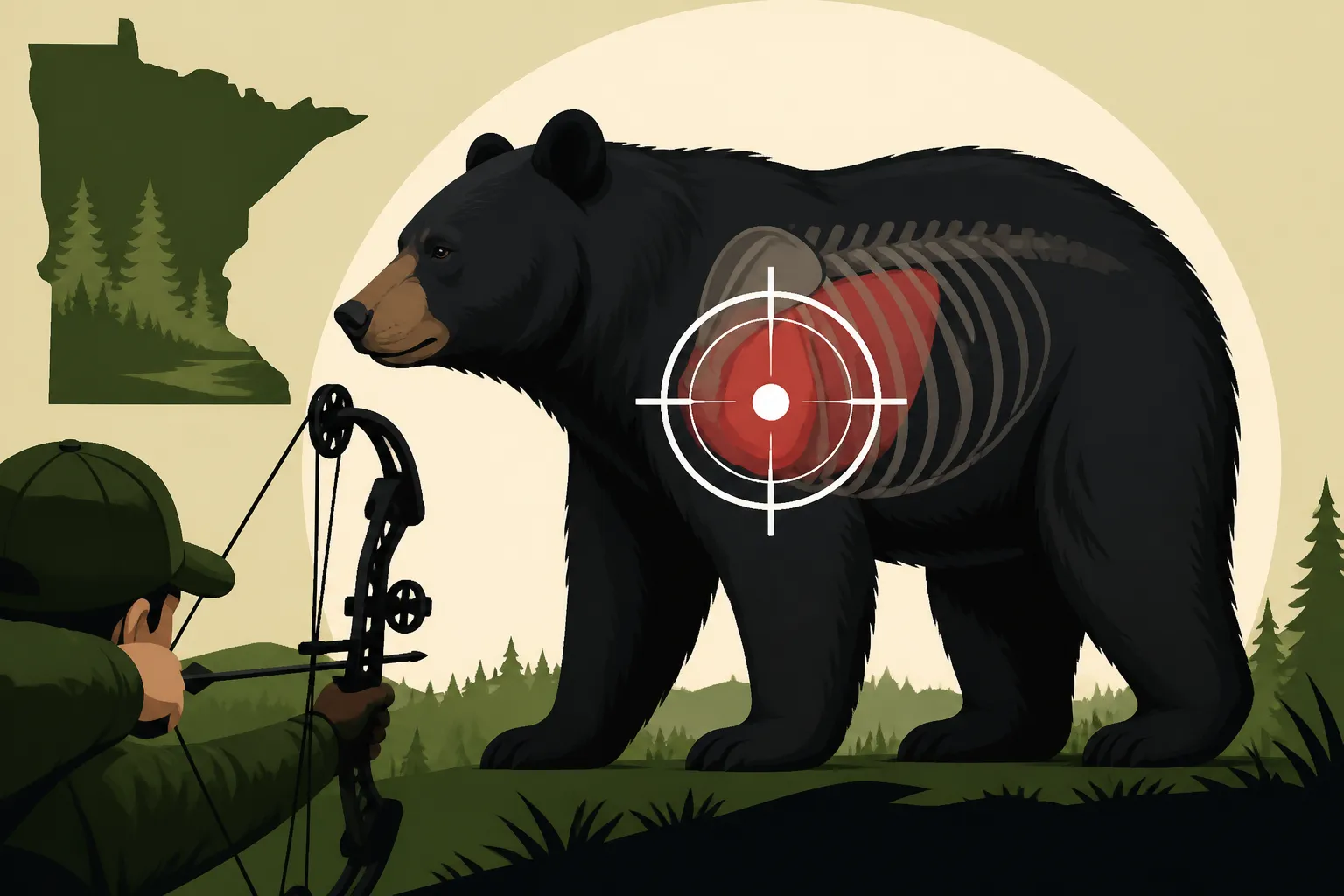
When you're aiming at a black bear, your primary target is what hunters often call the "vital triangle" – the area encompassing the heart and lungs. This zone is typically located just behind the bear's shoulder and roughly one-third to halfway up the body from the bottom of the chest. The lungs are quite large, providing a relatively generous target, while the heart sits lower and slightly forward, nestled between the lungs. A shot through both lungs or the heart leads to rapid blood loss and incapacitation, ensuring a quick and ethical kill. Visualizing this area correctly means understanding its relationship to the bear's leg; when the bear is broadside, imagine a vertical line coming up from the back of the front leg and aiming about a third of the way up the body.
Many hunters, accustomed to deer anatomy, might aim too high or too far back on a bear. Remember that a bear's rib cage is shaped differently, and its shoulder blade can be much thicker and more encompassing than a deer's. The key is to visualize the internal organs. The sheer amount of fur, hide, and fat can sometimes obscure the true contours of the bear's body, making precise aiming tricky. This is where meticulous scouting, often aided by tools like GoHunt's mapping features for studying terrain and potential bear movement patterns, and practice with your chosen firearm or bow become invaluable.
The Central Nervous System: Brain and Spine
While the heart and lungs are the primary target, shots to the central nervous system – the brain and spine – offer instantaneous incapacitation. A brain shot, if executed perfectly, will drop a bear on the spot. However, the brain is an incredibly small target, especially under hunting conditions where adrenaline is high and a bear might be subtly shifting its head. A slight miss can result in a jaw shot, blinding the bear, or other non-lethal but horrific wounds that condemn the animal to a slow, painful death. For this reason, many experienced bear hunters strongly advise against brain shots unless you are at very close range (e.g., over a bait barrel) and are absolutely confident in your marksmanship and equipment.
Spine shots, particularly where the spine meets the skull (the atlas joint) or further down the neck, can also be immediately incapacitating. A hit to the spine will typically drop the bear in its tracks by severing the nervous system's connection. However, a bear immobilized by a spinal hit is still very much alive and capable of aggressive behavior. This type of shot demands a rapid follow-up to the heart-lung area to ensure a humane dispatch. While effective, the spine itself is a relatively thin target, and misjudging the angle or height can lead to a glancing blow or a wound that allows the bear to escape.
Skeletal Structure and Shot Obstructions
One of the biggest challenges in black bear shot placement is navigating their robust skeletal structure. The shoulder blade, or scapula, is significantly thicker and denser than a deer's, capable of deflecting or stopping many projectiles, especially at steep angles or with lower-powered firearms. Aiming directly at the shoulder blade, while seemingly targeting the "shoulder," is often a recipe for a wounded animal and a difficult tracking job. The bear's humerus, the upper bone in its front leg, is also a substantial barrier.
To bypass these formidable bones, hunters must visualize the path of their bullet or arrow. For a broadside shot, you want to tuck your projectile just behind the shoulder blade, allowing it to penetrate the softer rib cage and reach the vitals. Understanding how the shoulder blade moves as the bear walks can help you time your shot for when the leg is forward, rotating the shoulder blade out of the way, exposing more of the rib cage. Caliber selection and bullet construction are also critical. Choosing a reliable, heavy-for-caliber bullet designed for deep penetration, even with cartridges like the popular 6.5 Creedmoor or .308, can significantly increase your chances of punching through to the vitals. If you're considering your options, our guide on "Rifle Calibers for Minnesota Bear" can provide more detail on suitable choices.
Optimal Shot Angles and Positions
The angle at which a black bear presents itself dictates the optimal shot placement. Rarely does a bear offer that perfect textbook broadside, and knowing how to adapt your aim for various real-world scenarios is crucial. Taking a bad angle can turn a potential harvest into a tracking nightmare.
Broadside: The Classic Ethical Shot
The broadside shot is universally considered the most forgiving and ethical shot for black bears, just as it is for most big game. In this scenario, the bear is standing with its body perpendicular to you, offering a clear view of its side. Your aim point should be just behind the front leg, about one-third to halfway up the bear's body. This trajectory will send your bullet or arrow through both lungs, and ideally, through the top of the heart as well.
This shot minimizes the chance of hitting heavy shoulder bone, as the projectile enters through the softer rib cage. When you're in a stand over a bait site, or if you're lucky enough to have a bear feeding calmly while still-hunting, this is the shot to wait for. It offers the largest vital target area and provides the best chance for a quick, humane kill and a clear blood trail for recovery. Practice this shot extensively at various distances with your weapon, ensuring you can consistently hit a target the size of a bear's vital triangle.
Quartering Away: A Viable Alternative
A quartering-away shot occurs when the bear is angled slightly away from you, with its hindquarters presented more prominently than its front. This can be an excellent shot opportunity because it often exposes more of the vital organs while still allowing you to avoid the thick shoulder bone on the entry side. For a quartering-away shot, aim for the opposite front shoulder. Imagine the bullet or arrow exiting through the opposite side's shoulder. This angle ensures the projectile travels diagonally through the entire lung cavity and often catches the heart as well.
The degree of quartering away is important. A slight quartering angle is ideal, as it still provides a clear path to the vitals. If the bear is severely quartering away, almost facing directly away from you, the target area shrinks, and you risk hitting too much gut or hip bone. Always err on the side of caution; if you're unsure if you can make a clean shot, it's better to wait for a better angle. Many hunters find this shot especially effective when hunting from a treestand, as it naturally offers a downward angle that can help with penetration.
Quartering To: When to Avoid and How to Approach
The quartering-to shot is when the bear is angled towards you, presenting its front shoulder and chest more prominently. Generally, this shot should be avoided if at all possible. The heavy shoulder bone and the front leg are directly in the path of your projectile, making it very difficult to reach the vitals effectively. A hit to the shoulder or leg could wound the bear without being lethal, leading to a lost animal.
However, sometimes a bear on a bait site might only offer a quartering-to angle. If you absolutely must take this shot, and you are highly confident in your bullet's penetration (especially with powerful rifle cartridges, now legal statewide in Minnesota, as discussed in "Why Straight-Wall Rifles Are Now Legal Statewide"), aim for the pocket just behind the shoulder and angle your shot to exit towards the opposite hindquarter. This path attempts to sneak a projectile past the heavy bone and into the heart/lung area. It’s a high-risk shot with a smaller margin for error, and frankly, if you have other options or can wait, you should. Your ethics as a hunter demand the best possible chance for a clean kill.
Frontal Shots: High Risk, High Reward
A frontal shot presents the bear facing directly toward you. This is another high-risk shot that should be taken only under specific circumstances, typically at close range over bait, and with a high degree of confidence in your equipment and skill. The advantage is that a perfectly placed frontal shot can be instantly lethal, targeting the heart, lungs, or the spine/neck junction.
The primary aim point for a frontal shot is dead center of the chest, slightly lower to target the heart and lungs, or higher for the neck/spine. However, the bear's chest is a relatively small target from this angle, and the heavy sternum bone and front leg bones can still cause issues. A slight deviation can result in a non-lethal hit to the brisket, a leg, or a jaw. If you choose to take a frontal shot, ensure your weapon is capable of sufficient penetration and that your aiming is impeccable. This isn't a shot for the faint of heart or the under-practiced.
Common Shot Placement Mistakes and How to Avoid Them
Even the most experienced hunters can make mistakes under the pressure of a bear encounter. Understanding the most common pitfalls can help you prepare mentally and physically to avoid them. Nobody wants to wound an animal, and bears, in particular, are incredibly tough, making a clean shot even more critical.
The Shoulder Blade Challenge
One of the most frequent mistakes hunters make with bears is aiming directly at the center of the shoulder, thinking it's the target. While it might be a viable target for a deer with a highly powerful rifle, a black bear's shoulder blade (scapula) is a dense, thick bone designed to protect its vitals. A bullet or arrow hitting this bone head-on can flatten, deflect, or simply fail to penetrate adequately, leading to a superficial wound. The bear might survive, or worse, die a slow death far from your recovery efforts.
To avoid this, always aim behind the shoulder. Visualize where the vital organs lie internally. The sweet spot is a few inches back from the crease of the shoulder, midway up the body, especially when the bear is broadside or slightly quartering away. When the bear steps forward, its shoulder blade rotates, exposing more of the rib cage. This is often the prime moment to take your shot. Practice visualizing this "pocket" on target diagrams or even photos of bears. Your rifle or bow setup for Minnesota's long archery season should be capable of consistent accuracy to ensure you hit this relatively small target area.
"Gut Shot" Risks and Consequences
A "gut shot," or hitting the abdominal cavity rather than the vitals, is every hunter's worst nightmare. For bears, a gut shot typically means hitting the stomach, intestines, or liver, none of which lead to a quick, humane kill. These shots result in a prolonged, agonizing death for the animal and an incredibly difficult, often futile, tracking job for the hunter. The bear may travel a great distance, leaving little to no blood trail, and the meat can be spoiled due to the rupture of digestive organs.
Gut shots usually occur when a hunter aims too far back on the bear's body, or misjudges the angle. Bears have a longer torso compared to deer, and what might seem like a good shot on a deer can be too far back on a bear. Another factor is a bear "stringing" the shot, meaning it begins to move forward just as the shot is fired, causing the projectile to strike further back than intended. To mitigate this risk, always err on the side of caution and aim forward. If there's any doubt about the shot's placement or angle, wait for a better opportunity. Patience is a virtue in bear hunting, and it's far more ethical to pass on a questionable shot than to risk wounding an animal.
Rushing the Shot and Target Panic
The adrenaline rush when a black bear steps into view is immense. This surge of excitement, often coupled with months or years of anticipation for a Minnesota bear lottery tag, can lead to "target panic" or simply rushing the shot. In this high-pressure moment, fine motor skills can degrade, breathing becomes erratic, and the desire to just get the shot off overrides careful aiming. This is when mistakes happen – jerking the trigger, punching the release, or failing to properly align sights.
To avoid rushing, mental preparation is key. Before your hunt, visualize the shot. Rehearse your breathing, your aiming process, and your follow-through. When a bear appears, force yourself to take a deep breath, focus on a precise spot, and only then execute the shot with a smooth, controlled motion. Remind yourself that you have all the time the bear gives you, and sometimes that means not taking the shot. Don't let the "trophy" aspect override the ethical responsibility to make a clean kill. Our article on "Sighting In a Rifle for Minnesota Woods Ranges" can offer valuable tips for ensuring your aim is true under pressure, while "Binocular Power for Big Woods Hunting" can help you clearly identify your bear and its anatomy before the shot.
What Happens After the Shot: Tracking and Recovery
Even with a perfect shot, the moments immediately following can be fraught with anxiety. Unlike deer, bears don't always react predictably to a hit. They are incredibly tough and can often run a surprisingly long distance even with a fatal wound. Knowing what to do in the aftermath of a shot is just as important as shot placement itself.
The Importance of Waiting
After you've taken your shot, resist the immediate urge to jump up and run after the bear. This is arguably the hardest part of bear hunting. If you believe you made a solid hit to the vitals, give the bear at least 30-60 minutes before you begin tracking. A mortally wounded bear will often bed down nearby and bleed out quietly. If you pursue too quickly, you might push the bear, causing it to run further, making recovery much more difficult, especially in dense Minnesota cover.
If your shot felt questionable, or if the bear's reaction indicated a potential gut shot (e.g., hunched posture, slow movement, no immediate collapse), the wait time should be significantly longer – at least 4-6 hours, or even overnight if the weather conditions are cool and dry. A gut-shot bear needs time for the internal bleeding and infection to weaken it. Rushing a gut-shot bear almost guarantees you'll never find it. Mark the exact spot where the bear was standing when you shot and its direction of travel. This initial information is gold for a successful recovery.
Blood Trailing Strategies for Bear
Tracking a wounded bear can be challenging, even for seasoned hunters. Bear blood trails are often less pronounced than deer trails for several reasons: their thick fur can soak up a lot of blood, their fat layers can sometimes seal wounds, and their large paws can churn up the ground, obscuring signs. You'll need to look for more than just blood. Keep an eye out for disturbed leaves, broken twigs, scuff marks, and even hair on branches or the ground. A good quality headlamp is crucial if you end up tracking after dark.
Start at the last known location of the bear and meticulously follow its path. Mark your trail with flagging tape every few yards, especially if the blood trail is sparse. This allows you to back-track if you lose the trail and resume from the last confirmed sign. If you lose the trail, spread out and search in widening circles. Tools like GoHunt's GPS mapping can be invaluable here, allowing you to mark blood sign, direction of travel, and even create a grid search pattern. In Minnesota, tracking dogs are a legal and highly effective option for finding wounded bears, especially on those tough trails. Don't hesitate to call in a reputable tracking dog service if you're struggling to locate your bear. You can find more specific advice in our article "Blood Trailing After Dark in Minnesota".
Safety and Follow-Up Shots
A wounded bear, especially one cornered or in heavy cover, can be incredibly dangerous. They are powerful animals capable of inflicting serious harm. Always approach a downed bear with extreme caution, and ideally, with a partner. Have your weapon ready for a follow-up shot. If the bear appears to be down but is still breathing or showing any signs of life, do not approach directly. Instead, deliver a follow-up shot to the head or vitals from a safe distance to ensure a quick and humane dispatch.
Be particularly careful if the bear has gone into thick brush or a dense swamp, as these areas offer ideal cover for an ambush. Always assume the bear is alive and capable of defending itself. After ensuring the bear is completely deceased, you can begin the process of field dressing and recovery. Our guide on "Handling a Bear After the Shot" provides detailed steps for care, ensuring the meat is preserved and respectful of the animal.
| Shot Angle | Aim Point | Vitals Hit (Primary) | Avoids (Primary) | Notes |
|---|---|---|---|---|
| Broadside | Just behind the front leg, 1/3 to 1/2 up body | Heart, Both Lungs | Shoulder Blade | Ideal shot. Offers largest vital target. Wait for the front leg to be forward to expose more rib cage. |
| Quartering Away | Angled towards the opposite front shoulder | Both Lungs, Heart, Liver | Entry Side Shoulder Blade | Excellent shot. Penetrates through softer tissue into vitals. Imagine the exit point. |
| Quartering To | Behind the entry side shoulder, angling deep | Single Lung, Heart, Major Vessels | Heavy Entry Side Shoulder | High Risk. Generally avoid. If necessary, requires precise aiming to sneak past heavy bone into vitals. Best with powerful, deeply penetrating rounds. |
| Frontal | Center of chest, slightly lower for heart/lungs | Heart, Lungs, Spine (upper) | Sternum, Heavy Brisket | High Risk. Very small vital target. Best at close range with powerful, penetrating rounds. Can be instantly lethal if perfectly placed, but a slight miss is often devastating. Always be prepared for an immediate follow-up. |
Disclaimer
Always consult the most current Minnesota Department of Natural Resources (DNR) regulations before heading afield. Hunting laws and regulations can change, and it is the hunter's responsibility to stay informed and compliant. This guide is for informational purposes only and does not supersede official DNR guidelines or hunter safety training.