Minnesota Trespass and Permission Law
There's nothing quite as frustrating as spotting a prime deer rub line or a thick pheasant cover only to realize you have no idea who owns the land, or worse, if it's open for hunting. The thought of unknowingly stepping onto private property and facing legal trouble or an angry landowner is enough to deter even the most eager hunter. This guide is here to untangle the complexities of Minnesota's trespass and permission laws, helping you navigate private lands responsibly and ethically, so you can hunt with confidence and peace of mind.
Understanding "Posted" Land and Implied Permission
Let's start with a foundational truth that many new, and even some experienced, hunters misunderstand: unposted land is not automatically public. Just because you don't see signs every ten feet doesn't mean you have free rein. Minnesota law is quite clear about what "posted" means and, more importantly, what it doesn't mean.
What "Posted" Really Means in Minnesota
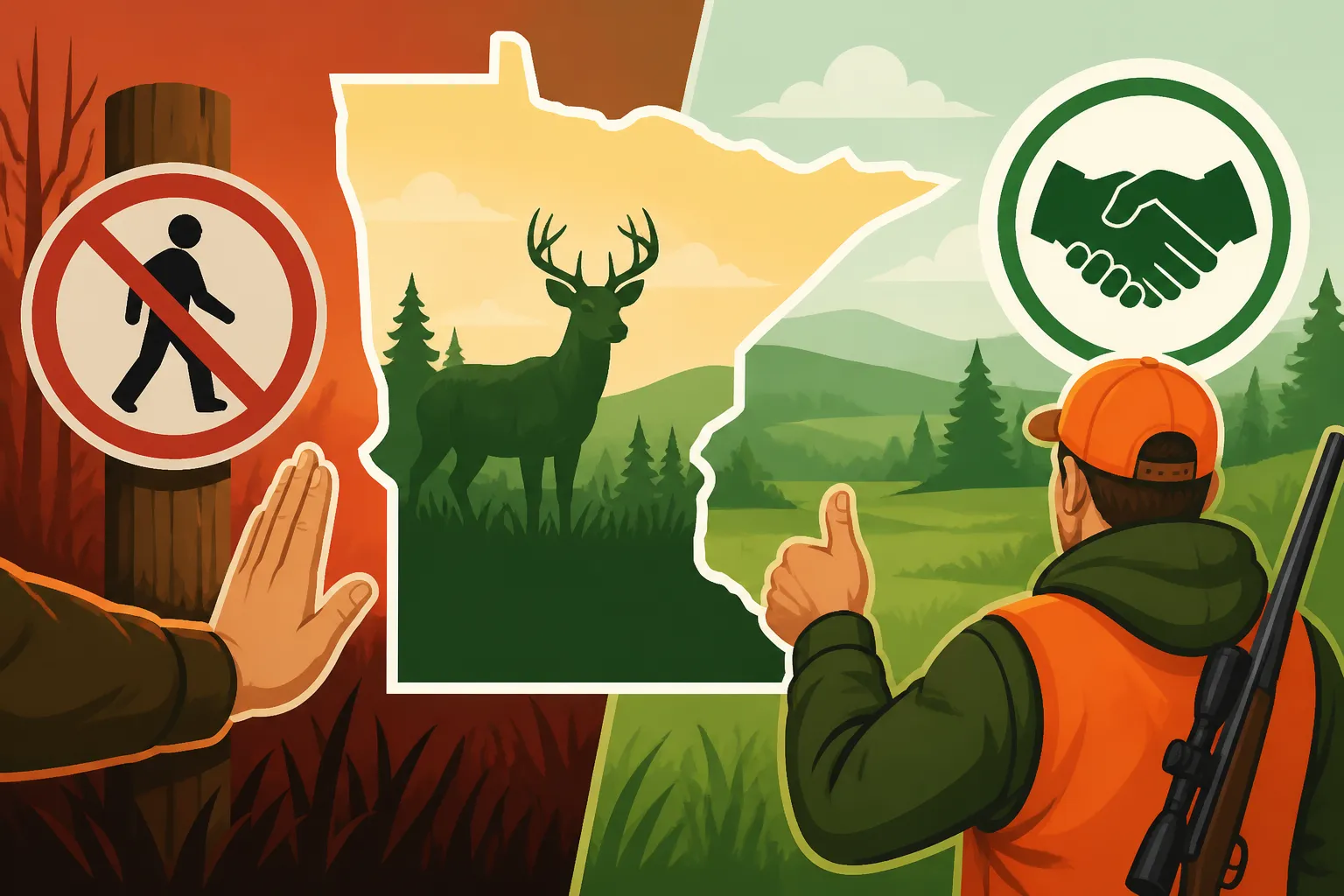
In Minnesota, land is legally considered "posted" if it has signs conspicuously placed, or if the boundaries are marked with purple paint. These signs typically say "No Trespassing," "Private Property," or similar warnings. The idea is to give clear notice that the land is private and entry is forbidden without permission.
You, as the hunter, have a fundamental responsibility to identify whether land is posted. This means paying attention to property lines, looking for signs, and recognizing purple paint marks on trees or posts. Imagine you're driving down a gravel road in northern Minnesota, eyeing a promising patch of popple cover. You think it looks like perfect grouse habitat. You might see a few old, faded "No Hunting" signs nailed to trees along the road. Even if those signs look ancient and barely legible, and aren't spaced every 100 feet, they still serve as a legal warning. Don't assume that because they're old, they're no longer valid. The intent of the landowner, clearly expressed at some point, still stands. It’s always safer to assume the posting is active than to risk a fine or worse.
The Absence of "Posted" Does Not Equal Permission
This is perhaps the biggest misconception. Many hunters operate under the assumption that if land isn't specifically marked with "No Trespassing" signs or purple paint, it's fair game. This is simply not true in Minnesota. The law states that entering private land for recreational purposes, including hunting, without the owner's permission is trespassing, regardless of whether the land is posted.
Think about it this way: you scout out a fantastic funnel between two large cattail sloughs, an ideal spot for catching a cruising buck during the rut. Both sloughs are clearly private and posted, but the strip of timber connecting them has no visible signs. It feels like an open corridor, doesn't it? Many hunters would see that "unposted" strip and assume it's okay to sneak in. However, that timber is still owned by someone. That owner might have simply never gotten around to posting it, or perhaps they prefer a more subtle approach. Regardless of their reasons, that land is private, and you need permission. Operating under the "unposted means fair game" mentality is a quick way to find yourself in legal trouble or to burn bridges with landowners who might otherwise be open to granting access. For more specifics on what exactly constitutes posted land, check out Minnesota Posted Land Rules.
Implied vs. Express Permission
In the context of hunting, the concept of "implied permission" is almost always a risky bet and rarely applies. Implied permission generally refers to situations where it's understood you're allowed on property, like walking up to a front door to knock. For hunting, you need express permission.
Express permission means the landowner (or an authorized agent) has explicitly given you permission to be on their property for hunting. This can be verbal or, even better, written. It leaves no room for doubt or interpretation. The frustration for many hunters is the ambiguity. You might have waved to a farmer a few times, and he's always seemed friendly. Does that imply you can hunt his back forty? Absolutely not. That friendly wave doesn't translate into permission to carry a firearm onto his land. Without a clear "yes, you can hunt here" from the landowner, you simply do not have permission. Always err on the side of caution and seek that explicit approval.
The Critical Importance of Express Permission
Once you understand that unposted land still requires permission, the next step is securing that permission properly. This isn't just about following the law; it's about respecting the landowner and building trust.
Verbal Permission: Its Strengths and Weaknesses
Verbal permission is often the easiest and quickest way to get access. You knock on a door, have a friendly chat, and the landowner says, "Sure, go ahead, but stick to the back woods." It's direct, personal, and can quickly open up opportunities. Many hunting relationships start with a handshake and a verbal agreement.
However, verbal permission comes with significant weaknesses. Memories fade. People change their minds. And tragically, landowners pass away. Imagine you've hunted a specific woodlot for years, always getting a verbal "yes" from old man Johnson. You've built a rapport, maybe even helped him out with a few chores. Then, one opening weekend, you're sitting in your stand, and a truck pulls up. It's Mr. Johnson's son, who inherited the land, and he has no idea who you are or that his dad ever gave you permission. He sees a stranger with a rifle on his property and immediately calls the sheriff. Suddenly, a long-standing, friendly arrangement turns into a legal nightmare for you. Without anything in writing, it becomes your word against his, or against a memory that no longer exists. While verbal permission is better than none, it lacks the legal weight and clarity of a written agreement.
Written Permission: The Gold Standard
For true peace of mind and protection for both you and the landowner, written permission is the gold standard. A simple written note, signed and dated by the landowner, can prevent countless misunderstandings and legal headaches. What should it include?
- Landowner's Name and Contact Info: Essential for identification.
- Hunter's Name and Contact Info: So they know who is on their land.
- Specific Dates: Start and end dates for the permission. Is it for the whole season, a specific week, or just a day?
- Specific Area: Clearly define where on the property you are allowed to hunt (e.g., "the forty acres west of the creek," "south side of the cornfield").
- Permitted Activities: Hunting deer, pheasants, small game? Using a firearm, bow, or muzzleloader?
- Limitations: Are there areas off-limits? Can you drive on their fields? Are guests allowed?
- Landowner Signature and Date: Crucial for legal validity.
Picture this scenario: you've secured permission to hunt a parcel of private land adjacent to a Minnesota WMA. You've even gone so far as to draw a crude map on the back of the permission slip, outlining the specific boundaries the landowner agreed upon. This simple act provides clarity. If you're ever approached by another hunter, a neighbor, or even law enforcement, you have tangible proof of your right to be there. It protects you from accusations and gives the landowner peace of mind knowing exactly who is on their property and what they're doing. This attention to detail is what sets apart a responsible hunter and helps build a positive reputation. Do You Need Written Permission in Minnesota? delves deeper into this often-asked question.
Landowner Agreements and Leases
Beyond a simple permission slip, some hunters and landowners opt for more formal arrangements. These can include detailed written agreements that outline responsibilities, liability, and usage over multiple seasons. For larger or more desirable properties, hunting leases are becoming increasingly common.
A hunting lease is essentially a contract where you pay the landowner for exclusive hunting rights to a specific piece of property for a set period, typically a season or a year. These are much more comprehensive than a simple permission slip, often covering liability insurance, maintenance of the property, specific rules for stands or blinds, and even limits on the number of hunters. While a lease involves a financial commitment, it provides the highest level of security and often exclusive access, which can be invaluable in areas with high hunting pressure. It's a significant step, and hunters considering this path should understand all the terms involved. If you're looking into more structured access, you might want to read about Minnesota Hunting Lease Costs to understand the financial implications and typical arrangements.
Navigating Property Lines and Boundaries
Even with the best intentions and proper permission, understanding and staying within property lines can be a challenge, especially in dense Minnesota cover. Modern technology has certainly made this easier, but traditional methods and good old-fashioned scouting still play a vital role.
Identifying Property Lines in the Field
Knowing where one property ends and another begins can be surprisingly difficult in the woods. Fences might exist in some areas, but often you're looking for subtle changes: a change in timber type, an old two-track road, a stream, or perhaps a series of survey markers that are decades old and barely visible. These markers, if you can even find them, might be rusty rebar stakes, carved trees, or concrete monuments. In thick popple cuts or dense alder swamps, those lines can disappear entirely.
This is where technology becomes your best friend. GPS mapping apps like onX Hunt and GoHunt have revolutionized how hunters navigate property boundaries. These apps use GPS signals to pinpoint your exact location on a map that displays property lines, ownership information, and even different types of public land. Imagine you're still-hunting through a thick aspen stand, slowly picking your way through the tangles, when you notice a promising rub line leading towards a small swamp. With your onX Hunt app open, you can see that the rub line is heading straight for the boundary of the property you have permission for, and beyond that lies a parcel of private land you don't have access to. The app allows you to instantly visualize these boundaries, ensuring you don't inadvertently step onto unauthorized ground. This real-time awareness is indispensable. For more details on leveraging these tools, check out onX Layers for Minnesota Land Status.
Accidental Trespass and How to Handle It
Despite your best efforts, mistakes happen. You might get disoriented, follow a game trail too far, or simply misread your map. Accidental trespass is not ideal, but how you handle it can make a huge difference.
If you realize you've accidentally crossed onto private property where you don't have permission, the immediate and most crucial step is to cease hunting activities. Unload your firearm or secure your bow, make yourself visible, and calmly but quickly retreat back to legal ground. Do not try to sneak out or hide. If you are confronted by the landowner or law enforcement, be honest, apologize, and explain what happened. Most people are understanding if you are respectful, apologetic, and immediately rectify the situation. Trying to bluff your way out or argue will only escalate the problem and reflect poorly on all hunters. Remember, even if it was an honest mistake, you were still technically trespassing. Your actions in that moment speak volumes about your character as a hunter.
Retrieving Game From Private Land
This is one of the most frustrating and often misunderstood aspects of trespass law for hunters. You've made a great shot on a magnificent Minnesota whitetail, you've trailed it a good distance, only to find its tracks leading directly onto adjacent private property where you do not have permission. Your shot was legal, the deer is legally yours, but retrieving it from private land requires new permission.
It doesn't matter how close the deer is to the property line, or how long you've been tracking it. The moment that deer crosses onto land you don't have permission for, you must stop. The worst thing you can do is simply follow the deer onto that property without asking. This turns a legal kill into a potential trespass violation. Instead, mark the location where the deer crossed the property line as precisely as possible. Then, attempt to contact the landowner. Explain the situation calmly and politely, emphasizing that you stopped at their property line and are now asking for permission to retrieve your legally harvested animal. Offer to retrieve it quickly and respectfully, causing as little disturbance as possible. Sometimes, the landowner may even offer to help you. If you can't reach the landowner, contact a local conservation officer. They might be able to help facilitate contact or even accompany you. This situation highlights the importance of knowing your hunting area thoroughly and, ideally, securing permission for adjacent parcels before you hunt. For detailed steps on this specific challenge, refer to Retrieving Game From Private Land in Minnesota.
Tools and Technologies for Responsible Hunting
In today's world, technology has given hunters powerful tools to ensure they stay on the right side of the law and maintain positive relationships with landowners. Gone are the days of guessing where property lines might be.
Mapping Apps: Your Best Friend for Public and Private Land
I cannot stress enough how much a good mapping app like onX Hunt or GoHunt can change your hunting experience for the better. These aren't just gadgets; they are essential tools for responsible public and private land navigation.
Here's how they work wonders:
- Property Line Overlays: They display precise property boundaries directly on satellite imagery or topographic maps. You can see exactly where public land ends and private property begins, or where one private parcel meets another.
- Owner Information: Many of these apps provide landowner names, and sometimes even contact information, which is invaluable for Asking a Minnesota Farmer for Permission. Instead of just knocking on a random door, you can call ahead or address the landowner by name.
- Real-Time GPS Tracking: As you walk, the app shows your exact location relative to all these boundaries. This eliminates guesswork in dense cover, helping you avoid accidental trespass.
- Custom Waypoints and Tracks: You can mark your stand locations, game sightings, and even track your path, making it easy to analyze your movements and stay within permitted areas.
- Offline Maps: Crucially for many remote Minnesota hunting areas where cell service is non-existent, you can download maps ahead of time. This ensures you always have your property line information, even miles from the nearest tower.
Imagine you're scouting a new section of state forest, but you suspect a few fingers of private land jut into it. With an app like onX Hunt, you can zoom in, identify those private sections, and adjust your scouting and hunting plans accordingly. It prevents you from wasting time on inaccessible land and, more importantly, keeps you out of trouble. Finding Minnesota Property Lines is made infinitely easier with these modern marvels.
Plat Books and County Resources
While digital maps are phenomenal, traditional resources still have their place, especially if you're planning a trip to a truly remote area or prefer analog methods. Plat books, available for most Minnesota counties, are essentially atlases that show land ownership by parcel.
These books are often found at county courthouses, libraries, or local sporting goods stores. They provide a static, detailed view of property lines and landowner names. The benefit is their comprehensive nature for a given area, and they don't rely on batteries or cell service. The drawback, of course, is that they aren't real-time. Land ownership can change, and you won't know your exact location on a paper map as precisely as with GPS. However, for initial research or for cross-referencing, a plat book is a valuable tool. Additionally, county assessor's offices are public resources where you can look up parcel information and landowner details, often even online. These offices can be a great starting point for identifying who owns the land you're interested in before you ever set foot on it.
Scouting and Due Diligence
No matter how many maps or apps you use, nothing replaces good old-fashioned boots-on-the-ground scouting. Physically exploring the property and its boundaries before hunting season opens is an act of due diligence that pays dividends.
When you scout, you can visually confirm property lines, look for old fences, survey markers, or natural breaks that delineate parcels. You can also identify potential access points, understand the terrain, and get a feel for how the landowner might have posted their property. Sometimes, a property line that looks straight on a map might actually follow a meandering creek or a subtle ridge line in reality. Knowing these nuances helps prevent mistakes when you're focused on the hunt. Furthermore, scouting allows you to identify neighboring properties and, if necessary, seek permission from those landowners too, particularly if you anticipate a game animal might cross onto their land. This proactive approach to land access is a hallmark of an ethical hunter. To learn more about effective pre-season preparation, take a look at Scouting Minnesota Public Land Before Season.
Legal Consequences and Ethical Hunting
Understanding Minnesota's trespass and permission laws isn't just about avoiding trouble; it's about upholding the integrity of hunting as a whole. Your actions, good or bad, reflect on every other hunter out there.
Penalties for Trespassing in Minnesota
Make no mistake, trespassing while hunting in Minnesota is a serious offense, not merely a slap on the wrist. The penalties can range significantly depending on the circumstances, but none of them are pleasant.
Typically, trespassing is a misdemeanor, which can carry fines and potentially jail time. However, if the trespassing involves damage to property, ignoring direct orders from a landowner, or repeatedly violating the law, the charges can be elevated. Beyond the legal fines, you could face the loss of your hunting license and privileges for a period of time, meaning you won't be able to hunt any game animals in Minnesota. In some cases, your hunting equipment—firearms, bows, even vehicles—could be confiscated. Imagine the personal and financial impact of losing your hunting rifle and your right to hunt for a year or more, all because you didn't take the time to get permission. It's a risk simply not worth taking. The specific penalties can vary, and it's always wise to be aware of the potential consequences. For a broader view of what can happen when rules are broken, see Minnesota Wildlife Violation Penalties.
The Ripple Effect of Unethical Behavior
Beyond the personal legal consequences, every act of unethical hunting, including trespassing, has a detrimental ripple effect on the entire hunting community. Landowners are often the gatekeepers to vast tracts of huntable land, and their perception of hunters is largely shaped by the actions of a few.
One bad apple truly can spoil the bushel. If a landowner has a negative experience with a trespassing hunter, they are far less likely to grant permission to any hunter in the future, even responsible ones who ask politely. This leads to more "No Trespassing" signs, more locked gates, and less available land for everyone. It fuels the anti-hunting narrative and makes it harder for future generations to experience the tradition. Ethical hunting is about more than just following the law; it's about being a good steward of the land and a respectful guest. Every time you ask for permission, thank a landowner, or pack out your trash, you're contributing positively to the image of hunters and potentially opening doors for others.
Building Trust and Securing Future Access
The best way to ensure access to private land, both for yourself and for the wider hunting community, is to build and maintain trust with landowners. This starts with respect and clear communication.
When you approach a landowner, be polite, well-groomed, and concise. State your name, where you're from, and clearly explain why you're there. Offer references if you have them. Be ready to show proof of hunter safety training and your hunting license. Be flexible and willing to adhere to any specific rules or restrictions they might have. Perhaps they don't want you driving on their newly seeded alfalfa field, or they prefer you don't hunt near their house. Respect these requests without argument. If they say no, accept it gracefully, thank them for their time, and move on. Even a "no" today doesn't mean a "no" forever. You might be surprised how a polite approach can eventually lead to permission down the road. Furthermore, consider offering to help them out – maybe offer to mend a fence, help with chores, or share some of your harvest. These small gestures can go a long way in building a lasting relationship. The process of Asking a Minnesota Farmer for Permission is an art, and mastering it benefits everyone involved.
| Permission Type | Pros for Hunter | Cons for Hunter | Pros for Landowner | Cons for Landowner |
|---|---|---|---|---|
| Verbal | Quick, easy to obtain, builds personal rapport. | No legal proof, easily forgotten/misunderstood. | Simple, informal, maintains flexibility. | No formal record, potential for misunderstanding. |
| Written | Clear legal proof, outlines terms, protects hunter. | Requires more effort, less flexible once written. | Clear record of who, when, where; reduces liability risk. | Less flexible than verbal. |
| Lease | Exclusive access, clearly defined rights, long-term. | Costly, legally complex, less spontaneous. | Guaranteed income, clear terms, limits hunter numbers. | Less personal, potential for legal disputes. |
Disclaimer
This article is for general informational purposes only and does not constitute professional advice. Laws, prices and regulations vary by location and change over time. Consult a qualified professional for guidance on your specific situation.