Illuminated Reticles for Dark Timber
One of the most frustrating things about hunting in Minnesota, especially when you're tucked deep in the hardwoods or scanning a dense popple cut at dawn or dusk, is that crucial moment when you spot a deer, but your reticle just disappears into the shadows. That split second of fumbling, trying to line up a shot without a clear aiming point, can mean the difference between filling your tag and watching a trophy buck melt back into the timber. This guide is all about shedding light on how illuminated reticles can transform your low-light hunting experience, helping you make confident shots when it matters most in Minnesota's challenging woods.
The Challenge of Dark Timber and Low Light Shots in Minnesota
Minnesota's diverse hunting landscape, from the sprawling "Big Woods" of the north to the dense river bottoms and heavily wooded bluffs of the south, presents unique optical challenges. Hunters frequently find themselves in situations where legal shooting light is technically available, but the actual ambient light under a thick canopy or on a heavily overcast day is shockingly dim. This isn't just an inconvenience; it can severely impact shot accuracy and hunter confidence.
Why Minnesota's Woods Demand Better Optics
Think about setting up your treestand deep in a tamarack swamp or along a thick pine ridge for deer. You know the deer are moving through there, perhaps hugging the cover to avoid open areas. You're trying to identify a legal buck, looking through branches, shadows, and the general gloom that settles in before sunrise or clings long after sunset. Traditional black reticles, while excellent in bright conditions, vanish against the dark background of tree trunks, tangled brush, or a deer's hide. They blend in completely, leaving you with a vague sight picture and no distinct aiming point. It's not just about hitting your target; it's about making an ethical shot, and that starts with being able to clearly see where your bullet will go.
This challenge is compounded by specific cover types we encounter here. A mature oak forest can feel like a cave even at midday under heavy cloud cover, with dense canopies blocking out light. Cattail sloughs, famous for holding big bucks, create extremely dark pockets of cover where light struggles to penetrate. Even open fields with thick edges, common in our farm country, can present issues if a deer steps out just before legal shooting hours close, and the treeline shadows are already long and deep. Rifle Scopes for Low-Light Timber become critical for discerning details and making those crucial determinations about shot placement.
The Moment of Truth: When Light Fails You
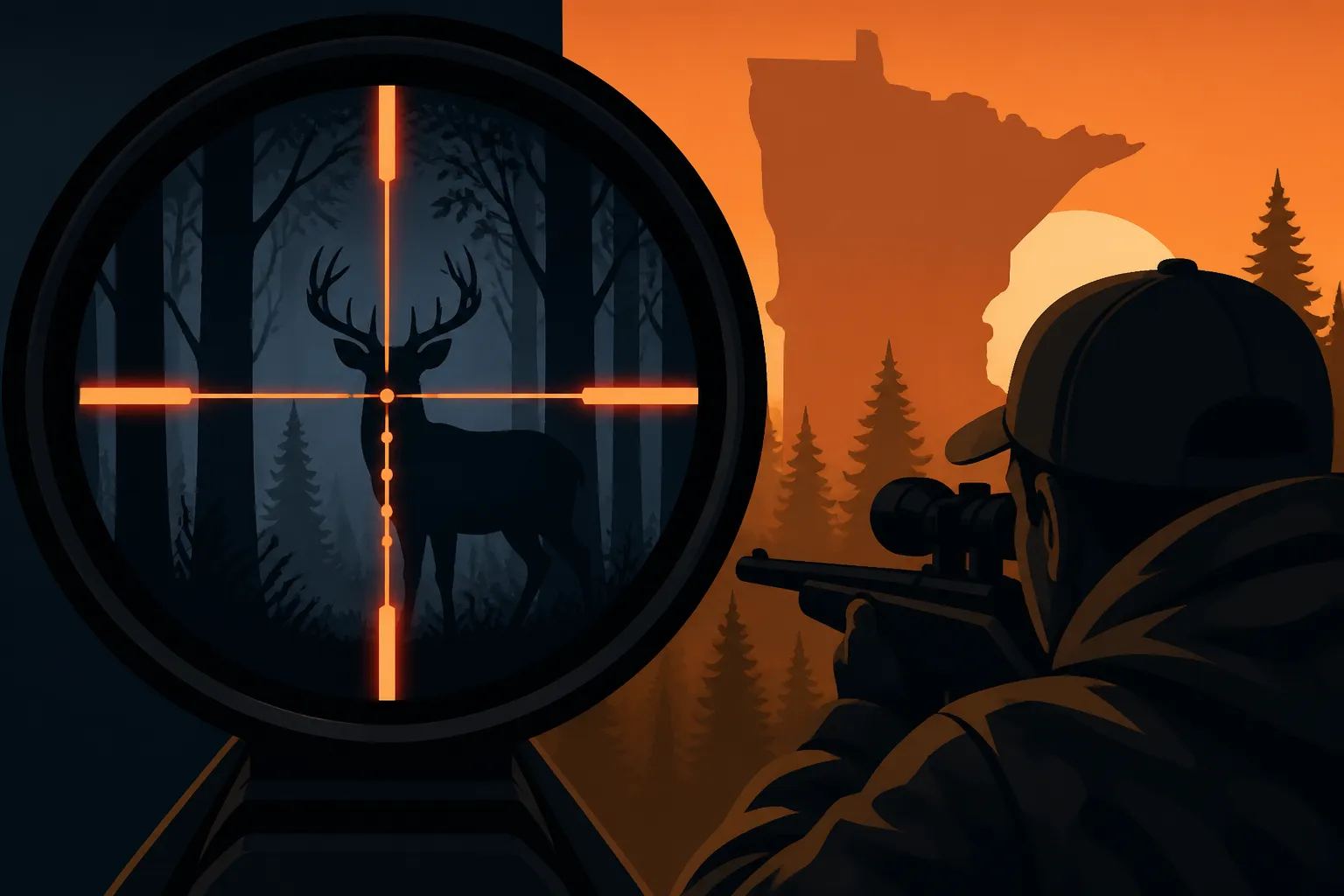
It's happened to almost every Minnesota hunter: you're patient, you're quiet, and finally, a deer steps out. Maybe it's that giant eight-pointer you've been after all season, or simply a doe to fill the freezer. But the light is fading fast, or you're in an area so thick it feels like midnight. You shoulder your rifle, look through your scope, and all you see is a blurry target with a ghostly black crosshair that's indistinguishable from the background. The adrenaline spikes, your heart races, and suddenly, doubt creeps in. Can you really make that shot?
This isn't just a mental hurdle. It's a real optical problem. Without a visible aiming point, you might instinctively try to guess the center, leading to an imprecise shot. Or, worse, you might hesitate, causing the deer to move or bolt before you can confidently fire. This scenario is particularly common during the peak of Hunting the Minnesota Rut in Early November, when bucks are active throughout the day but often move into the darkest, thickest cover during twilight hours. An illuminated reticle eliminates this guesswork by providing a bright, clear aiming point that stands out, regardless of the surrounding light conditions, giving you the confidence to make the shot when it truly counts.
What an Illuminated Reticle Is and How It Works
So, what exactly are we talking about when we say "illuminated reticle," and how does this technology benefit a hunter peering into the Minnesota gloom? Simply put, an illuminated reticle is a scope reticle (the crosshairs or aiming point) that can be lit up, usually by a small internal LED, making it glow. This isn't just a fancy gimmick; it's a practical tool designed to solve the problem of a disappearing reticle in challenging light conditions.
Understanding Reticle Types and Illumination
There's a wide variety of illuminated reticles out there, far beyond just a basic crosshair that lights up. Many scopes feature a simple illuminated dot at the center of the crosshairs, which is often sufficient for timber hunting. This dot draws your eye directly to the aiming point without cluttering the view. Other designs might illuminate the entire crosshair or even more complex reticles, sometimes called "Christmas tree" or BDC (bullet drop compensator) reticles, which have additional marks for long-range holdovers. For typical Minnesota woods hunting, where shots are often under 100 yards, a simple illuminated dot or a partially illuminated crosshair is often ideal, as it keeps the field of view clean. Zeroing at 100 Yards for Timber Hunting is a common practice, and an illuminated reticle helps with precision even at that closer range.
The illumination source is usually a small LED powered by a watch-style battery, and the light is projected onto the reticle itself. Most illuminated reticles offer multiple brightness settings, allowing you to adjust them to match the ambient light. You don't want a reticle that's too bright, as it can cause glare and actually obscure your target. Conversely, a reticle that's too dim won't offer much advantage. The ability to fine-tune the brightness is crucial for adaptability, whether you're in the deep shade of a pine forest or the slightly brighter edge of a clear-cut.
Battery Life and Brightness Settings in the Field
One common concern hunters have is battery life. Modern illuminated reticles are incredibly efficient. A single battery can often last for hundreds, if not thousands, of hours of intermittent use. However, it's always smart to carry a spare battery, especially if you're heading out for an extended hunt or camping trip. Most scopes will have a battery compartment that's easily accessible in the field, so a quick swap is usually no problem. Before heading out each season, or even for a weekend hunt, it's a good habit to check your scope's illumination and ensure the battery is fresh.
Brightness settings are your friend. On a truly dark, overcast morning, you might need a brighter setting to make the reticle stand out. But as the sun rises and filters through the trees, you'll want to dial that back to prevent "blooming," where the reticle light bleeds into the surrounding view. In very low light, a setting that's barely visible to the naked eye is often perfect, offering just enough contrast to make the aiming point pop without overpowering your natural vision. Many high-quality scopes, like those you might research on GoHunt, offer a very wide range of settings, including extremely dim ones specifically designed for true low-light conditions or even night vision compatibility, though that's generally beyond the scope of legal deer hunting in Minnesota.
Benefits of Illuminated Reticles for Minnesota Hunters
The advantages of an illuminated reticle go beyond just making your crosshairs visible. For Minnesota hunters, who frequently deal with challenging light and dense cover, these benefits translate directly into more successful and ethical hunts. They enhance your ability to perform under pressure and extend your effective hunting window.
Enhanced Visibility in Low Light and Heavy Cover
As we've discussed, the primary benefit is undeniable visibility. Imagine it's last legal shooting light, and a buck steps into a thick cedar swamp. Without illumination, your black crosshairs might completely disappear against the dark branches and the deer's shadowy body. With a glowing reticle, whether it's a red dot or a green crosshair, that aiming point pops. It gives you a clear, unambiguous reference point, even when the rest of your scope picture is dim and indistinct. This is especially true for hunters pursuing deer in areas like the Where Big Woods Bucks Bed in Minnesota, where daylight hours can feel shorter due to the canopy.
This enhanced visibility doesn't just apply to twilight. It's incredibly useful on heavily overcast days, during light rain or snow, or when hunting in deep valleys or ravines where sunlight rarely reaches. I've been in stands where, at midday, under a dense stand of pines, it felt like perpetual dusk. An illuminated reticle allowed me to confidently identify and place a shot on a deer that would have been a "no-go" with a traditional reticle. This greatly improves your ability to make ethical shots by ensuring you can always see exactly where you're aiming.
Faster Target Acquisition and Shot Placement
When a deer presents itself, especially in a timber setting, you rarely have a lot of time. They might only be visible for a few seconds before stepping behind another tree or into thicker brush. Fumbling to find your crosshairs in dim light eats up precious seconds. An illuminated reticle, with its bright, distinct aiming point, allows for incredibly fast target acquisition. Your eye is naturally drawn to the glowing dot or cross, immediately aligning it with your target. This is critical for making a quick, clean shot before the opportunity vanishes.
Beyond speed, it improves shot placement. When you can clearly see your reticle, you can be much more precise with where you put it on the animal. No more guessing if your barely visible crosshair is centered on the vitals. This leads to cleaner kills, less tracking, and less chance of wounding an animal. For instance, when Hunting the Minnesota Rut in Early November, bucks can be on the move quickly, and an illuminated reticle gives you that extra edge in getting on target efficiently. This confidence in precise shot placement is invaluable.
Versatility for Different Hunting Scenarios
Illuminated reticles aren't just for deer hunting in dark timber. They offer versatility across a range of Minnesota hunting pursuits. For example, during Muzzleloader Deer Hunting in Minnesota in December, when days are short and often overcast with heavy snow, an illuminated reticle can be a huge asset. The low light combined with falling snow can make traditional reticles almost impossible to see against a white, shadowy backdrop.
Even for smaller game or predators like Coyote Calling in a Minnesota Winter, where animals might come in quickly at dawn or dusk, an illuminated reticle can provide that crucial aiming advantage. For hunters who also use their rifle for other purposes, such as target shooting or even some varmint control, having the option of illumination means your optic is adaptable to a wider array of lighting conditions. The ability to turn the illumination off when not needed, saving battery life and preventing glare in bright conditions, ensures it's a tool you can use all the time, not just in specific scenarios.
Here's a quick comparison of how an illuminated reticle helps in various Minnesota hunting conditions:
| Condition | Traditional Reticle Challenge | Illuminated Reticle Advantage |
|---|---|---|
| Deep Woods / Dark Timber | Black reticle disappears against dark trees/brush/animal hide. | Glows brightly, stands out against any background for clear aim. |
| Dawn/Dusk Twilight | Very difficult to discern against fading light or shadows. | Provides a distinct, high-contrast aiming point as light dims. |
| Overcast / Rainy Days | Flat, dull light reduces contrast; reticle fades. | Maintains visibility, cutting through gloom and haze. |
| Inside a Ground Blind | Blind interior can be darker than outside, obscuring reticle. | Offers a bright aim point even in your confined, darker space. |
| Against Snow Background | Black reticle can blend into white, shadowy snow. | Contrasts sharply with snow, preventing washout and maintaining aim. |
| Quick Shots | Eye searches for reticle, wasting critical time. | Eye is instantly drawn to glowing point, speeding target acquisition. |
Choosing the Right Illuminated Reticle for Your Minnesota Hunt
With so many options on the market, choosing the right illuminated reticle can feel a bit overwhelming. However, by focusing on key features relevant to Minnesota hunting, you can narrow down the choices and find an optic that truly enhances your experience. It's about finding the sweet spot between functionality, durability, and your budget. Optics for Minnesota Big Woods and Farmland often emphasize different features, but illumination is a universal benefit.
Key Features to Look For
When you're comparing illuminated reticle scopes, here are some critical aspects to consider:
- Brightness Settings: Look for a scope with a wide range of brightness settings, including very low, subtle options. Too many scopes have a "lowest" setting that is still too bright for true dark timber or twilight, causing glare and hindering your natural night vision. The best scopes allow for almost imperceptible illumination, just enough to make the reticle pop. Some scopes even have an "off" position between each brightness level, which is a fantastic feature for quickly dialing to your preferred setting. When researching, sites like GoHunt often have user reviews that speak to the practical range of brightness levels in real-world conditions.
- Reticle Design: For Minnesota deer hunting, a simple, uncluttered reticle is usually best. A fine illuminated dot or a partially illuminated crosshair will give you a precise aiming point without obscuring too much of your target. Avoid overly complex reticles unless you genuinely plan on taking very long shots, which are rare in our thick woods. The goal is clarity and speed.
- Illumination Color: Most illuminated reticles come in red, but some are available in green or even blue. Red is generally considered excellent for low-light conditions as it's less disruptive to your natural night vision. Green can also work well, especially if you have an astigmatism that makes red bloom. Try to look through different colors if possible to see what works best for your eyes.
- Battery Life and Accessibility: As mentioned, good battery life is standard now, but check typical runtime. Also, ensure the battery compartment is easy to access and that replacement batteries are common and affordable. A side-mounted illumination control turret is often preferred over one integrated into the eyepiece, as it's easier to manipulate while keeping your eye on the target.
- Durability and Weatherproofing: Minnesota hunting conditions can be tough – cold, wet, snowy. Your scope needs to be robust. Look for optics that are nitrogen-purged (fog proof), O-ring sealed (waterproof), and shockproof. The illumination system itself should be well-protected within the scope's housing. A scope that fogs up or has its illumination fail in damp conditions is worse than useless.
Common Mistakes to Avoid When Using Illumination
Even with the best illuminated reticle, there are a few pitfalls hunters sometimes fall into:
- Leaving it on Constantly: This is the quickest way to drain your battery. Only activate the illumination when you anticipate needing it or when you've spotted an animal in low light. Many modern scopes have an auto-off feature after a period of inactivity, which is a great safeguard, but don't rely solely on it.
- Too Bright Setting: A common mistake is using the illumination too brightly. If the reticle is glowing intensely, it can create a distracting halo effect, reduce your natural vision outside the reticle, and make it harder to see details on your target. Always dial it down to the lowest effective setting. The reticle should be just bright enough to stand out clearly without being overpowering.
- Forgetting Spare Batteries: It's a simple thing, but easily overlooked. Tuck a spare battery into your pack, your rifle case, or even taped to the inside of your scope cap. A dead battery at the critical moment renders your illuminated reticle useless.
- Not Practicing with Illumination: Don't wait until opening day to try out your illuminated reticle. Practice at the range in varying light conditions. Get a feel for which brightness settings work best for you in different scenarios, from bright daylight to simulated low-light conditions. This practice will build confidence and make its use second nature when that trophy buck finally steps out.
- Ignoring Low-Light Performance in a Scope Beyond Illumination: While illumination is great, it doesn't replace overall optical quality. Make sure the scope still gathers light effectively, has clear glass, and good contrast. The illumination is there to make the reticle visible, but the scope itself still needs to provide a bright, sharp image of your target. A high-quality scope with illumination will always outperform a budget scope with illumination.
By understanding the benefits and how to properly select and use an illuminated reticle, you can significantly improve your chances of success and make more ethical shots during Minnesota's challenging low-light hunting hours. It's a game-changer for deer, bear, and other game where precision in dim conditions is paramount.
Disclaimer
This article is for general informational purposes only and does not constitute professional advice. Laws, prices and regulations vary by location and change over time. Consult a qualified professional for guidance on your specific situation.