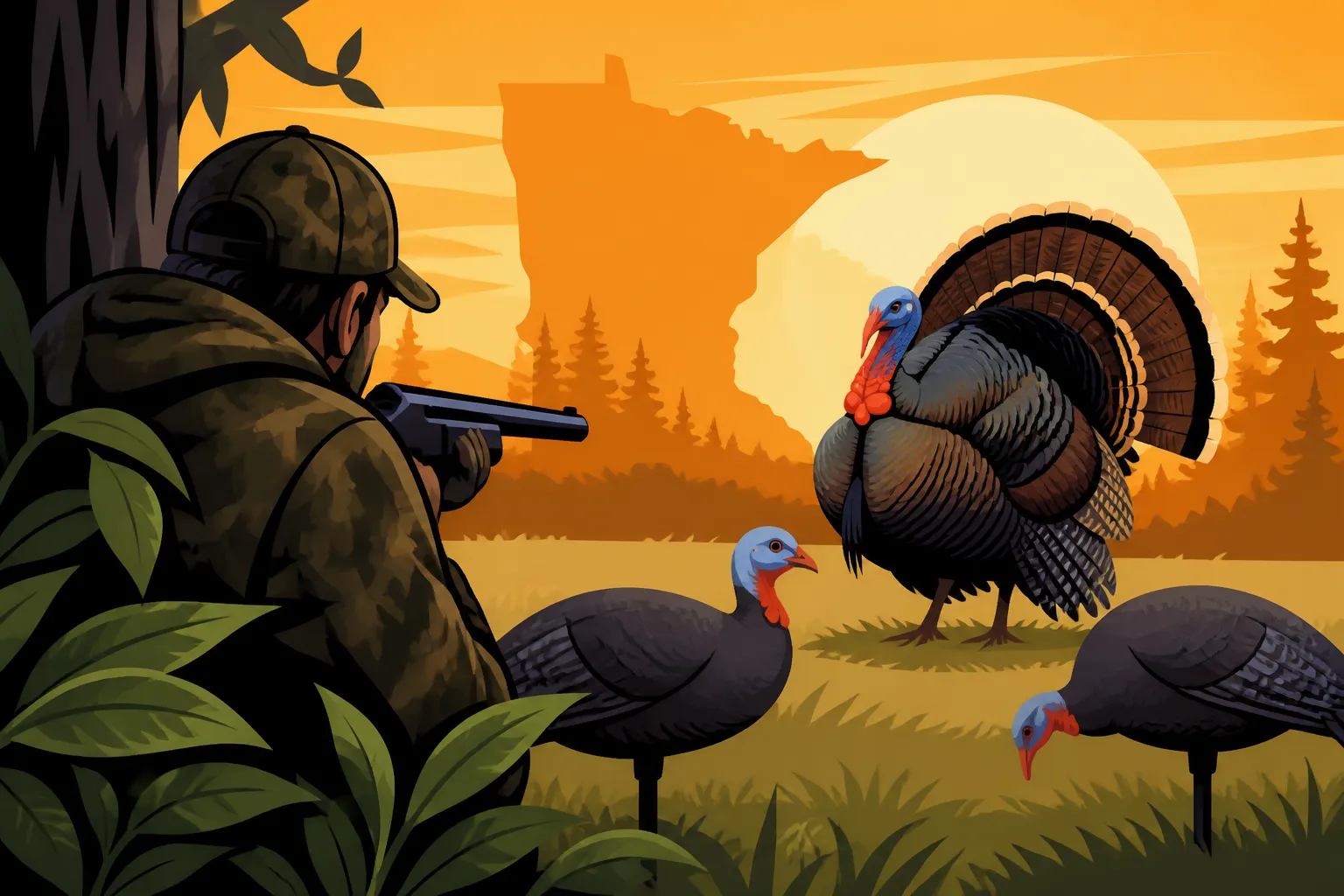
Turkey Decoys That Work on Pressured Birds
Hunting pressured gobblers in Minnesota can feel like trying to catch smoke. Those wily longbeards have heard every call, seen every spread, and are incredibly wary of anything that looks or sounds out of place. This guide is all about giving you the edge, focusing on decoy strategies that actually work when the birds are tight-lipped and skittish, helping you coax even the most educated turkeys into range.
Understanding Pressured Turkeys in Minnesota
If you've spent any time chasing spring gobblers here in Minnesota, especially on public land or during later seasons, you know they're a different breed. That early-season excitement, when birds might gobble at anything and stride right into a full spread, quickly fades. You're left scratching your head, wondering if they've all just vanished. But they haven't; they've just gotten smart.
What Makes a Turkey Pressured?
A pressured turkey is essentially one that has learned from negative experiences. Maybe they've been shot at, spooked by human scent, or simply called to incessantly by less-than-subtle hunters. On public land, especially in popular Wildlife Management Areas or State Forests, birds often encounter hunters from opening day onward. This teaches them caution. They become less vocal, more apt to hang up just out of range, and incredibly suspicious of anything too overt. You'll find this particularly true during mid to late spring periods, or in areas like Whitewater WMA where hunting intensity can be high. It’s not just about the gun pressure, either. Constant calling, hunters walking through roosting areas, or even just general human presence can make a bird "pressured." Think about those toms that gobble on the roost, fly down, and then clam up, often drifting away silently – that's a classic sign of pressure.
How Pressure Impacts Decoy Effectiveness
When turkeys are pressured, their natural instincts for self-preservation kick into overdrive. An elaborate, aggressive decoy spread that worked wonders on opening weekend can become a red flag. A gobbler might see a full strutting tom decoy with multiple hens and immediately associate it with danger, or simply view it as too much competition and detour around it. They're looking for subtle, natural interactions, not a neon sign screaming "come get shot!" Their guard is up, and they've developed a keen sense for what's real and what isn't. This is why many hunters, myself included, have watched a beautiful longbeard strut his way to 70 yards, then just hang there, staring suspiciously at the plastic birds before melting back into the timber. It's frustrating, but it's a clear signal that your current strategy isn't cutting it. It's time to adapt, to think like the wary bird, and to adjust your decoy setup accordingly.
Decoy Characteristics for Pressured Gobblers
When it comes to outsmarting those Minnesota longbeards that have seen it all, your decoy choice isn't just about throwing out some plastic. It's about subtle realism and portraying a non-threatening, inviting scenario. Forget the flashy, super aggressive setups that might work in less-pressured areas. Here, we're aiming for a quiet confidence.
Realism is Key: Detail Feather Texture, Paint Schemes, and Posture
Pressured birds have seen enough fake birds to know the difference. The cartoonish, brightly painted decoys of yesteryear are largely ineffective now. You need realism. Look for decoys that mimic the actual feather patterns and coloration of Minnesota's wild turkeys. Darker, more muted tones with detailed feathering will blend in better and look more natural from a distance. Some of the best options on the market today even incorporate flocking or texture to reduce shine and give a more lifelike appearance, especially under varying light conditions.
Consider the material's finish. A shiny plastic decoy can flash in direct sunlight or look unnatural in certain light, instantly putting off a wary tom. A matte finish or flocked surface will absorb light, making the decoy appear softer and more like a real bird. Posture is also crucial. A stiff, unnatural pose screams "fake." Look for decoys with subtle, relaxed postures – a hen feeding, looking around, or even just standing calmly. These less aggressive, more natural poses communicate safety to an approaching gobbler, suggesting that the area is secure.
Choosing the Right Pose and Size: Discuss Submissive, Breeding, and Feeding Poses
For pressured birds, less is definitely more, and submissive or non-threatening poses are your best friends.
- Submissive or Breeding Hen: A single hen in a receptive or breeding pose is incredibly effective. It tells the gobbler, "Here's an opportunity, and there's no competition." This takes away the intimidation factor of a strutting tom.
- Feeding Hen: A hen with her head down, looking like she's contentedly scratching for bugs, signals absolute safety. She's relaxed, not on alert, which can put a wary gobbler at ease. It's a non-threatening, inviting visual.
- Juvy Jake (Quarter Strut): If you absolutely feel the need for a male decoy, a small, half-strutting jake can work. The key is "small" and "half-strut." This pose is less threatening than a full strut and often signals a young, easily intimidated male that a dominant gobbler will want to chase off. It triggers that territorial instinct without causing outright alarm. Avoid full-strut tom decoys entirely for pressured birds; they often intimidate more than they attract.
Decoy size also matters. A smaller, more compact hen or jake decoy can appear less imposing and more natural. Don't feel the need for oversized, exaggerated decoys. The goal is to blend in, not stand out aggressively. When you're dealing with birds that have likely been called to and seen spreads multiple times a week, the subtle approach is often the only one that works.
Material and Durability: Discuss Foam, Plastic, and Inflatable Options
Decoys come in a variety of materials, each with its pros and cons, especially when you're hiking into public land or setting up in challenging conditions.
- Foam Decoys: These are often very lightweight and can be compressed for easy packing, which is a huge bonus if you're doing a lot of Run-and-Gun Turkey Tactics on Public Land. Many offer good realism and a quiet setup. The downside can be durability; they might not withstand heavy abuse as well as hard plastic, and sharp branches can tear them. However, their light weight makes them ideal for mobile hunting.
- Hard Plastic Decoys: These are generally the most durable and can offer excellent realism, especially with detailed paint jobs and flocked surfaces. They hold their shape perfectly, which is great for consistent presentation. The drawback is weight and bulk. Hauling multiple hard plastic decoys deep into the woods can be a workout, especially if you're also carrying a shotgun, calls, and other gear.
- Inflatable Decoys: Some modern inflatable decoys offer surprisingly good realism, are incredibly lightweight, and pack down to almost nothing. This makes them fantastic for hunters who cover a lot of ground. The main concern is punctures, but good quality inflatables are quite robust. They also often offer some natural movement in the wind, which can be a huge advantage.
When choosing, consider how you hunt. If you're primarily setting up near vehicle access, hard plastic might be fine. But if you're regularly covering miles of timber or farmland edge, a lightweight foam or inflatable decoy will save your back and make you more inclined to pack it in and out. Regardless of material, ensure your decoy stands are sturdy enough for Minnesota winds and silent to deploy.
Strategic Decoy Placement for Tricky Birds
Getting the right decoy is only half the battle; knowing how and where to place it is equally, if not more, critical for pressured Minnesota gobblers. This isn't about setting up a grand display; it's about creating a believable, non-threatening scene that speaks to a tom's natural instincts. Using a mapping tool like GoHunt can really help you visualize the terrain and identify natural approach routes where your decoy setup will be most effective.
Solo Hen or Juvy Jake: Explain Why Less is Often More
When turkeys are pressured, a big, flashy spread can be a deterrent. Instead, simplify. A single hen decoy, or perhaps a hen with a submissive jake, is often the most effective.
- Single Hen: This is my go-to. A lone hen, particularly in a breeding or feeding posture, is incredibly inviting. It signals an opportunity for a lonely gobbler without any perceived competition. He sees an unattached hen and his natural urge to breed takes over. This is especially effective after the initial peak of the rut, when hens might be nesting, and gobblers are actively seeking the few remaining receptive females. Think of a single hen as a quiet invitation, rather than a challenge.
- Hen and Juvy Jake: If you want to add a touch more visual appeal, a hen paired with a small, submissive jake (think half-strut or even just standing) can work wonders. The jake acts as a rival that a dominant tom wants to intimidate or chase off, without being a full-grown threat himself. The hen is still the primary draw, and the jake simply enhances the scene by subtly preying on the longbeard's territorial nature. This setup can be particularly potent when Hunting the Rut in Late October or early November, when dominant behaviors are still strong.
Avoid large numbers of decoys. Two at most, and often one, is all you need for pressured birds. The fewer decoys, the less there is for a wary gobbler to scrutinize and find "off."
Positioning for the Shot: Discuss Angles and Distance Relative to the Hunter
Your decoy placement needs to serve a dual purpose: attracting the bird and setting him up for a clean, ethical shot.
- Distance: Place your decoy 15-25 yards from your blind or setup location. This is the sweet spot. If it's too close, a gobbler might approach too quickly, making you rush the shot. Too far, and he might hang up out of range of your shotgun. This range also gives you a bit of a buffer if the bird circles the decoy before committing.
- Angle: Position your decoy so that an approaching gobbler will naturally present a broadside or slightly quartering-away shot as he focuses on the decoy. Often, gobblers will circle the decoy, approaching from the rear to get a full view of the "hen." Anticipate this by setting your decoy slightly off-center from your position, so the bird's natural approach path brings him into your shooting lane. If you're right-handed, you might want the decoy slightly to your left, encouraging the gobbler to swing around and face away from your left side. This puts his vitals in a prime position as he approaches your decoy.
- Visibility: Ensure your decoy is visible from a distance, but not so exposed that it looks out of place. Utilize subtle openings in the timber, field edges, or logging roads. Reading a Ridge for Northern Minnesota Deer can help you understand how visibility changes with terrain, and the same principles apply to turkeys.
Blending with the Environment: Talk about Natural Cover and Visibility
Decoys, no matter how realistic, must look like they belong there.
- Natural Cover: Don't plop your decoy in the middle of a perfectly manicured lawn unless that's where turkeys naturally feed. Instead, position it near natural cover – the edge of a field, a logging trail, near a brush pile, or along a subtle rise in the terrain. Turkeys use these features for safety and navigation. A decoy nestled naturally in such an environment is far more convincing.
- Sun Angle: Always try to position your decoy so that the sun is hitting it from the same direction as your blind. This prevents shadows from distorting its appearance and makes it pop in a natural way. More importantly, it often places the sun in the approaching gobbler's eyes, making it harder for him to pick out details and spot your hidden position.
- Background: Avoid placing a decoy directly in front of a busy, contrasting background that makes it hard to distinguish. A clean, uniform background (like a dark stand of pines or a distant field) will make your decoy stand out cleanly and naturally. Think about the sight picture from the gobbler's perspective.
- Elevation: Sometimes a slight elevation can make your decoy more visible. Placing a hen on a slight knoll or rise in the field can help her be seen from a greater distance, drawing in a tom that might otherwise have missed her.
Movement and Enhancements: Mention Fan Decoys or Subtle Motion
Even the most realistic static decoy can look lifeless to a wary bird. Incorporating subtle movement can be a game-changer.
- Fan Decoys (Reapers): These are extremely popular for a reason, especially when Hunting Minnesota's Fall Turkey Season. A real or artificial turkey fan, often held by the hunter, can mimic a gobbler fanning or a jake moving. The key is subtle movement. A gentle twitch, a slow rotation – not wild flapping. This simulates a real turkey's head or fan movement, drawing a tom's attention and making him believe he's seeing a real bird. When a gobbler sees a "fan" moving, it engages his vision in a way a static decoy cannot. Many hunters use these in combination with a ground blind, peeking the fan over cover.
- Decoy Stakes with Movement: Some decoy stakes are designed to allow for slight rotation in the wind, mimicking a bird turning its head. Even a slight, natural wobble can add immense realism. You can also experiment with flexible stakes or adding a bungee cord to the base to give it a little more bounce in the breeze.
- Slight Adjustments: If a bird is hung up, a very subtle and slow adjustment to your decoy – maybe a slight tilt or rotation – might be just enough to seal the deal. This is an advanced technique that requires careful practice to ensure you don't spook the bird, but the slightest shift can sometimes make a previously suspicious bird commit.
Remember, the goal is to make your setup look so natural that a pressured gobbler doesn't think twice. These strategic placement tips, combined with realistic, non-threatening decoys, significantly increase your chances of success on those tough Minnesota birds.
Common Mistakes to Avoid with Pressured Turkeys
Hunting pressured turkeys requires a different mindset and approach than chasing uneducated birds. Making even small mistakes can send a wary gobbler packing, often without you ever knowing he was there. Avoiding these common pitfalls is crucial for success in Minnesota's challenging turkey woods.
Over-Decoying: Too Many Decoys, Too Aggressive
One of the biggest mistakes hunters make with pressured birds is bringing too much to the party. We've all seen those impressive spreads with a full-strut tom, three or four hens, and a jake or two. While this can work in areas with minimal pressure, it's a huge red flag for educated gobblers.
- Why it Fails: A large, aggressive spread can intimidate less dominant gobblers or make dominant birds overly cautious. It looks like a whole flock, which might make a wary tom suspect a trap. Furthermore, the more decoys you have, the more likely one of them looks "off" or unnatural in some way – too shiny, too stiff, or just poorly positioned. A lone gobbler might not want to confront what appears to be an entire party, especially if he's been shot at or spooked before.
- The Better Way: As discussed, stick to one or two decoys at most. A single breeding or feeding hen is often your most effective tool. If you add a second, make it a submissive jake. This minimalist approach reduces the intimidation factor and makes your setup appear more natural and less threatening. It conveys a calm, safe environment, which is exactly what a pressured tom is looking for. This less-is-more approach also reduces the amount of gear you're carrying, which can be a real plus when trying to be mobile and stealthy on public land.
Ignoring the Wind and Sun: Visibility Issues
The elements play a huge role in how turkeys perceive your decoys. Ignoring them can render your setup useless.
- Wind: Wind can make lightweight decoys wobble excessively, looking unnatural, or it can cause hard plastic decoys to create subtle, unnatural sounds. Worse, a strong wind can actually make it harder for a gobbler to hear your calls, even if he sees the decoy. Always try to position your decoy so it's somewhat sheltered from direct, strong winds, or use a stake that allows for natural movement rather than erratic wobbling. Consider how the wind will carry your scent, too; you want it blowing away from the direction you expect the turkey to approach, not towards your decoy or potential fly-down zones.
- Sun Angle and Glare: Direct sunlight hitting a glossy decoy can create an unnatural glare that screams "plastic." This is a dead giveaway to a wary bird. Position your decoy so the sun is either at your back (shining on the decoy and into the approaching turkey's eyes, reducing his ability to scrutinize it) or angled so that the decoy remains in natural light without harsh reflections. Scout your location at different times of day if possible, or use your mapping app like GoHunt to understand sun angles. Similarly, avoid placing your decoy in deep shadow while the rest of the area is brightly lit, creating an unnatural contrast. A bird's eyesight is incredibly sharp; don't give them a reason to be suspicious.
Static Setups: Lack of Realism
Real turkeys move. They peck, they stretch, they turn their heads, they fan. A completely static decoy spread, no matter how realistic the paint job, can look like a museum exhibit rather than living birds.
- Why it Fails: A turkey might approach and see your beautiful, lifelike decoy, but if it doesn't move at all, it becomes suspect. A gobbler will often pause, looking for that subtle twitch or head turn that indicates a live bird. If it doesn't happen, he'll often lose interest or become spooked. This is especially true When Minnesota Gobblers Go Quiet and are already on high alert.
- Adding Subtle Movement: This is where a little ingenuity comes in.
- Motion Decoy Stakes: Some stakes allow decoys to gently sway or spin in the wind, mimicking natural movement. These are a simple, effective addition.
- Pull String/Bungee: You can rig a thin monofilament line or even a small bungee cord to a decoy to impart subtle movement from your blind. A gentle tug can make a hen's head bob or a jake's body shift.
- Fan Decoys: As mentioned, a handheld fan decoy can be incredibly effective when used with very subtle, intermittent movements. A slight fan or head twitch is far more convincing than a completely stationary plastic bird. Just remember, these are for subtle movements, not wildly waving a fan around like a flag. A slight movement, then stillness, then another slight movement, mimics a real bird's behavior far better than constant motion.
By understanding these common mistakes and actively working to avoid them, you'll significantly improve your chances of luring in those wise, weary Minnesota gobblers. It's a game of psychology and realism, and a well-thought-out, minimalist decoy strategy is often the winning ticket.
| Decoy Type/Setup | Best for Pressured Birds | Best for Unpressured Birds | Pros | Cons |
|---|---|---|---|---|
| Single Hen (Feeding/Breeding) | Highly effective, non-threatening | Good, but might be too subtle for aggressively gobbling birds | Very realistic, signals safety, less intimidating | May not draw in highly competitive gobblers as quickly |
| Hen & Juvy Jake (Submissive) | Effective, triggers territorial instinct without threat | Excellent, aggressive enough without being overpowering | Appeals to dominance, less intimidating than full strut | Two decoys mean more to carry and position |
| Full Strut Tom + Hens | Avoid entirely | Can be highly effective, triggers aggressive response | Mimics a challenging rival or dominant male | Too aggressive, often spooks pressured birds; bulky to carry |
| Motion/Fan Decoys | Excellent, adds crucial realism | Enhances any setup | Imparts lifelike movement, captures attention | Requires active hunter input, can be tricky to use subtly |
| Minimalist Approach | Essential for success | Less is often fine, but more can be used | Less to scrutinize, reduces suspicion | May not capitalize on super aggressive birds |
Disclaimer
This article is for general informational purposes only and does not constitute professional advice. Laws, prices and regulations vary by location and change over time. Consult a qualified professional for guidance on your specific situation.